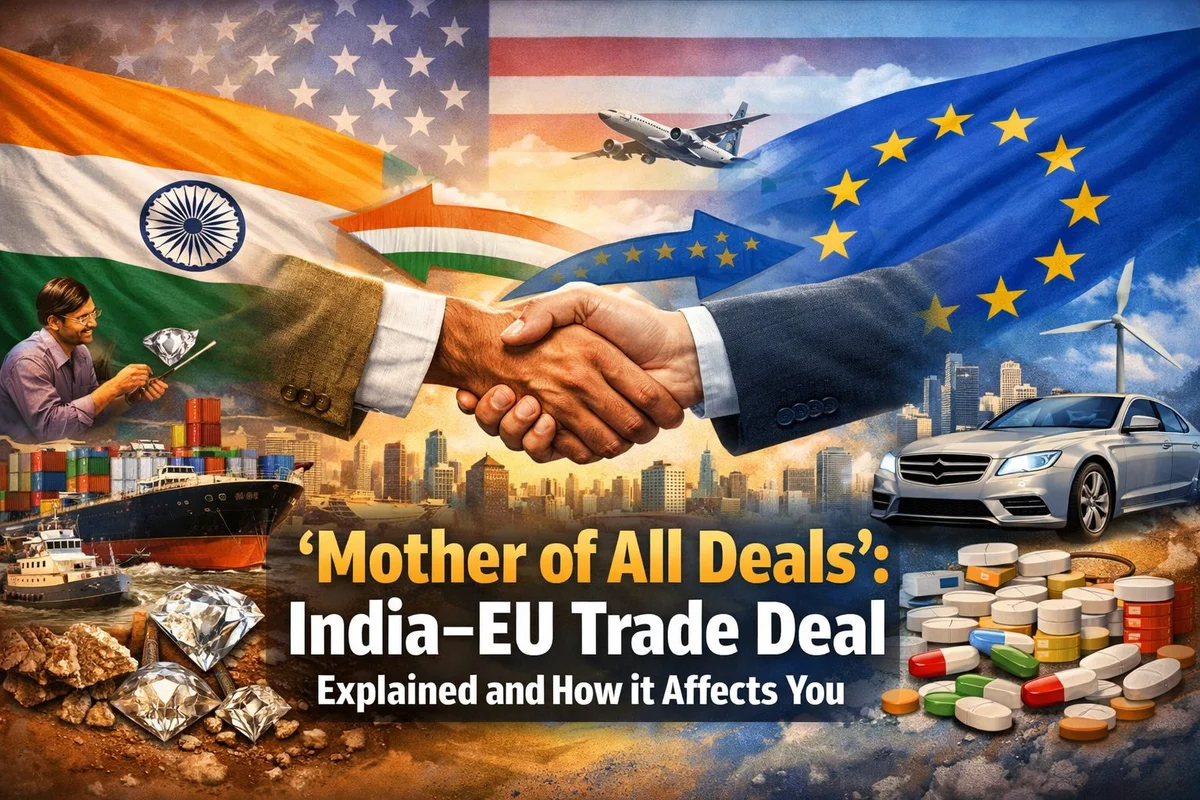
After nearly two decades of back-and-forth, India and the EU hammered out a trade agreement in late January that’s being called the “mother of all deals.” The name might sound like marketing, but when you’re talking about 2 billion people and roughly 25% of global GDP, the hyperbole kind of fits.
Here’s what happened, why it matters, and what comes next.
What Exactly Changed?
Bottom line: tariffs are dropping on both sides. For European companies, access to the Indian market just got easier. For Indian exporters, Europe’s huge consumer base just became more accessible.
Let’s get specific. German car makers have been facing tariffs as high as 110% when trying to sell to India. That’s coming down to 10% over time. Same story with European chemicals, machinery, and industrial equipment. India’s middle class is exploding, and suddenly there’s actual demand for this stuff.
India’s angle is different. Textiles, gems, leather goods, and pharmaceuticals; these sectors employ millions. The EU is essentially opening its doors to Indian products without the tariff walls that made exporting expensive. Indian IT and consulting services, which already send around $44 billion to Europe yearly, will operate more smoothly.
The tariff cuts don’t happen overnight. They’re phased in over several years. But the direction is clear: tariffs go down, trade goes up.
The Numbers
India and the EU already trade heavily with each other. Last year hit €180 billion. India’s actually ahead in that exchange, exporting €75.85 billion while importing €60.68 billion. Not bad at all.
The real hope is that this agreement pushes things past €200 billion by 2030. The EU has 6,000 companies already operating in India. More will follow once tariffs drop.
The payoff for Indian workers is straightforward: when European demand for Indian textiles and gems increases, factories hire more people and wages go up. For Europeans, they get to sell more expensive goods to a rapidly growing market.
Who Actually Benefits?
European companies: The obvious winners are car makers and manufacturers. Lower tariffs mean they can compete in a market they couldn’t really penetrate before. India’s middle class is growing fast, and there’s actual demand for quality European goods now.
Indian exporters: The textile mills, gem traders, leather factories, and pharmaceutical companies suddenly have access to 450 million EU consumers without tariff walls eating into margins. For gems and jewellery workers in cities like Surat, this is meaningful. More exports mean more jobs.
Consumers: Tariff cuts eventually mean cheaper imports, but it takes time. You won’t wake up tomorrow and notice European goods cost less. Over the years, though? The competition should push prices down. That’s the theory.
The Geopolitical Picture
This deal didn’t happen in a vacuum. The US has been slapping tariffs on India, 50% on a bunch of goods, among the highest rates around. Trump’s been using tariffs as leverage, and the stated reason involves Russian oil. The EU’s facing its own tariff threats.
So what do India and Europe do? They figure out they’re stronger together. This agreement is basically saying: we have options. We’re not completely dependent on American trade terms.
Von der Leyen made this pretty clear when she announced it. The UK already signed its own separate India trade deal in July 2025. More are coming.
This marks a shift in how global trade works now. The big multilateral agreements everyone used to chase are stuck. Countries are going bilateral instead, picking partners they can actually work with. That’s what’s happening here.
Implementation Timeline
The deal’s in principle, but bureaucracy still moves slowly. Legal teams need to vet everything, translate it, and get approvals. India’s Commerce Minister said the legal review should wrap up sometime in 2026.
Companies affected by this need to pay attention now. Supply chains change, pricing models shift. The ones who plan actually make money from it.
India’s Bigger Picture
This deal fits into something India’s been building for years, not getting too dependent on any single partner. Smart thinking. The EU offers stable markets with consistent rules. At least the rules don’t change overnight based on political mood swings.
There’s also a manufacturing angle. European companies nervous about China see India as a potential alternative. Cheaper labour, stable supply chains eventually, and a massive domestic market to sell into. This deal makes that happen faster.
India-US Deal: A Parallel Negotiation
While India was wrapping up the EU deal, negotiations with the US were going sideways. Trump hit India with a 50% tariff in August 2025. Indian exporters in textiles, gems, and electronics got crushed. Margins collapsed. Orders dried up.
The Trump administration wanted India to buy more American agricultural products, drop tariffs on industrial goods, and reduce its purchases of Russian oil. None of that was simple. Agriculture is politically sensitive in India. Cheap American dairy kills Indian dairy farmers. The farm lobby has serious political power.
For months, both sides were stuck. Then, in February 2026, they announced an interim framework. It’s not the final deal. The US cut tariffs from 50% down to 18%. Still higher than other countries, but relief for Indian exporters.
India agreed to reduce tariffs on US industrial goods and agricultural products like sorghum, tree nuts, fruits, and soybean oil. They’re also committing to buy over $500 billion in US energy, technology, and aircraft over five years. And they’re reducing, not eliminating, Russian oil purchases.
This is just an interim. They’re still working toward a comprehensive bilateral trade agreement that goes deeper. That’ll take time.
India’s Balancing Act
India’s now juggling three things. With the EU: stable, rules-based, predictable. With the US, volatile, tariffs still high, conditions keep shifting based on Washington politics.
For Indian farmers, the American agricultural system is scary. Every tariff negotiation also turns political for Modi’s government.
For most Indians, though, the EU deal feels simpler: more jobs in export-driven sectors. The US situation is murkier because those tariffs are still relatively high, and there’s tension wrapped up in everything.
What It All Means
The India-EU trade deal is real. It took forever, and both sides compromised on things they didn’t want to compromise on, but it’s happening. You’re looking at a lasting market access agreement that lets European companies compete in India, and Indian exporters access Europe.
The timing matters. Global trade is reorganising. This deal signals that countries are building alternatives to being too dependent on the US. That’s not decoupling, it’s hedging.
For India, the EU is the play on stable, predictable trade. The US is the relationship that might pay off or might blow up, depending on what Washington decides matters this month.
You’re watching the old trade system break apart and reorganise in real time.