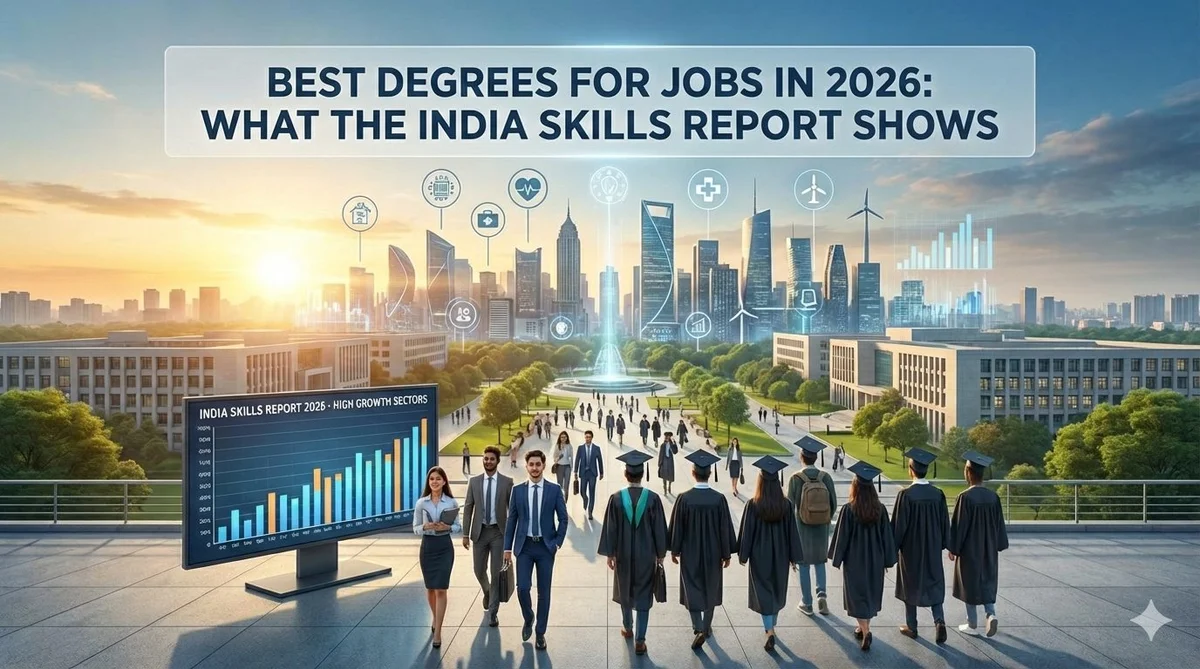
If you are trying to make sense of today’s job market, the India Skills Report 2026 offers a clear snapshot of where things stand and which degrees will create more jobs. Compiled by ETS in partnership with CII, AICTE, AIU, and Taggd, the report draws from responses by more than 1 lakh students and over 1,000 employers across seven key sectors.
The headline number is encouraging. India’s overall employability rate has risen to 56.35 per cent in 2026, up from 54.81 per cent last year. Hiring is picking up, but the report also makes one thing obvious. Your choice of degree can strongly shape your chances of getting hired.
Degrees With the Strongest Job Outcomes
Courses that focus on technology still top the charts when we talk about employability. Computer science graduates are at the top of the list, with around 80% of them considered ready for the job. IT engineering graduates are following closely behind at 78%. As automation, data-driven roles, and digital systems mostly lead the way in hiring, the demand for these profiles is still increasing
Engineering grads, in general, have been doing well with an employability rate of 70.15%. However, this percentage has slightly fallen compared to the previous year. Employers are no longer content with broad engineering backgrounds. They are now seeking graduates who have been trained in highly specialised areas like machine learning, automation, and advanced computing.
Commerce has turned out to be one of the biggest surprises. The employability of commerce graduates jumped to 62.81%, whereas last year it was only 55%. Most of this growth is due to the banks, fintech firms, and financial services companies aggressively hiring their staff.
Science and arts graduates have also seen steady improvement. Science stands at 61 per cent employability, while arts graduates have 55.55 per cent. The expansion of digital roles in marketing, research, content, and operations has opened doors that did not exist a few years ago.
Where the Struggle Is Showing
Not all degrees are seeing the same momentum. MBA graduates experienced a noticeable drop, with employability falling from 78 per cent in 2025 to 72.76 per cent this year. Employers are moving away from general management profiles and favouring candidates with focused training in areas like finance, technology, supply chains, and analytics.
The toughest numbers appear in vocational education. ITI graduates show an employability rate of 45.95 per cent, while polytechnic graduates are at 32.92 per cent. These figures raise concerns, especially since these programs are meant to prepare students directly for jobs.
Sectors That Are Hiring the Most
Technology companies continue to lead fresher recruitment. Around 35 per cent of new hires in the IT sector are fresh graduates, a sharp jump compared to last year’s overall average.
Banking, financial services, and insurance form the second-largest hiring block. The sector is expected to create around 2.5 lakh new jobs by 2030, driven by digital banking and financial products.
Healthcare and pharmaceuticals show a different pattern. Approximately 65% of new hires have 1-5 years of experience. Students targeting this sector should really take advantage of internships and get some early exposure to the workplace.
The manufacturing sector is still somewhat reserved towards fresh talent; de facto, only 5% of hires are direct college graduates. Most of the time, companies want professionals with experience who can immediately take on their roles.
Quietly, renewable energy is gaining traction. India is putting more and more money into clean power and environmentally friendly projects, and right now, the whole industry is seeing an upsurge in job creation in engineering, operations, and policy roles.
Skills Are Carrying More Weight Than Degrees
One of the most powerful takeaways from the report is that hiring is gaining momentum. Employers intend to increase their recruitment by 40 per cent in the fiscal year 2026–27, as against 29 per cent the previous year. Meanwhile, degree requirements for hiring are being relaxed.
Skills such as machine learning, data analysis, cloud platforms, and cybersecurity are at the top of the list of most desirable ones. Generative tools have been employed by over 90 per cent of employees in India in their work. Therefore, graduates without any experience with such technologies are quite naturally getting the short end of the stick.
How the Gig Economy Is Creating New Kinds of Jobs
Full-time jobs are no longer the only option. India’s freelance and gig workforce is expected to reach 23.5 million by 2030, with project-based hiring growing rapidly each year. At present, gig work accounts for roughly 16 per cent of total employment.
For students and young professionals, this means career paths may look less linear. Flexibility, self-management, and continuous skill upgrades are becoming part of everyday work life.
A Shift in Gender Trends
Women have beaten men in employability for the first time in five years. The employability of women is 54 per cent, whereas that of men is 51.5 per cent. Hybrid working options and more accessible digital learning have been the key factors, especially in smaller cities.
The pattern of interests is also different. Women highly prefer legal and healthcare careers, whereas men are still prevailing in fields such as graphic design and engineering design roles.
Geography Still Counts, But Less Than Before
The most employable states are Uttar Pradesh, Maharashtra, and Karnataka. But here’s the interesting part: tier-2 and tier-3 cities like Lucknow, Kochi, and Chandigarh are catching up fast. You don’t need to be in Bangalore or Mumbai anymore to have good job prospects.
What These Job Trends Mean for Students and Graduates
If you are deciding on a degree, the most sustainable job leads are technology-focused programs or specialised engineering tracks. Commerce is also worth considering if finance or banking interests you.
If you already hold a degree, short-term certifications in data, cloud systems, or security can make a real difference.
MBA students should focus on specialisation rather than general management.
Students in vocational programs may need to supplement formal training with digital and technical courses.
Across the board, internships matter. Nearly 93 per cent of students are actively seeking hands-on experience, especially in states like Karnataka, Madhya Pradesh, and Tamil Nadu.
The Big Picture
The jobs available in 2026 will primarily be for fast learners who can readily apply their skills in real-world situations. The biggest share of employability is within the 22 to 25 age group that indicates companies’ interest in training fresh graduates for new roles.
Your degree still matters, but the real value is in your capability. It is your continuous curiosity, skill development, and adaptability that will actually keep you employable in the years to come.