
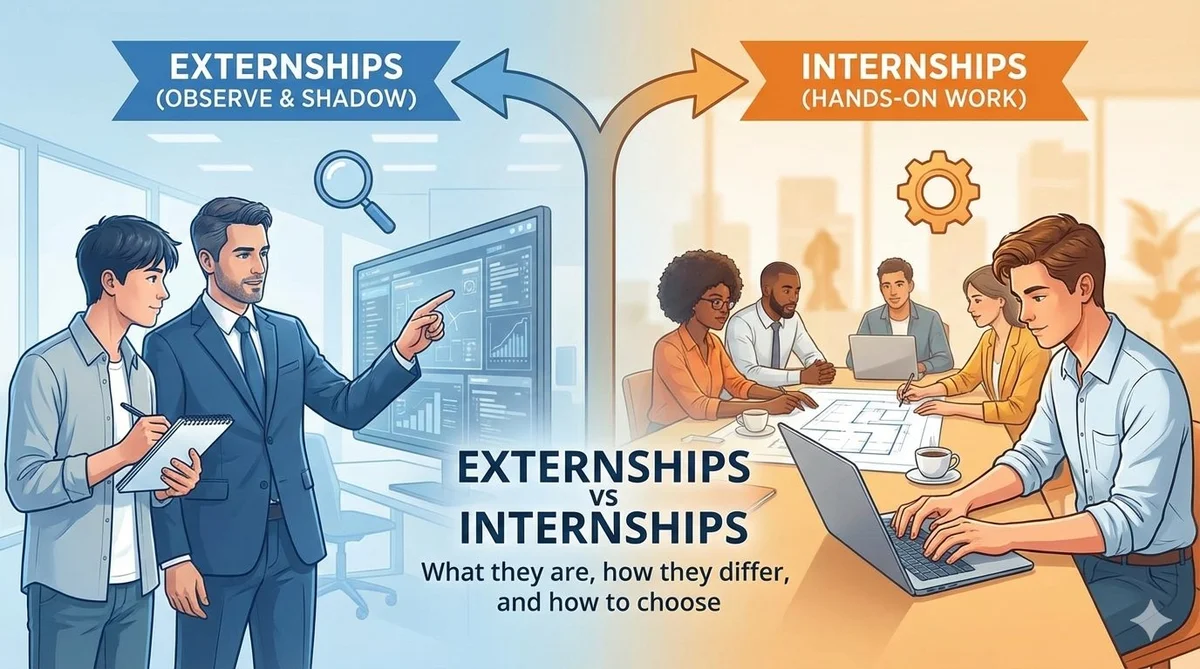
If you are trying to gain work exposure before graduating, internships are usually the first option that comes to mind. Externships often get overlooked, even though they can play an important role, especially early on. While both introduce you to professional life, they work in very different ways.
Here is a clearer breakdown to help you decide what fits your current stage.
Externships: A Closer Look
What you do
Externships are based on observation. You shadow a professional, follow their routine, sit in meetings, and ask questions. You are there to understand the role, not perform it.
How long do they last
They are short. Some last a single day, others run for a few weeks, rarely beyond two months. Many students do them during semester breaks.
Pay and credit
Most externships are unpaid and usually do not offer college credit.
Why do people choose them?
They help you figure out whether a career path actually suits you. You get a realistic picture of the work without a long commitment.
Internships: What to Expect
What you do
Internships involve real responsibilities. You join a team, complete assigned tasks, and report to a supervisor. Your work contributes to the organisation.
How long do they last
Most internships run for at least eight weeks and often cover a full summer or academic term.
Pay and credit
Many internships are paid, especially in fields like tech, finance, and media. Some offer academic credit instead, and some offer both.
Why do people choose them?
Internships help you build skills, gain confidence, and strengthen your resume. They often lead to job offers after graduation.
Side-by-Side Comparison
Time commitment
Externships are short and flexible. Internships need sustained time and regular hours.
Level of involvement
Externships focus on watching and learning. Internships focus on doing and contributing.
Compensation
Externships are usually unpaid. Internships are more likely to offer pay or credit.
Main goal
Externships help with decision-making. Internships help with job readiness.
Who Should Choose an Externship?
Externships work best if you are still undecided. If you are curious about several fields and want to see what daily work looks like, this option makes sense.
They are also useful if you want exposure without disrupting your academic schedule. Some students complete multiple externships across different industries before settling on one direction.
Healthcare, design, and creative fields often rely on externships to introduce students to professional settings before full participation.
Who Should Choose an Internship?
Internships suit students who already know their field and want hands-on experience. If your goal is to strengthen your resume and prepare for full-time roles, this is the better choice.
Internships help you build examples of work you can talk about in interviews. Instead of saying you observed a process, you can explain how you handled tasks and solved problems.
Using Both to Your Advantage
You do not have to choose one over the other. Many students benefit from doing both at different stages.
A short externship can help confirm interest in a field. After that, internships allow you to gain practical experience. Together, they give you clarity and competence.
How to Find Opportunities
Externships
These are often found through direct outreach. LinkedIn messages, professor recommendations, alumni connections, and campus speakers are common entry points.
Internships
Universities, job portals, career fairs, and company websites regularly list internship openings. Applications usually follow a formal process, so applying early helps.
Adding Them to Your Resume
Both belong on your resume.
Internships show work experience.
Externships show initiative and thoughtful career planning.
Even if an externship was short or unpaid, list what you observed and who you worked with. It shows you took time to understand your options.
Final Word
Externships help you decide. Internships help you prepare. Each serves a different purpose at a different time.
If you are early in college and unsure about your direction, start with externships. And If you are ready to build skills and move toward employment, internships are the stronger step.
If you can manage both, you will graduate with clarity and experience. That combination makes the transition into the workforce much smoother.