


















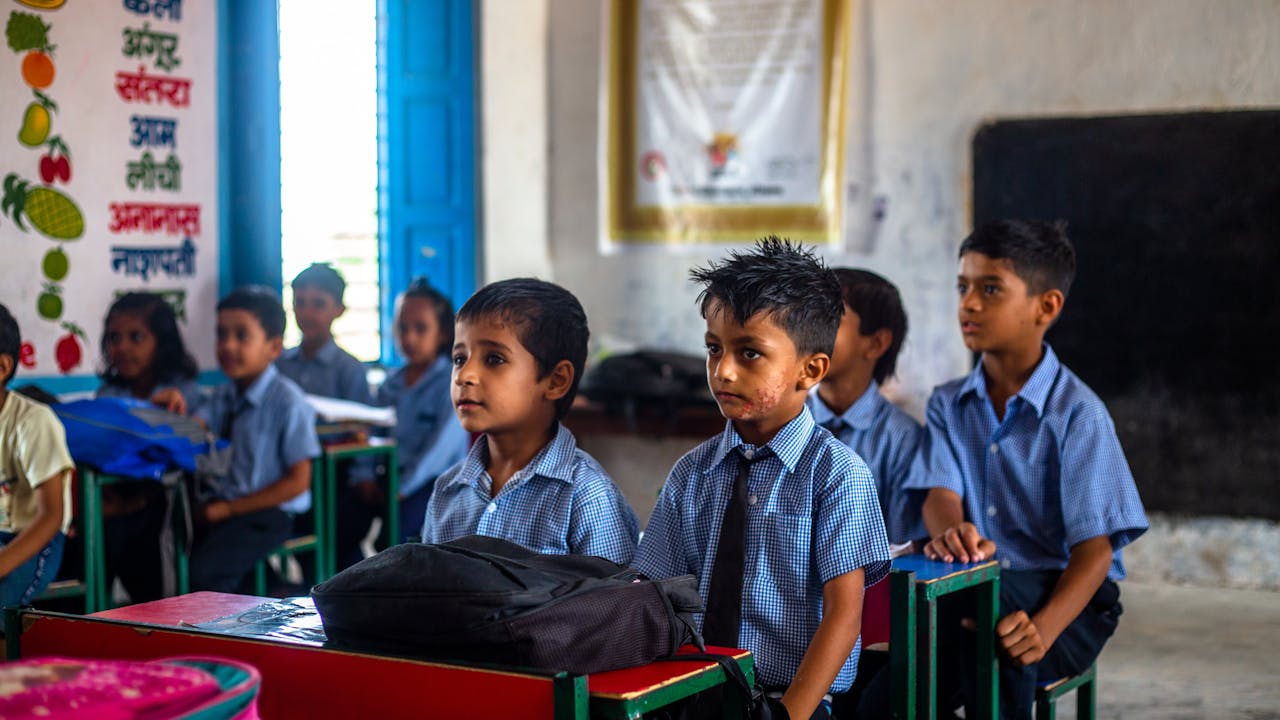
Step into most government schools across India today, and you’ll see a system in distress. Cracked walls, broken furniture, missing teachers, and overcrowded classrooms paint a picture that’s become all too familiar.
These institutions, meant to be the great equalisers of Indian society, have instead become what education activists call “monuments of mediocrity”, places where millions of children learn that their dreams don’t matter.
The numbers tell a story that should alarm every Indian parent and policymaker.
Government Schools Face Mass Exodus: Students Abandoning the System
India’s school education system is massive, with 24.8 crore students across 14.72 lakh schools, making it the largest in the world. But size doesn’t equal success. Recent government reports reveal a shocking reality: total enrollment has dropped by 2 crore students between 2020-21 and 2023-24, falling from 25.38 crore to 23.5 crore children.
This isn’t just a statistical blip. It represents millions of families losing faith in government schools and either moving their children to private institutions or, worse, pulling them out of education entirely.
The dropout crisis gets more severe as children grow older. The Economic Survey 2024-25 reveals that the dropout percentages stand at 1.9% for the primary level, 5.2% for upper primary, and 14.1% for secondary level, which is quite a shocking figure. It has been found that the Gross Enrollment Ratio falls to only 56.5% by the time students are in grades 11-12, indicating that 32.2 million children in the age group of 6-17 years are not going to school.
Karnataka provides a particularly telling example. The ASER 2024 report shows enrollment in government schools for children aged 6-14 dropping from 76% in 2022 to just 71% in 2024. When parents abandon government schools at this rate, it signals a system-wide failure.
Why Government Schools Are Failing: Learning Nothing While Attending
Even the children who attend government schools are not necessarily learning.
The Annual Status of Education Report (ASER) is quite consistent in reporting that most students are unable to do the basic chores that are expected to be done by students of their grade level. Kids in grade 5 find it difficult to read the texts of class 2, or they are not able to solve the basic arithmetic problems.
This learning crisis is a result of the following factors: teacher absenteeism, lack of adequate training, outdated teaching methods, and a curriculum that is more focused on rote memorisation than on understanding. When even teachers are without proper training or lack motivation, how can students be motivated to excel?
Problems with infrastructure are making things worse. A lot of government schools do not have the basic facilities, such as washrooms in working condition, clean drinking water, electricity, or even proper ceilings and doors. How can a student concentrate on their studies when they are sitting on broken furniture in classrooms with leaking roofs?
The Teacher Problem: Quantity Without Quality
98 lakh teachers in India are part of schools in the country. However, having teachers and having quality education are two different things. Many government schools are plagued by long-term teacher shortages, resulting in a single teacher being tasked with multiple grades simultaneously.
In rural areas, for instance, it is a common occurrence for one teacher to take care of 60-80 students from 5 or 6 different classes. Training for the teachers is not satisfactory, and many of the educators lack the knowledge of the subject, which in turn makes it difficult for them to teach effectively. The system is designed in a way that it results in the promotion of mediocre culture, which in turn makes the staff consider it enough just to be present regardless of actual teaching quality or student outcomes.
The situation is aggravated by political meddling. Teachers are forcibly removed from their classrooms to execute election duties, do census work or engage in other activities assigned by the government. At such periods, the schools simply stop working, or the students wait, doing nothing.
Government Schools and Technology: The Digital Divide Deepens
The pandemic gave the public a glimpse of how poorly government schools were prepared for digital education. While private schools rapidly switched their online modes of teaching, a majority of government schools were just not ready with the necessary infrastructure, equipment, or teacher training for remote education.
The ASER 2024 survey reveals that 90 per cent of 14-16-year-old children have access to a smartphone, with boys being more likely to use them than girls. Unfortunately, the educational system has not effectively leveraged technology to improve learning outcomes, despite this access. In fact, rather than serving as an educational instrument, smartphones frequently become a source of distraction in poorly managed classrooms.
The Funding Paradox: Money Without Results
The government states that education is its top priority and it is allocating Rs. 73,008 crores to the Department of School Education and Literacy for the year 2024-25, out of which Rs. 37,010 crores are to be spent on the Samagra Shiksha Abhiyaan. These are very large numbers, but the fruits that follow are not commensurate with the investments.
Most of this cash is frittered away in the maze of inefficiencies that plague the bureaucracy, corruption, or the officials’ misdirected priorities. The money that was earmarked for raising the standard of teaching quality, unfortunately, just goes to the construction of more schools without confirming that they are properly staffed or equipped. The concentration is still on numbers — more schools, more enrollments, more teachers — rather than on quality results.
Government Schools vs Private Schools: The Great Migration
For the most part, government schools are now deserted by middle-class families. Not even low-income families would want to lose their kids in government schools; instead, they are ready to make a considerable sacrifice of their monthly income to enroll their children in private schools.
The movement forms a dangerous cycle. As wealthy families exit public schools, these facilities become providers for only the economically deprived segments of society. The political demand for improving them is lowering since the officials and politicians send their kids to private schools rather than going to public schools.
So, where does this leave India’s future? If millions of children are dropping out, if those who stay are barely learning, and if parents are voting with their feet by abandoning government schools, can we really call this system an engine of opportunity anymore? More importantly, how long can India afford to ignore an education emergency that is quietly eroding the promise of its young population?