
In a world that’s constantly evolving, Artificial Intelligence is now at the forefront of both the business as well as the education sector. From global corporations to Indian startups, businesses are no longer functioning by the traditional ways as organizations now heavily rely on automation, predictive analytics, digital transformation and global expansion. The Indian government through its Digital India initiative and National Strategy for AI program is driving sector-wide adoption of AI technology across multiple industries including fintech, health tech, ed tech and manufacturing.
According to industry estimates from global consulting and research firms, the AI industry is projected to contribute trillions of dollars to the global economy by 2030–2035, with estimations indicating that it might add more than $15 trillion to global GDP in the next decade. India too has established itself as the world’s third largest startup ecosystem which now relies on AI technology for business expansion through machine learning, automation and data analytics.
Similarly, MBA and business master’s programs today are no longer limited to finance, marketing, or strategy alone. These programmes now teach students to combine technology, analytic, ethical and leadership skills in new ways that benefit the future. Global reports show that 75 to 83% of MBA and business master’s programs worldwide have adopted AI technology for their educational programs while business schools experienced a 500% increase in student enrollment for generative AI courses over the past year according to Coursera data included in the 2025 State of Business Education report.
For example, Harvard Business School has made AI a core part of its curriculum, introducing courses like Data Science and AI for Decision Making that equip leaders with hands-on experience in machine learning, data science, and generative AI.
Similarly, The Wharton School introduced a dedicated Artificial Intelligence for Business MBA major covering applied machine learning, data engineering, statistics, neuroscience, and ethics including courses such as Big Data, Big Responsibilities: Toward Accountable Artificial Intelligence.
Institutions across India are also adopting AI operationally. IIM Nagpur is planning to use AI to assist in exam setting and evaluation processes of student answer sheets and projects, while Manipal Academy of Higher Education has collaborated with OpenAI to integrate AI into research and teaching practices. IIM Ahmedabad too has launched its first blended MBA Programme in Business Analytics and AI.
The education curriculum is clearly bringing a shift by blending AI and business in a structured, practical, and future-focused way. Students are not just learning about AI; they are actively integrating it into projects, research, decision-making, and institutional systems.
Many top schools offer flexible formats that combine online learning with some physical time on campus. The learning experience at universities has improved through their implementation of live online class discussions which use actual business cases and virtual consulting projects that allow students to collaborate with international companies and digital networking platforms for connecting with classmates and industry professionals and short on-campus immersion programs which provide students with face-to-face experience and real-world practice.
This brings us to an important question:
Are global business schools truly preparing students for this AI-driven economic shift?
Which institutions are leading in innovation, employability, research, and industry integration? And how do Indian schools compare on the global stage?
As we explore the Global Business School Rankings 2026, we take a closer look at how institutions across the world from the US and Europe to India and Asia are redefining management education, aligning with market realities, and shaping the next generation of business leaders.
Analysis:
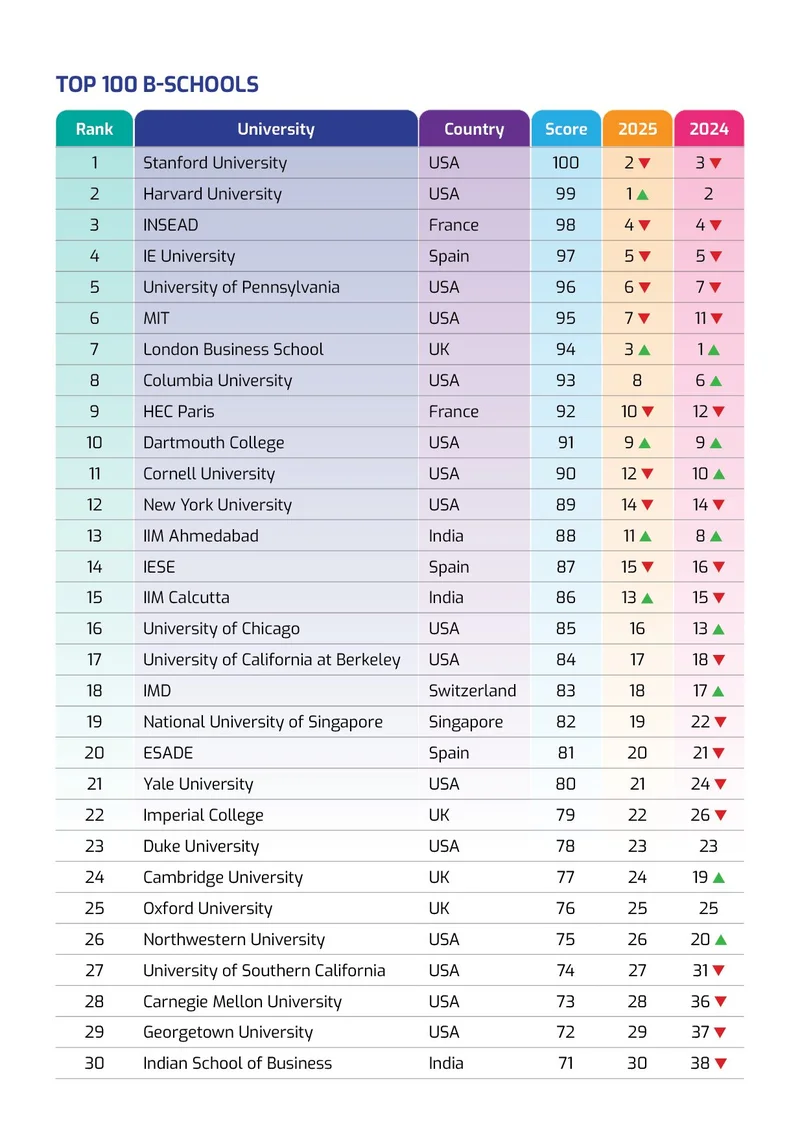
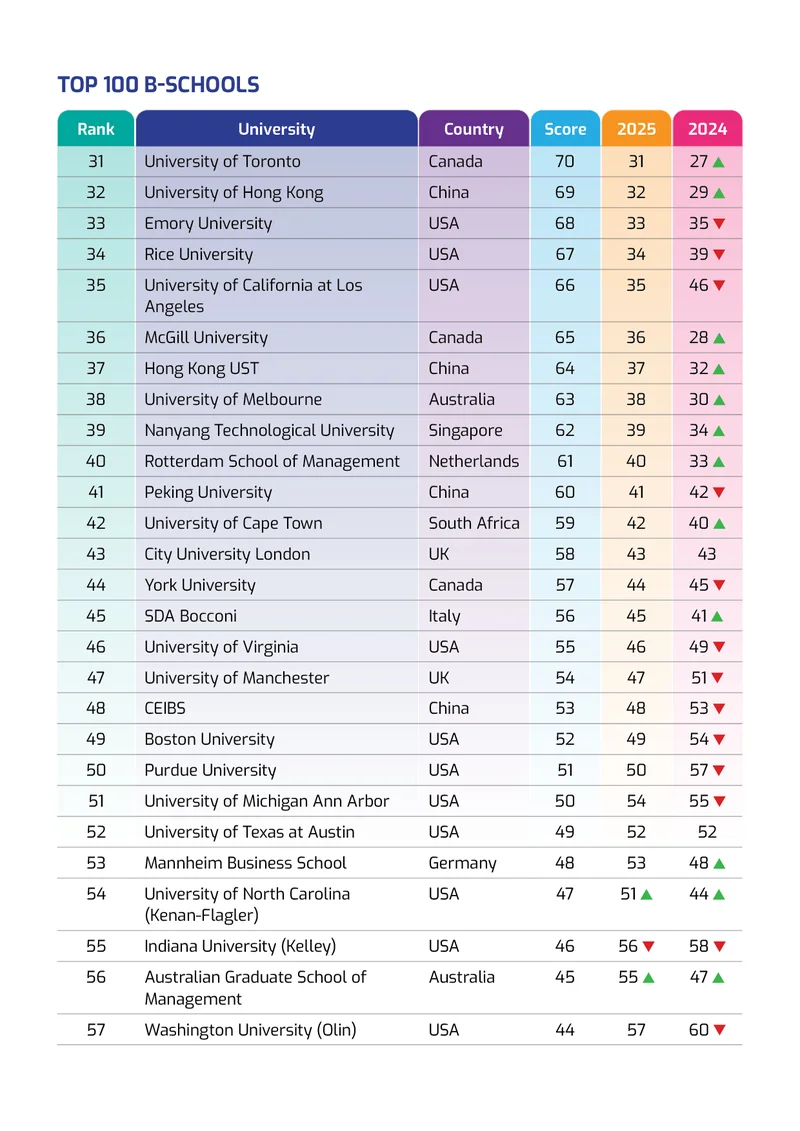
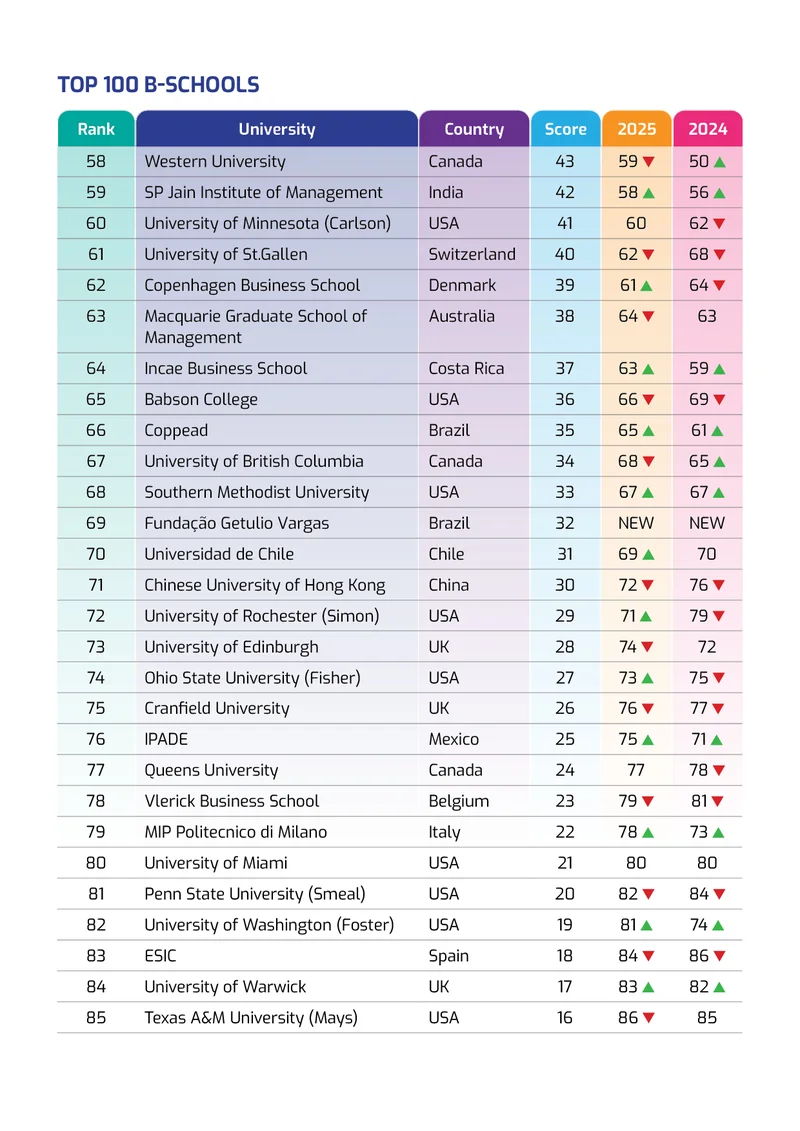
The Global Business School Rankings 2026 reflect a year of relative stability among the world’s elite institutions. Stanford University and Harvard University continue to hold their first and second positions in the MBA rankings as both institutions demonstrate strong academic standards, influential alumni networks and their graduates achieve successful career results. This year, Stanford University has reclaimed the first position, climbing from the second place in 2025 and third position in 2024. Harvard University has dropped to second place after leading the first place last year. INSEAD University has moved to the third position from its fourth place in 2025, while IE University has reclaimed the fourth position compared to its fifth position in 2025 and 2024. The University of Pennsylvania (Wharton) has shown remarkable progress by now standing in the top 5 at the fifth position compared to its sixth and seventh in the previous years.
MIT college has secured the sixth place up from the eleventh place in 2024. However, London Business School, which ranked first in 2024 and third in 2025, has fallen to seventh place in 2026. Within the top ten, Columbia University remains stable at the eight position as last year, while HEC Paris now continues to be at the ninth place and Dartmouth college rounds off the top ten list by securing the tenth place.
Beyond individual movements, the 2026 rankings highlight a broader shift in business education. Institutions are increasingly being evaluated not just on legacy and academic rigor, but also on employability outcomes, recruiter recognition, global exposure, and curriculum innovation. Strong employer pipelines, international mobility opportunities, and measurable career advancement are now key differentiators.
Among the Indian Institutions, the performance between IIM Ahmedabad and IIM Calcutta remains steady but competitive as they stand among the top 20 global business schools. IIM Ahmedabad ranked thirteen from its eleventh position in 2025 and eight position in 2024. IIM Calcutta stands fifteenth compared to its 13th position in 2025. The Indian School of Business continues to hold its 30th position after significant improvements from its 38th position in 2024.
Overall, the 2026 rankings confirm that while leadership at the top remains consolidated, global business education is becoming more technologically adaptive, internationally connected, and strongly focused on real career impact. For students, reputation still matters, but global exposure, industry integration, and tangible career outcomes are increasingly defining the true value of a business degree.
Ranking Methodology:
How did we choose institutes?
We chose 1890 institutes across the world after having discussions with students, recruiters and faculty. We also consulted professional organizations such as AMBA, EQUIS and AACSB. Youth Inc’s Research Unit (YRU) also studied domestic rankings in various countries to find the best institutes.
All the institutes were sent identical surveys. We then contacted current students, alumni as well as local and international recruiters and gathered specific information about the institutes.
Factors considered
- Recruiter Perception – Identical surveys were sent to recruiters worldwide. The recruiters were asked to rate the institutes that they were most likely to recruit from. The recruiters were also asked to rate the students they have recruited from specific business schools on several criteria including leadership potential and strategic thinking.
- Diversity of Students – The institutes were asked to report the total number of students on campus and what percentage of the students were international and speak two or more languages. Gender diversity of the students was also considered.
- Diversity of Faculty – The institutes were asked to report the total number of faculty on campus and what percentage of the faculty was international, hold a doctorate degree and accredited with their own publishing material. Gender diversity of faculty was also considered.
- Innovation of Programs – We considered the different ways to construct degree programs as well as the choice students have in terms of selecting electives.
- Innovation in Teaching Methodologies – Institutes were asked to select different teaching methodologies that we considered innovative. Some of these included company visits, dual or multiple majors and course collaborations between different departments at the institute. Our list was selected after surveying students across different campuses worldwide.
- Value for Money – We considered students and alumni opinions on whether a particular institute was perceived as ‘value for money’. We also asked institutes to state the percentage of students who received some sort of funding from the institutes.
- Campus Support – We asked the institutes, current students and alumni to select the different types of assistance provided by the student office or a similar body on campus. Our list was selected after surveying students across different campuses worldwide.
- Career Service – We asked the institutes, current students and alumni about the availability and functioning of a career service cell and how active such a service was for the students. We also considered what percentage of students were actually placed through the institute’s career service cell, how long it look for such placements and what the average starting salaries were.
- Exchange Programs – Institutes were asked to report the percentage of students that opted for exchange programs. We also considered the exchange students present on the institute’s campus.
- Student Satisfaction – Current students and alumni were asked to rate their institutes on various factors including career services, attitude of staff and professors, location, and course content.
Actual Methodology
Institutes were provided a link using which they could send us their completed survey online. They were asked to answer questions relating to full time faculty, career service, student and program information and all the factors listed above.
We contacted current students and alumni of the institutes and asked them to rate specific statements which were pertaining to the factors we considered in this ranking. All the institutes preferred to send the survey links to their students and alumni directly.
Over 16890 recruiters were sent emails with a survey. The recruiter list was prepared from the responses of the institutes and also included internationally well known recruiters. The recruiters were asked to enlist institutes that they were likely to recruit from.
Below is a summary of the factors and the weightage given to each factor when we ranked the institutes:
| Information reported by the institute | Information reported by current students | Information reported by alumni | |
| Diversity of Students | 2% | 2% | 2% |
| Diversity of Faculty | 2% | 2% | 2% |
| Innovation of Programs | 2% | 2% | 2% |
| Innovation in Teaching Methodologies | 2% | 2% | 2% |
| Value for Money | 2% | 2% | 2% |
| Campus Support | 2% | 2% | 2% |
| Career Service | 4% | 4% | 4% |
| Exchange Programs | 2% | 2% | 2% |
| Student Satisfaction | 2% | 2% | 2% |
| 20% | 20% | 20% |
| Information reported by recruiters | |
| Recall of institute where to recruit from | 10% |
| Likelihood of recruiting from same institute again | 10% |
| Overall satisfaction with students recruited | 10% |
| Satisfaction with institute career cell | 10% |
| 40% |
Each factor was made up of a set of questions. The total percentage attributed to that factor was based on the average score of the responses multiplied by the assigned weight-age. We then totalled the score from all factors and sorted the scores from highest to lowest. The institute with the highest score was ranked 1st.
Not just numbers!
After we received the total computed scores for the institutes, we subjectively analyzed the data provided by the institutes, current students, alumni and recruiters. If we found discrepancies in the satisfaction scores and the subjective descriptions, we omitted the data.
Institutes that did not fill out the survey reports in time
Out of the institutes that were contacted, 143 institutes did not complete the survey on time or did not respond. We used publicly available information on the institutes to include some of them in our ranking. We also contacted current students, alumni and recruiters of these institutes and compared the data we received with the data from institutes that did participate.
Special notes
Masters in Finance – The programs include the pre-experience as well as the post-experience Masters programs. The ranking also includes the programs which are recently established.
Masters in Management – Certain Masters of Management programs with specializations are also included in the ranking.
Masters in Marketing – Combination courses of Marketing with communication and other fields are also included in the ranking.
Online MBA – Certain factors such as Campus Support and Exchange Programs were omitted in the factors considered for the ranking.
Executive MBA – Certain factors such as Campus Support and Exchange Programs were omitted in the factors considered for the ranking.