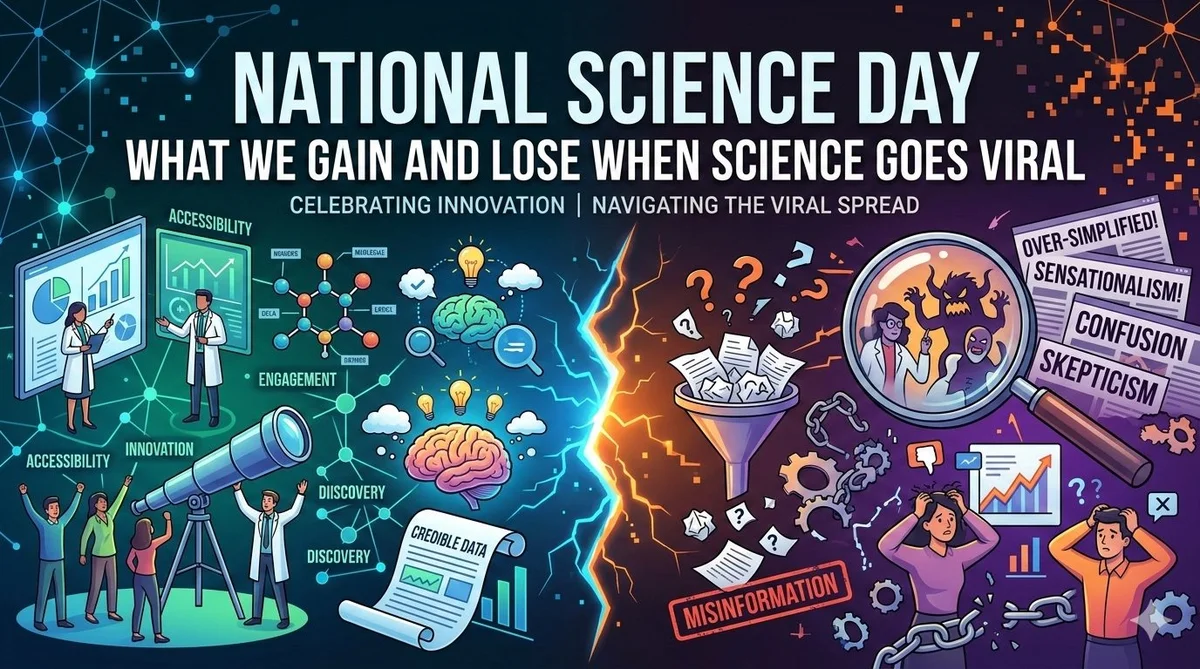
28th Feb is celebrated as National Science Day, and, frankly, it might not be the same as it was ten years ago. While scrolling through his feed, a teenager comes across a chemist demonstrating the reaction of molten aluminium poured into a watermelon. The clip boasts 2.3 million views. The comment section is totally chaotic, with people debating the physics, asking questions, and sharing it with their friends. So, is this a way of doing science education, or just nice explosions?
In fact, this is the question at the core of what is happening to how we learn about science today. Short videos on Instagram, TikTok, and YouTube Shorts have unexpectedly gone mainstream as science communication channels that are influencing people in deeply complex ways that require real thinking rather than quick answers. On a day dedicated to scientific discovery and learning, the question might be raised: Is this new science-sharing way genuinely contributing, or are we just seeing science’s mere semblance?
The Numbers Don’t Lie
Let’s start with what we know. Content creators with science backgrounds have built massive audiences. A virologist on TikTok. A physicist making YouTube videos about impossible scenarios. An evolutionary biologist explaining why you probably think about dinosaurs wrong. Millions of people who might never open a textbook are watching these videos, learning things, and asking follow-up questions.
That’s genuinely exciting. The barrier to entry for science communication has basically disappeared. You don’t need a university job or a publisher. You need a phone and something worth explaining.
But here’s where it gets uncomfortable. A video that’s engaging isn’t automatically educational. A chemist dropping liquid nitrogen into a drink looks spectacular. It gets clicked. But how many viewers actually understand what’s happening versus just enjoying the visual? The platform rewards whatever gets watched and shared, and that’s not always the same thing as accurate science.
When It’s Done Well
Some creators are doing something smart. They’re taking actual research—real, published studies—and making it accessible without dumbing it down. A marine biologist explaining how ocean acidification affects shellfish growth. A neuroscientist walking through how your brain processes fear. They’re specific, they cite their work, and they invite questions.
These creators have changed how some people think about science. They’ve made it feel like something you can actually understand and talk about, rather than a locked room where experts live. They admit what they don’t know. They update their videos when new research contradicts what they said. They’re doing the actual work of explanation.
And their audiences engage. Not always perfectly, but they engage. People in comments sections are asking real questions, pushing back on points, linking to studies. There’s a conversation happening that wouldn’t happen without these videos existing.
The Problem With Algorithms
Here’s the tension nobody wants to admit: the platforms that make this possible are fundamentally not designed for education. They’re designed to keep you watching. Longer attention spans don’t make money the same way sudden dopamine hits do.
This creates a weird pressure. A content creator might be able to explain something fully and clearly, however, if the explanation is not combined with a hook, a surprising moment, or beautiful visuals, fewer people will see it. On the other hand, a person making the 47th video about “science that will blow your mind” gets an algorithmic push. The system rewards sensation over substance.
Some creators have figured out how to do both. But many haven’t. And some have deliberately figured out ways to exploit the system, making up stories about health, physics, or medicine that are so convincing that people share them. And by the time a correction is issued, the misinformation has gone viral.
Are We Actually Learning?
This is the thing nobody can quite answer. Yes, more people are being exposed to science. But exposure isn’t the same as understanding. Someone who watches a three-minute video about quantum mechanics hasn’t actually learned quantum mechanics. They’ve maybe learned that it’s weird and confusing and interesting. That’s not nothing. But it’s not what happens in a physics class where you work through problems, make mistakes, get feedback.
That said, maybe that’s not really the goal of Instagram science. Maybe it’s not trying to be a textbook or a university course. Maybe it’s the appetizer. Someone watches a physics video, gets interested, seeks out more serious learning. The algorithm isn’t designed to do that job. It’s designed to keep people scrolling. But humans can actually do something different with what they watch.
Some do, some don’t. Some just enjoy the content and never think about it again. That’s fine too.
How Science Became Content
The fundamental change is that science is turning into a kind of entertainment, and at the same time, entertainment is becoming a way of science communication. These categories are blurring. Ten years ago, if you were interested in learning science, you didn’t have many choices. School. Science museums. Books. Television programs that aired on specific schedules.
Now you can learn about black holes at midnight while lying in bed. You can ask a question in a comment and maybe get a response from someone who actually studies black holes. You can find a creator whose explanation style clicks for you instead of being stuck with whatever your high school teacher’s approach was.
The negative side is exactly the same as the positive one: accessibility. We are bombarded with so much content that the quality varies greatly. It is very easy for misinformation to be widely distributed, as the barrier to content creation is almost nonexistent. Don’t assume that just because something sounds scientific, it really is.
Where That Leaves Us
The honest answer is that both things are true. Instagram science is helping some people understand the world better and encouraging genuine curiosity. It’s also spreading confidently stated wrong information that some people will believe. It’s making science feel accessible and interesting and also reducing science to entertainment, sometimes in ways that miss the point.
That’s not inherently worse or better than traditional science education. It’s different. It reaches people institutions don’t reach, oversimplifies in ways institutions don’t, makes mistakes faster. It also corrects mistakes faster when communities call them out, and also gets people interested in things they never would have asked about otherwise.
The real question for National Science Day and beyond isn’t whether Instagram science is good or bad. It’s about us deciding if we want to consider thoroughly the different ways of science learning mutually working. How do we leverage the strength of short-form content, which is making science feel real, accessible, and interesting, without losing in-depth possibilities for those who want to explore further?
This issue can’t be resolved by social media alone. But they’re not creating it either. They’re just showing us what was always true: people want to understand how things work. They just want to do it on their own terms, in formats that fit their lives. Instagram science is giving them that option, for better and worse. And maybe that’s worth celebrating too.