



















Over the last decade, the UAE has quietly become a serious study destination. What was once known mainly for tourism and business is now home to universities that attract students from across Asia, Africa, Europe, and beyond. With English-taught programs, modern campuses, and growing job opportunities, the country is drawing attention from students who want global exposure without the steep costs of the US or UK.
If you’re considering the UAE for higher education, here’s a clear look at what it offers and what you should think through before applying.
Why Students Choose the UAE
The UAE doesn’t try to copy Western education models exactly. It has built its own system with a few clear strengths.
English-taught programs are the norm. Most universities teach entirely in English. You don’t need Arabic to study, submit assignments, or take exams. Learning a few Arabic phrases is helpful outside of campus, but it’s not required for academics.
The location is practical. Sitting between Asia, Europe, and Africa, the UAE is easily accessible from many countries. Flights are frequent, and for students from India and nearby regions, travel time and jet lag are manageable. Families can visit without spending a fortune.
Safety is a major plus. Crime rates are low, public transport is reliable, and cities are well-maintained. Many students and parents cite safety as one of the main reasons they choose the UAE.
You’ll meet people from everywhere. Expats far outnumber locals. Universities reflect that mix. It’s common to have classmates from dozens of countries in one course, which changes how you see cultures and careers.
Costs are lower than expected. Annual tuition generally falls between AED 20,000 and AED 123,000. That’s far less than most US or UK universities. Living costs are also lower than in cities like London or New York, though Dubai can get expensive if you’re not careful.
Universities to Know About
| University | Location | Global Rank | Best For | Tuition | Entry Requirements |
| Khalifa University | Abu Dhabi | ~181 | Engineering, Science, Aerospace | ~AED 3,333 per credit | 80% in school, IELTS 6.5 |
| United Arab Emirates University (UAEU) | Al Ain | ~290 | Medicine, Business, Research | ~AED 2,400 per credit | 85% in school, IELTS 6.0 |
| American University of Sharjah (AUS) | Sharjah | ~332 | Liberal Arts, Engineering, Business | ~AED 96,140 per year | 70% in school, IELTS 5.0 |
| University of Sharjah | Sharjah | 601–650 | Law, Medicine, Engineering | ~AED 31,000 per year | 75% in school, IELTS 5.0 |
| Abu Dhabi University | Abu Dhabi | — | Business, Economics | ~AED 102,060 per year | Varies by program |
Scholarships and Funding Options
Many students overlook how much financial support is available.
Khalifa University offers full funding for PhD students and partial support for undergraduates and master’s students. PhD scholars receive about AED 17,500 per month, while master’s students get AED 15,000. Tuition, medical insurance, and conference travel are included.
UAEU provides fellowships, research assistant roles, and subject-specific funding, especially in science, energy, and space-related fields.
Abu Dhabi University offers several scholarships. Some cover full tuition and student services, while others provide 20 to 25 per cent fee reductions based on grades. Sports scholarships are also available.
MBZUAI provides full scholarships that include tuition and monthly stipends, making it one of the most attractive options for AI-focused students.
Most scholarships are competitive. Strong grades, test scores, and a clear personal statement matter. Deadlines vary, so early applications help.
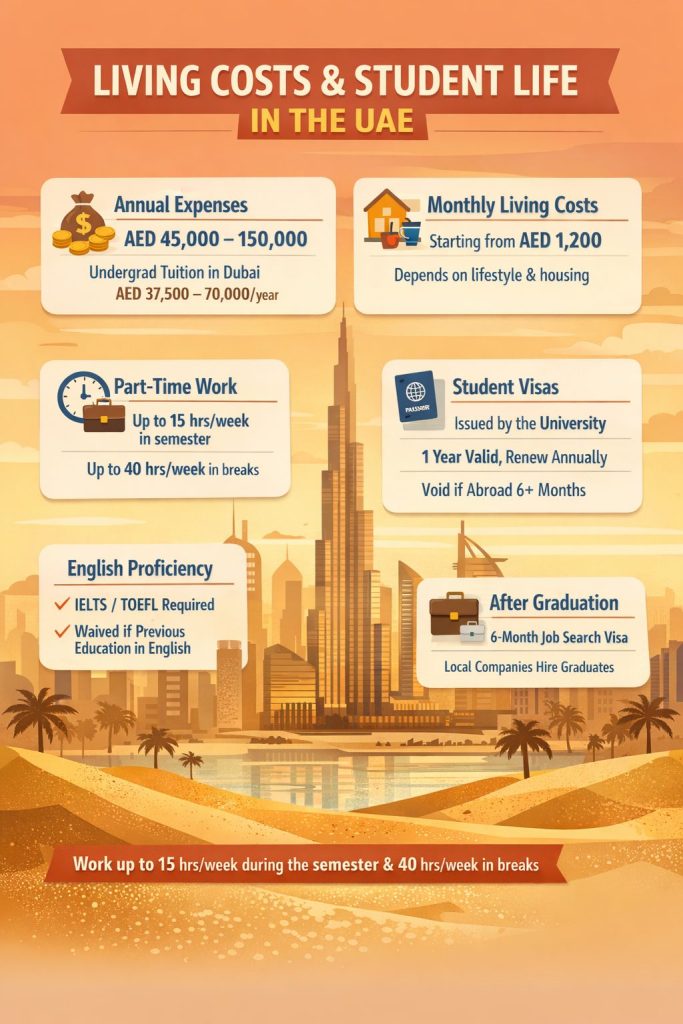
Living Costs and Student Life
How Applications Work
Most universities offer September and January intakes, with some May options.
You’ll usually need:
- School transcripts and certificates
- Equivalency approval from the UAE Ministry of Education
- English test scores
- Passport copy
- Recommendation letters
- Personal statement
- Portfolio for design-related courses
Applications are submitted online through university websites. Consultants are optional if you stay organised.
Things to Keep in Mind
Summers are extremely hot, often crossing 45°C. Outdoor life slows down from June to September.
Cultural rules are stricter than in many Western countries, especially around dress, behavior, and alcohol. Violations can have serious consequences.
Costs can rise quickly if you rely on taxis or eat out often, especially in Dubai.
Jobs after graduation depend heavily on your field and connections. Networking during your course matters.
The UAE makes sense for students who want quality education, safety, and international exposure without paying Western university prices. It’s not the place for a classic campus culture, but it works well for career-focused students who want access to a fast-growing region.
Research each university carefully. Look at accreditation, course strength, and student feedback. A well-chosen program in the UAE can open doors across the Middle East and beyond.