Kids in India have played cricket in the narrow lanes of the city. Or they are stuck with their heads in their mobile phones. School, classes, sports and home are the only places where parents generally think they would learn a thing or two about life. But now, a different generation is growing.
India is seeing young prodigies, not just making headlines in sports, but also in academics. Many students have used material available at hand to create such innovative projects that they surprised the world. The government is also taking initiative to encourage more of this. Teenagers are now looking at business and finance, even before they finish schooling.
Teenagers are slowing down their career paths to enjoy the age and the family time they have instead of going head-on with their projects. The modern education system works differently than what it was so many years ago. In light of that, we had a chance to get in touch with Mr Hiten Dharpure.
Who Is Hiten Dharpure & Which Records Does He Hold?
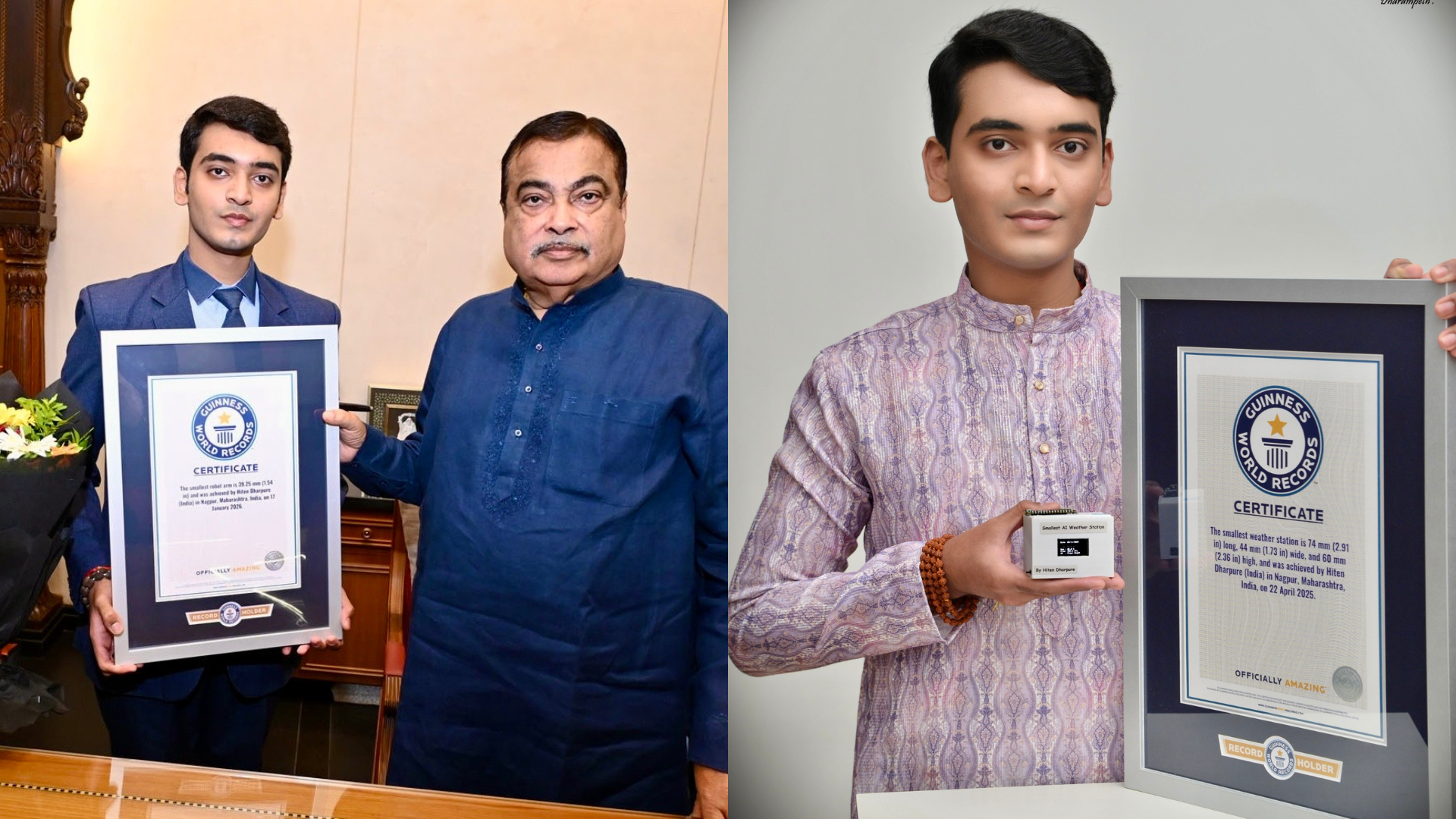
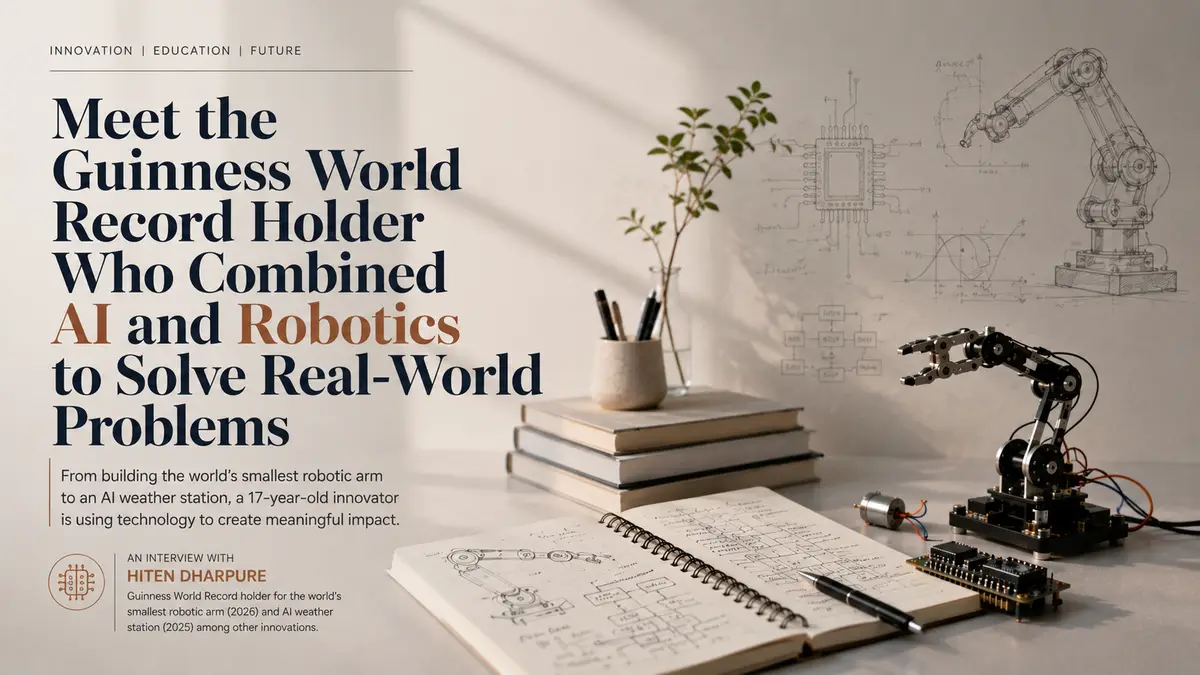
Hiten is a seventeen-year-old boy from Nagpur who holds two World Records. His name was etched in the Guinness Book of Records for 2 innovations in micro-engineering. In 2026, this year, he built the world’s smallest robotic arm; it is fully functional. The record was held by an American innovator before Hiten. This type of machinery can be used in medical procedures and industrial automation. It is 39.25 millimetres (1.54 inches).
Hiten has also built the world’s smallest AI Weather Forecast Station in 2025. It can track temperature, pressure, and humidity. It also comes with custom forecast algorithms. It measures 7.4 cm × 4.4 cm × 6 cm. It can be highly useful in places where speed and accessibility are mandatory. Hiten has also developed the HastaVaani App to bridge communication gaps. It has translations of Indian Sign Language.
He also has a Robot Performance Graphic World Record 2024. He achieved that by directing a synchronised dance performance of self-created 3D-printed robots.
Let’s have a look at what he has to say:
Q1. At 17, while many students are preparing for exams, you were building a robotic arm and an AI weather station and won 2 Guinness World Records. What made you choose creation over convention?
A. My interest in STEM started with simple curiosity, taking apart toys to see how their mechanisms worked. I realised early on that I didn't want to just consume technology; I wanted to create it. While academics are extremely important, building physical machines brings textbook theory to life. I chose creation because I wanted to push the absolute limits of micro-engineering and bring these global records home to India to contribute to the 'Viksit Bharat' vision.
Q2. Between the AI Weather Station and the robotic arm, which project challenged you more—and why?
A. The robotic arm challenged me significantly more. While the AI weather station focused heavily on sensors and data processing, the 39.25 mm robotic arm required mastering physical, electromechanical torque. Fitting the PWM control module, micro-servos, and wiring into such a tiny frame without the 3D-printed walls snapping, all while maintaining 3-axis independent movement, was incredibly frustrating and demanded extreme patience.
Q3. Where do you see micro-robotics making the biggest impact over the next decade—healthcare, manufacturing, education, or somewhere unexpected?
A. Healthcare is definitely where it will make the most profound impact, especially for highly precise, minimally invasive surgeries. Beyond that, it will be revolutionary in semiconductor manufacturing for accurately handling microchips, and in space exploration, where every gram of weight and centimetre of payload volume counts.
Q4. What emerging technology excites you more than AI right now?
A. I am incredibly excited by TinyML (Machine Learning for microcontrollers) and the advancement of ultra-miniaturised embedded systems. The ability to run intelligent, offline logic directly on edge hardware, without needing massive cloud computing power, is going to make complex tech much more accessible.
Q5. What's one habit that has contributed more to your success than intelligence?
A. Strict time management and categorisation. When I am at school, I focus strictly on academics. When I am in my home workshop, I dedicate 100% of my attention to my engineering builds and completely avoid multitasking. Treating failure as a learning process, using snapped prototypes as data rather than defeat, has also been essential.
Q6. Is your invention something you want to commercialise, or is it the first step toward something even bigger?
A. This is the first step toward something much bigger. My immediate goal was to prove that world-class, ultra-precision micro-manufacturing doesn't require a high-end lab. Long-term, I am targeting a career in the top-tier global tech sector where I can innovate and manufacture impactful solutions on a massive scale.
Q7. New invention that you are working on now?
A. I am currently working on upgrading my AI weather station by transitioning its software into a TinyML microcontroller framework. I am also constantly researching new concepts and micro-mechanics.
Q8. What is your future education plan, and which career path do you wish to pursue?
A. I am currently in Class 12 and balancing my academics with engineering entrance exam preparations. I plan to pursue higher education in computer science and robotics. Career-wise, I want to join the global technology sector to continue innovating on a large scale while proudly representing Indian youth in STEM.
Q9. Any 3 tips for the youth today?
A. First, start with what you have; you don't need a massive lab; accessible tools like CAD and basic electronics are enough to start. Second, embrace failure; building messy prototypes and learning from broken parts is exactly how innovation happens. Third, bridge the gap between software and the physical world.
The Aftermath
The best takeaway from such conversations is not just the story of the person or their projects, but the mindset behind it. With the increase in the consistent dependence on AI for every field, it is highly necessary to be aware of how to use it. Children nowadays are building so many different things that can be manufactured without abundant funding or big labs.
It is very important that the youth focus on what information and content they are consuming. This is where the difference between average and greatness lies. By exposing the children and youth to the right information, technology and sources of knowledge, we can unlock their great potential. Every student must keep their creative skills alive. Innovation and academics can not only change the lives of individuals but can bring a significant change in the world.