Robotics and Technology is one of the most prominently growing fields in recent years. There are new innovations happening every day. Not just professionals with adequate experience, but kids from all over the world have taken a deep interest in building robots and trying to simplify menial tasks.
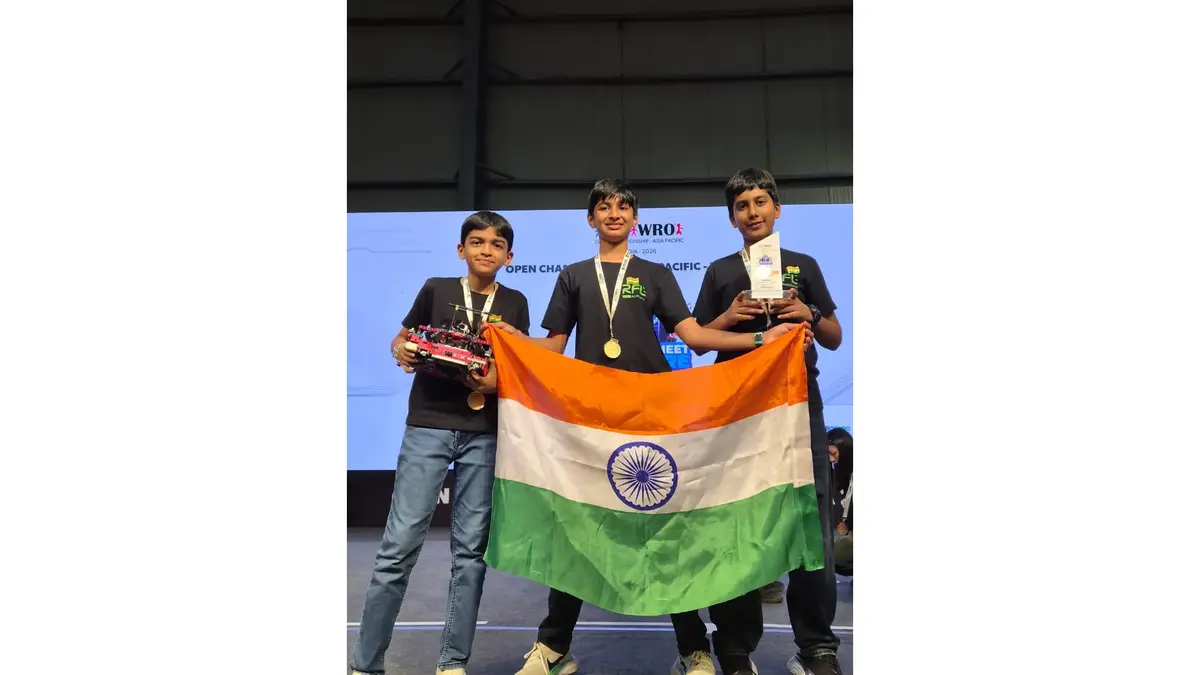
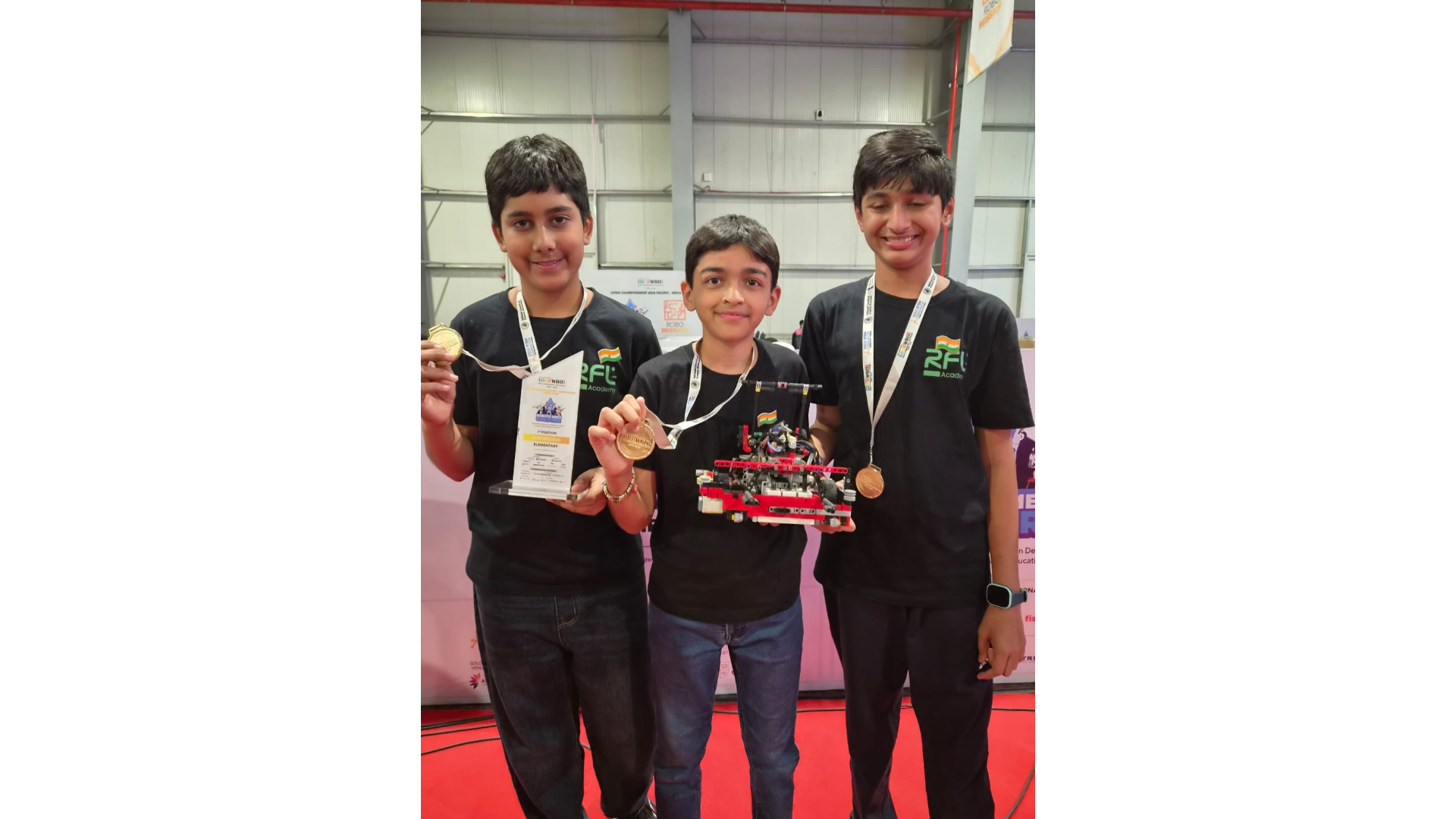
One such team of kids, Aryaman Valia, Hetansh Agrawal, and Prithiv Shah, are young robotics prodigies from Mumbai, 11-year-olds, who formed the team Robo Rockstars. They recently won a gold medal in the RoboMission Elementary Category at the World Robot Olympiad (WRO) Asia Pacific Open Championship.
We had an exclusive opportunity to learn about their journey and plans. Let's have a look at what they had to say:
1. How did the three of you first become interested in robotics, and when did you realise you wanted to compete internationally?
Aryaman: I have been interested in robotics for a long time and have always been fascinated by robots. I started taking robotics classes around three years ago, but I began competing in events like these only about a year ago. I always wanted to compete at the international level, and I am glad I finally got the opportunity.
Hetansh: I started robotics when I was four years old. Initially, I worked with electronics before moving on to building robots. I had participated in WRM when I was younger, but then I took a break from robotics. Eventually, I started again and participated in WRM as well.
Prithiv: I started robotics during the lockdown through online sessions. When in-person classes resumed, I switched to offline sessions. At the age of eight, I participated in the World STEM Robotics Olympiad (WSRO). After that, I continued with my regular robotics course and participated in the World Robot Olympiad (WRO) last year, which gave me another opportunity to compete internationally. This year, I competed in WRO again and qualified through the national-level competition.
2. What does each person bring to the team?
Aryaman: I am the main constructor, and I built the robot.
Prithiv: I am the main coder of the team, although I also contributed to most of the construction work.
Aryaman: We often overlap in our responsibilities. Even when one of us is building the robot, the others help out. We work together throughout the process.
Hetansh: I do a bit of both.
3. What was the most challenging part of the championship, and how did you overcome it?
Aryaman: The national championship was more challenging than I had expected. The rules changed considerably, which made things difficult for us. That was a surprise, especially on the third day.
Prithiv: At the Asia-Pacific competition, the table challenge was the hardest part because the entire challenge changed. We knew it would be difficult, but it still pushed us to adapt.
4. What had you planned to build, and what did you eventually end up building?
Prithiv: We ended up building something very close to our original plan, but we kept making modifications to improve the robot's efficiency and performance. We had several designs and experimented with different approaches before settling on the final version.
Aryaman: The robot we competed with was our first version. We built a second one but decided not to use it because we were unhappy with its performance. We also developed another version that we eventually set aside.
Hetansh: Initially, we were trying to design a robot that could grab four objects at a time. However, the robot we ultimately used could grab three at a time.
Aryaman: We have continued modifying the robot ever since the competition began. We are constantly looking for ways to improve it, whether through colour coding or other small adjustments.
5. International competitions bring together some of the strongest young robotics teams. What did competing against teams from different countries teach you?
Hetansh: We could not observe the other robots too closely because we had to concentrate on our own competition. However, whenever we got the opportunity, we were impressed by the robots built by teams from different countries. We also tried to make friends with the other participants.
6. Was there a particular robot, country or moment that stood out and inspired you to build something similar?
Hetansh: On the practice day, we saw a robot from the Philippines that was incredibly fast. The team scored full points in 60 seconds, which really fascinated us. We could not do much about it at the time, but perhaps we can build something comparable next year.
7. What was your robot designed to do, and what made its performance stand out in the competition?
Aryaman: Our robot was designed to complete four specific tasks set by the WRO team.
Hetansh: The first task involved six nodes, four of which were randomised, and four designated spots. We had to move the objects from their original starting positions to the designated drop-off points across the field. Each object was worth 20 points.
Prithiv: There were also two cables placed at the starting points. On the stage, there were two grey boxes that we had to move. The cables connected the amplifiers and speakers, which were part of the challenge. The amplifiers and speakers carried bonus points, with each worth 10 points. The cables were worth 15 points each, and there was also a flag that could earn bonus points.
Hetansh: We also had four musical instruments to handle. The microphone had to be placed in the designated microphone target area, while the piano, guitar and congas had to be placed in the backstage area.
Aryaman: At the start of the challenge, the robot had to fit within a 25 × 25 × 25 cm space. We had to design it within those dimensions and then complete as many tasks as possible within the two-minute time limit.
8. Were the robot's components made entirely of LEGO?
Aryaman: We chose LEGO EV3 for our robot. The competition allowed different building materials, but we decided to use LEGO.
9. Who or what has been your biggest inspiration in robotics and technology?
Aryaman: I have participated in quite a few competitions and have always been eager to win. I wanted to perform well in this competition and the others I have entered.
Prithiv: One of my biggest inspirations was the team that came first in WRO 2024.
Hetansh: My biggest motivation was the desire to compete internationally. That goal kept me going.
10. What are your plans for the future?
Aryaman: We are planning to participate in the FIRST Tech Challenge (FTC) this year. We have also planned to compete in WRO again next year, this time at the junior level.
Hetansh: I think robotics could become a major competitive sport in the future.
11. Has artificial intelligence played an important role in your robotics journey, whether during competitions, while learning or when developing ideas?
Aryaman: Not very much, but when I have used AI, it has helped me refine some ideas. It sometimes suggests better approaches, and I modify those suggestions before incorporating them into my work.
We could not use AI during the competition because internet access was not allowed. We relied on our own coding and the sensors we had brought with us. For example, the sensors could detect the colours on the field. We used coding to make the robot perform its tasks, but we did not use AI during the competition.
12. Is there a particular discipline or practice that helps you stay focused and perform better during competitions?
Aryaman: We need to keep observing and checking the robot because we cannot be completely certain that everything will work as expected. If it crashes badly, it could get damaged.
We have to take care of the motors and sensors and make sure we do not damage them during a competition. It is important to respect the robot.
The Takeaway
National and international competitions open doors for students to learn about education and skills growing in different parts of the world. For Aryaman, Hetansh & Prithiv, this is just a start. They are aiming to get better every day. We hope that we get to interview them for more prestigious achievements in the future.
If robots, technology and artificial intelligence interest you, there is no age barrier. You can start organic learning at home, join advanced classes, take up university courses and find a community of like-minded people. It is just a matter of time.