


Every country comprises different landscapes. There are hills, mountains, valleys, beaches, and forests. Forests are a very essential part of the ecosystem. And equally dangerous in a number of ways. Not just because of wildlife, but also because of the growing amount of illegal activity hidden under the dense cover of trees.
To combat these criminals, countries have developed authorities and rules to regulate forest management before human greed destroys them. There is a full government office in each state taking care of the forest cover in that particular area. Every officer working in the forest department has the sole responsibility to conserve the forests from natural and man-made happenings.
While doing so, many of the officials have even lost their lives. Today, we remember these officials and shed some light on the new-age careers that can find a place in your life if you are enthusiastic about forests and wildlife.
Why Do Forests Need To Be Preserved?
Forest Conservation has become a necessity because the required forest cover for the country is already less than the standard limit. Based on the Indian subcontinent’s demographics, we require 33% of land cover to be forested, which is only 25% at the moment; this also includes commercial lands that are used for different purposes, which do not match the shield that forests provide. We require forest cover because:
Carbon sequestration: The dense trees in forests are a significant source of carbon dioxide absorption, lowering global temperatures.
Water regulation: The large number of trees helps stop rainwater from running off, recharging underground water and preventing floods.
Soil Protection: The trees in the forests prevent the top layer of the soil from being carried away; the roots hold it in place, especially in sloping areas.
Habitat preservation: Forests are home to almost 80% of land-based animals and plants. Disrupting that cover puts the wildlife habitat in jeopardy. This is one of the reasons why we hear cases of wild animals parading in human localities.
Corridor connectivity: Huge forest cover allows animals to migrate safely without any breaks in their journey. If they don’t find the required routes, they might wander off into nearby villages.
Livelihood & culture: Indigenous groups rely heavily on the forests for food, water and traditions. They reside around and inside forests.
Medicine & resources: Traditional and modern medicine heavily relies on wild plants or by-products of certain plants. The forest is the only source for this.
Global framework: To meet the global standards of environmental conservation, it is required to maintain forests.
Top Career Opportunities In Forest Conservation
Government Forest Services:
Government Forest Services are the most structured way to move forward in this direction. They are responsible for managing the forest, making sure there are no illegal activities happening in the forest and supervising the team under them. They also make conservation plans.
There are two ways to enter the system: Indian Forest Service or State-level Forest Service.
The Indian Forest Service [IFoS]
This service holds responsibility for forests all over India. They are required to oversee biodiversity conservation, protect wildlife, and manage forest administration.
UPSC’s Indian Forest Service Examination must be cleared to get to this posting. You start as an ACF[Assistant Conservator of Forests], then become a DCF[Deputy Conservator of Forests] / DFO[Divisional Forest Officer], then become a CF[Conservator of Forests], then become a CCF[Chief Conservator of Forests], then become an APCCF[Additional Principal Chief Conservator of Forests], then become a PCCF[Principal Chief Conservator of Forests], then become a PCCF & HoFF[Principal Chief Conservator of Forests and Head of Forest Force].
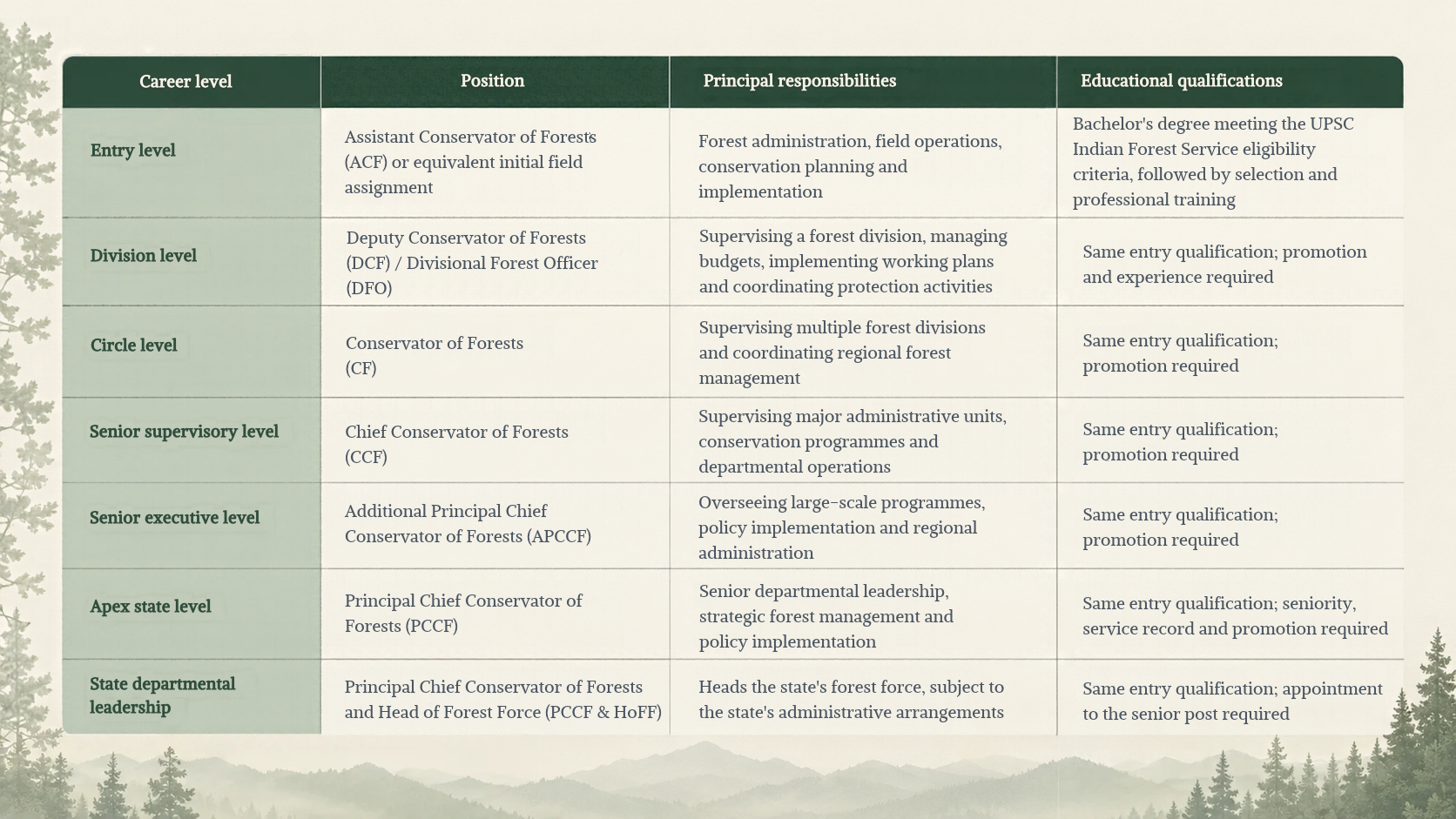
Other Accepted degree pathways include:
Bachelor's degree with at least one of these subjects: Animal Husbandry and Veterinary Science, Botany, Chemistry, Geology, Mathematics, Physics, Statistics or Zoology.
Bachelor's degree in Agriculture.
Bachelor's degree in Forestry.
Bachelor's degree in Engineering.
Other factors like nationality, age and medical requirements also favour the candidate's final assessment. It is necessary to be fully updated about the requirements through the official portal.
State-level Forest Services
Officers in these departments are only responsible for forests in a particular state. They have to be recruited via the State Public Service Commission, a state recruitment board or another authorised selection process.
You start as an ACF [Assistant Conservator of Forests], then become a RFO [Range Forest Officer], then become a Deputy Range Forest Officer or equivalent, then become a Forester, and then become a Forest Guard/Beat Guard.
NGO Based Opportunities
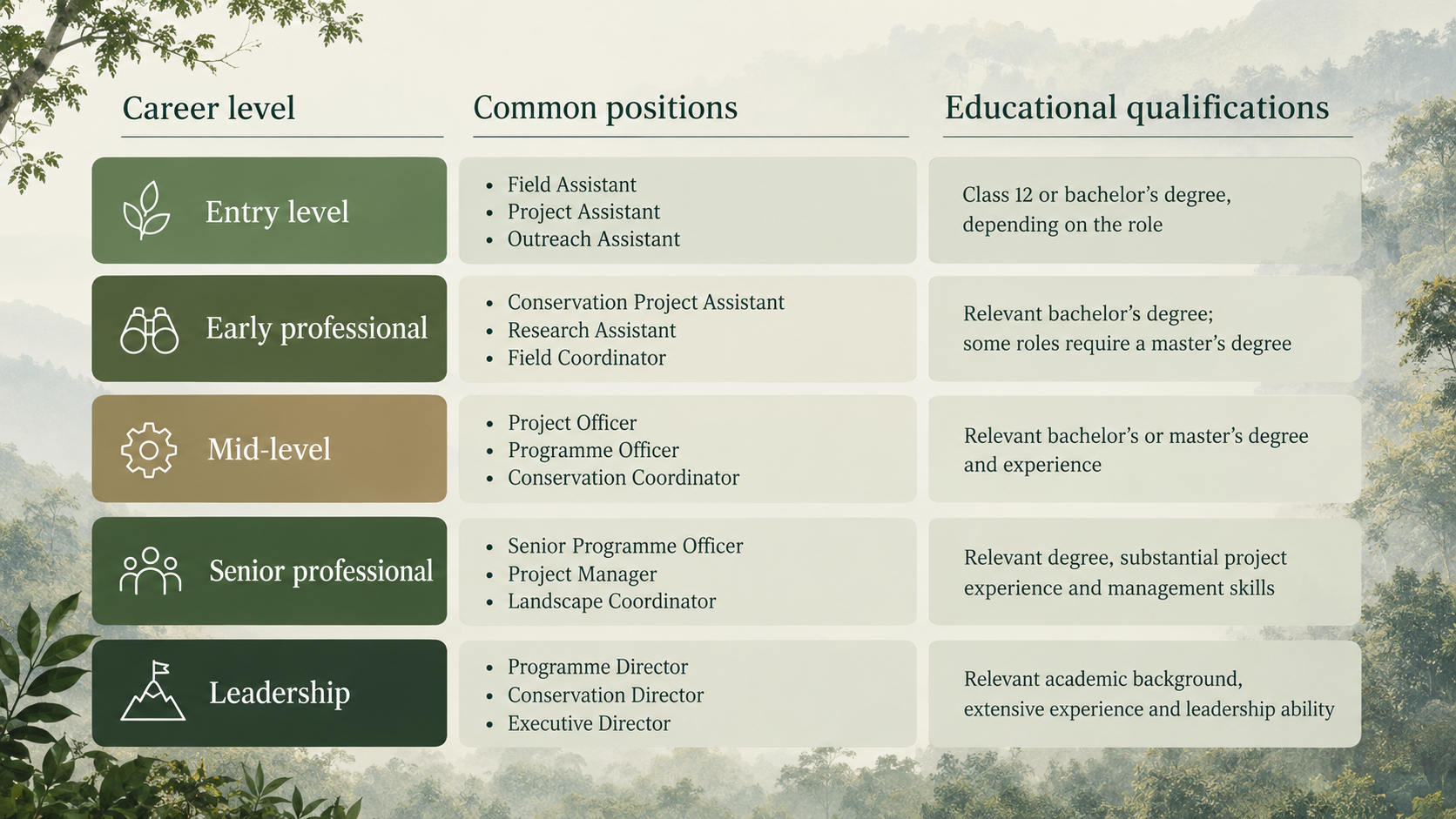
How To Start A Career
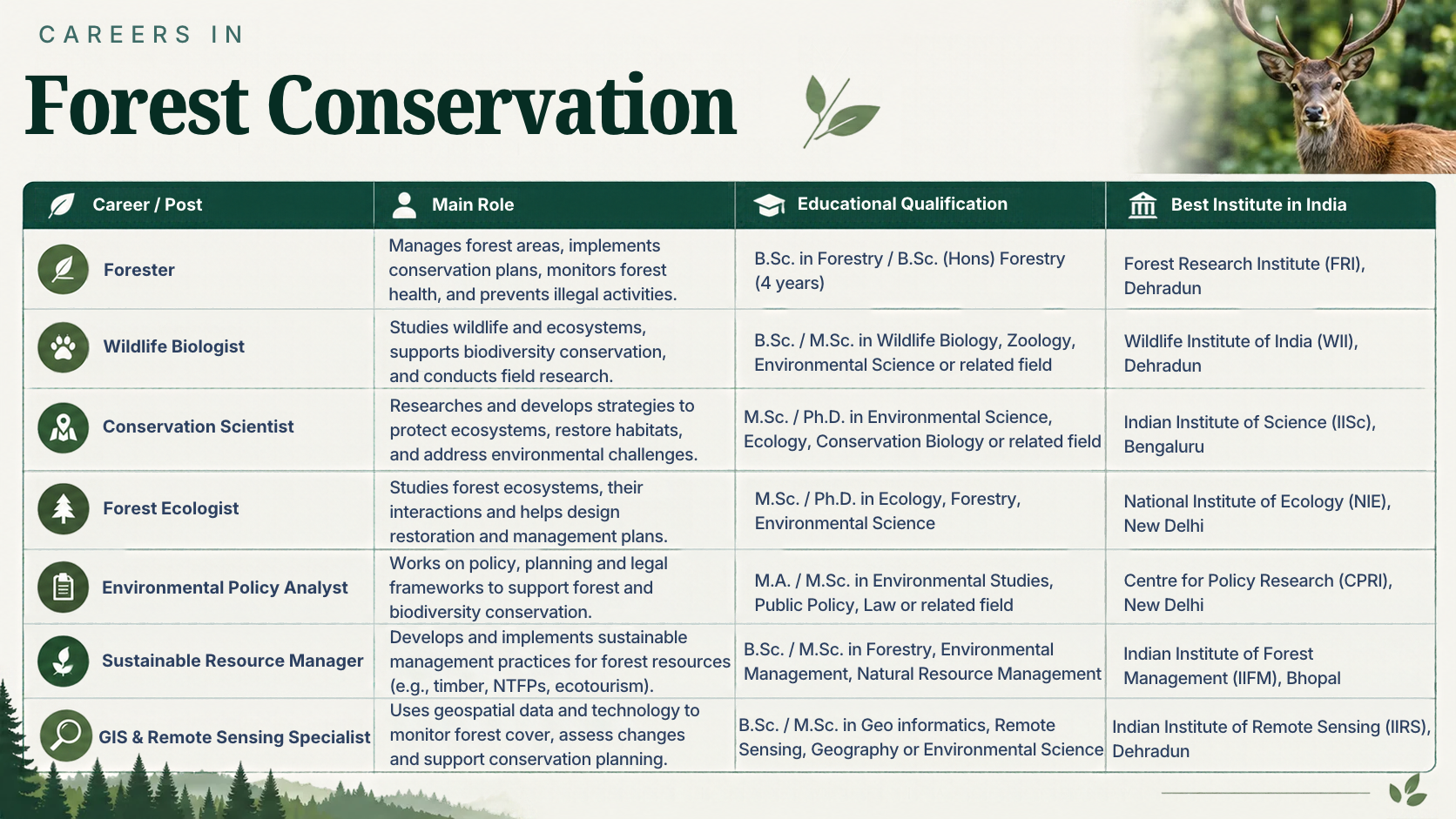
Apart from the Government & NGO based opportunities, forest conservation has a lot of other opportunities, as listed above. It is important to develop the required skills and then decide what suits your location and career the best.
For every student, the top 5 skills required to get into the Forest Career include:
Ecological Knowledge - Understanding forests, biodiversity, ecosystems and wildlife.
Field Research & Observation - Conducting surveys, collecting samples and monitoring habitats.
Data Analysis & GIS - Interpreting environmental data, maps and satellite imagery.
Problem-Solving & Critical Thinking - Identifying conservation challenges and developing practical solutions.
Communication & Teamwork - Sharing research findings and collaborating with scientists, communities and other professionals.
Conclusion
Building a career that merges professional growth with environmental impact is one of the most significant opportunities in the modern workforce. For someone who loves to work with nature and wildlife, this is a massive opportunity.
There are so many officers who pursued this career path with unmatched courage. They were martyred while fulfilling their duty. The nation remembers their sacrifices, and the coming generation on the same path walks by the example they set. Any career in forest conservation requires bravery and dedication.
Not just in India, every country has a dedicated government office for forest ecosystems. New technologies are being developed by spending a lot of time, energy and money to preserve the forests and to make sure that there is a curb on deforestation, illegal activities and mining in the forest areas.
If you are starting college, have cleared 12th or are pursuing something else, there is no better time to explore this career pathway. Know your interests, learn about the educational opportunities, colleges and universities and give it a try.