
If your college called today asking for ₹500, would you answer? Michael Dell answered with $750 million.
Most of us remember college after passing out only for nostalgia, reunions or better canteen food. We would only be called to return a library book. But Michael Dell and his wife, Susan Dell, returned to pay $750 million to a university that Michael didn’t even graduate from. He was a dropout. It is one thing to have money and a completely different thing to use it for a good purpose. Not everyone has that courage.
While Alumni Giving Culture is very common in the UK or US, it is highly rare in India. For Indians, connections with the universities end the day you get your final results. People rarely look back, let alone give donations to the place where they spend so much time, shaping their lives.
Donations to any university don’t necessarily get used for daily operations but are instead beneficial for projects, research and development. It is not a necessity for the annual budget, but a cherry on top for the side experiments. Making donations helps future generations to gain more knowledge and reduces the pressure on the government to run universities.
What Is The Alumni Giving Culture?
Alumni Giving or Alumni Philanthropy is a culture particularly seen in the West, which emphasises annual fundraising from the students who have previously studied or graduated from the said university. There is a proper team that handles this calling and emails to get donations from former students.
The Alumni Giving comes in different forms:
The culture of giving, as in students being encouraged to ‘give back’ to the university they studied at.
‘Pay it forward’ is where alumni donate with the thought that future generations can receive the same knowledge and opportunities that they had.
The Alumni Campaigns, which are annual fundraisers targeting graduates specifically.
This entire concept is also based on maintaining lifelong relationships with the students, mainly for the financial support of the institutions.
What Are The Benefits Of Alumni Giving?
Alumni Giving began in 1641, when the Massachusetts Bay Colony raised 500 pounds for Harvard College. The concept of formally organising and bringing former students back to their alma mater came into existence in 1792 at Yale University. In India, it has still not become a popular system. The practice of donations to school benefits the institution and the student in the following ways:
For The Institution
Enhanced Education & Infrastructure: The institutions receiving the funding can have campus upgrades, better research centres, and attract top-tier faculty.
Student Scholarship: The money from Alumni Giving can directly support the next generation of students by funding their education through scholarships, and more deserving students get an advantage.
Increased institutional prestige: Many colleges and universities are ranked on the basis of alumni participation. It is considered a metric to measure the long-term institutional health and reputation.
For The Students
Emergency: During a crisis of funding or personal emergencies, these alumni donations are quite helpful for the students.
Better Infrastructure: Students can get access to better learning facilities and tools through the university's good resources that can be built through donations from the Alumni.
Networking: Better Alumni can guarantee better recruitment, and students can access industry experts more easily for their future.
For The Alumni & Donors
Enhanced Networking & Degree Value: Funding can work for better infrastructure, which can produce successful graduates, increasing the value of the alumni’s own degree. And keeping in touch with the institutions can get you in touch with established professionals in case you want to be a mentor or hire someone.
Tax Benefits: Many countries do not tax the income that goes to charity and donations. You can enjoy tax deductions, and you may get VIP perks in certain schools as well.
Legacy & Gratitude: Giving back to the place where you learnt allows you to practice gratitude, and you get a chance to actively shape the future for the coming generation.
Why Hasn't India Developed The Same Culture?
In India, Alumni Giving has hardly existed. We do not hear any successful people donating back to the colleges or universities that shaped them. There are a few reasons why we don’t donate to colleges:
Government-funded Universities: Traditionally, most of the universities were funded and managed by the government. People only paid a small amount of money as a fee. Now the idea of donating has to be marketed, and people should be made aware of it, so they might consider giving.
Inactive Alumni Associations: In countries where Alumni Giving is relatively popular, there are dedicated associations in colleges that make a call to the alumni and ask them to donate. These types of associations are formed by the universities by hiring current students. They keep in touch with the Alumni and eventually get them to donate. India does not have any such associations or clubs. Even if there are, the alumni would be hard to reach over the years and would eventually stop answering.
No Engagement With Graduates: As per our systems, once the student has collected the final marksheet, there is no looking back to the institution or the alma mater. The universities never get in touch with the passed-out students, and there are no reunions unless planned by the students of the same batch. The lack of emotional connection makes it difficult to practice Alumni Giving.
Limited Transparency: There is absolutely no accountability for how the donations are used in the university. The Alumni who are paying a certain amount of money should be well informed about where his/her money has been used. Indian institutions do not have complete transparency, which might put someone in doubt before donating.
Un-promoted Tax Incentives: Tax deductions on charity and donations have always been a part of our Income Tax Laws, but most of the people are highly unaware of this. Making people more aware through sessions and workshops might be a good initiative to make them start donating.
Most Donations Go To Temples: The philosophy behind donations in India is big. Almost all religions preach it, but they are mainly directed towards temples, beggars and the needy. They would donate to disaster-relief funds but not to universities and colleges. This mindset comes from the teaching that this good deed will come back to them in a good form in future.
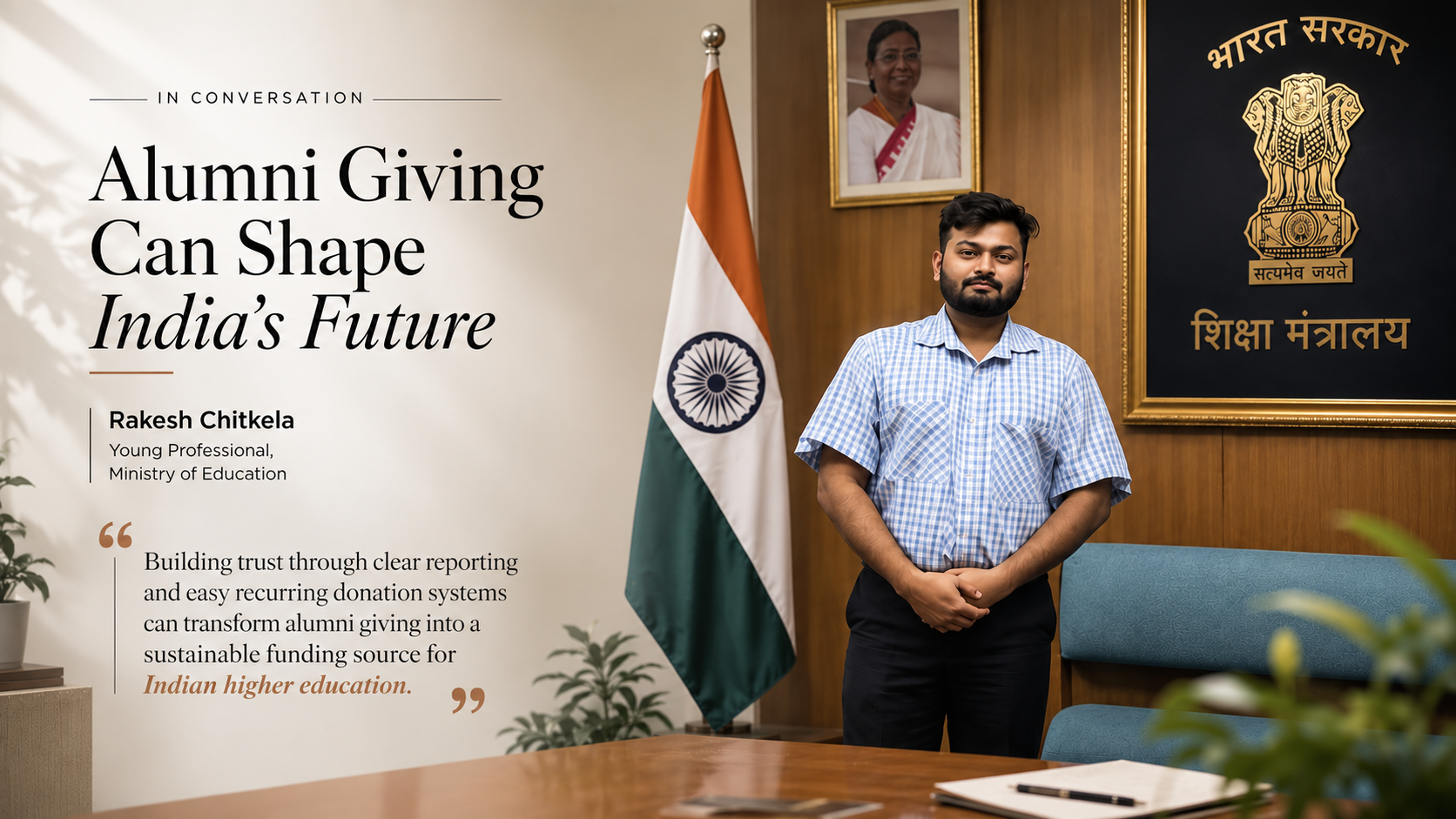
Concerning this, we had a chance to speak with Mr Rakesh Chitkela, a Young Professional at the Ministry of Education. His insights on the subject are as follows:
Q. Could alumni endowments reduce the financial burden on the government without increasing student fees?
Yes. Alumni endowments can supplement government funding by supporting research, scholarships, faculty, and innovation. However, they should complement—not replace—public investment, which remains essential for affordable and equitable higher education.
Q. Many alumni hesitate because they don't know how their donations will be used. Should universities be mandated to publish annual donor impact reports?
Absolutely. Transparent annual reports showing funds received, their utilisation, scholarships, research, infrastructure, and outcomes would build trust, improve accountability, and encourage more alumni to contribute regularly.
Q. If alumni donations increased significantly, which areas should receive priority—research, scholarships, faculty, or infrastructure?
Research and innovation should receive the highest priority, followed by scholarships, faculty development, and infrastructure. Research drives innovation and long-term growth, while scholarships ensure deserving students have equal access to education. Faculty development strengthens teaching and research, and infrastructure should support these academic goals. A balanced allocation could be 40% for research and innovation, 30% for scholarships, 20% for faculty development, and 10% for infrastructure.
Q. If one IIT graduate donated ₹100 every month, the combined impact would run into hundreds of crores annually. Why hasn't India institutionalised such a simple model of alumni giving?
The main barriers are culture, transparency, and fundraising systems—not affordability. Building trust through clear reporting, stronger alumni engagement, and easy recurring donation mechanisms can transform alumni giving into a sustainable funding source for Indian higher education.
Signs Of Change In Alumni Giving In India

Alumni Giving in India is not completely off. Many students have been active in donating money and staying in touch with their alma mater.
Dr Krishna Chivukula donated ₹228 crore to IIT Madras. As a result, he has a Krishna Chivukula Block on the campus.
Infosys Co-founder Nandan Nilekani donated ₹315 crore to IIT Bombay. The Alumni base recently reached a mark of ₹200 crore, which goes into upgrading the student housing facilities.
IndiGo Co-founder Rakesh Gangwal donated ₹100 crore for a school of medical sciences and technology on the institute’s premises.
The US-based founder of Yardi, Anant Yardi, donated $10 million to IIT Delhi for its School of Artificial Intelligence.
The Alumni Giving Culture is emerging in India, but it is confined to particular institutions only. It is not very popular. But with the right campaigns and efforts, it can be better.
Could India Build World-Class Universities Through Alumni Giving?
It is difficult to find one person to donate a million rupees, but it is easy to get 1 rupee donations from a million people.
Small donations from a lot of people can also generate enough money that can help the universities transform. It can reduce considerable pressure on the government.
Research and development sectors in every college and institution require funding at every stage. With little or no funds, these innovations are limited, and students often do not get the chance to shine. With donations from the alumni, this facility can encourage students to do better.
Donations from Alumni can encourage students from low-income families to study by funding their scholarships. This can bring the students with bright minds into the spotlight who would have otherwise never been able to do something worthwhile with their knowledge.
Alumni Giving cannot alone solve the problems of the institutions, but with the right policies and structure, it can make Indian institutions globally competitive.