

For decades, studying abroad has been considered as a dream for millions of Indians. Typically for students and their families, a degree from a prestigious international university often means a better career, opportunities and global exposure. Students have a chance to choose between their homelands and studying abroad but what if I told you that some of these foreign universities have set up their campuses in India.
Today rising tuition fees, increased cost of living, visa restrictions, currency fluctuations, inflation, and higher standard of living have made overseas students' education significantly more expensive. Institutions from countries such as Australia, the UK, and the US are exploring or launching Indian campuses.
Due to the National Education Policy (NEOP 2020) and regulations by the University Grants Commission leading universities are beginning to establish a campus on Indian land. Some of the major colleges that have set up universities in India are University of SouthHampton, Deakin University, University of Liverpool, University of York & University of Bristol (UK), University of Wollongong, University of Birmingham and University of Melbourne (Joint Initiative), Illinois Institute of Technology, whereas other colleges like the Western Sydney University, Victoria University, Queens University Belfast.
Although, with globally ranked universities now here many students are also left questioning if earning an international degree in India is the same as studying abroad? Let's have a look at this in the article below.
Why Are Foreign Universities Coming to India?
India is home to the world's largest youth population and also the largest higher education systems. The country has over 43 million students enrolled in higher education and among 1.4 million of Indian students study abroad. This makes India one of the largest international student markets globally. Indian families also collectively spend over US$60 billion annually on education overseas.
Students choose countries such as Canada, Australia, UK, Germany, and the US as the biggest destinations. Recognising both demand and outflow of money and talent, the Indian government introduced reforms allowing highly ranked foreign universities to establish campuses in India. One of the main objectives is to increase access to world-class education, reduce financial barriers and retain talented students, while strengthening India’s research ecosystem and position India as an international education hub.
What Degrees Do These Colleges Offer?
Unlike the traditional franchise programmes, these campuses are expected to award degrees directly from the foreign university. The foreign universities in India offer a variety of undergraduate and postgraduate courses popular in Computer Science, Artificial Intelligence, Data Science, Cybersecurity, FinTech and Business. Other degrees are engineering, public health, design, media and communication and international business.
According to the Union Ministry Of Education, 15 foreign universities have so far been issued Letters of Intent (LoIs), clearing the way for them to establish independent campuses in the country. While most of the campuses are set to open in August 2026 with each campus likely to begin operations with 200 to 250 students.
Is the Degree the Same?
One of the major questions students ask is if the degree is different to the one abroad.
In most cases the degrees are the same, as most foreign branch campuses are expected to award the same degree as their home campus.
For example, if a university offers a Bachelor of Business Administration in London and the same programme is approved for its Indian campus, the degree certificate generally carries the same university name.
However, students should always verify:
Is it the same curriculum?
Is the degree identical?
Is it taught by university-appointed faculty?
Are credits transferable?
Does the programme include international mobility?
These details differ across institutions.
Does It Feel Like Studying Abroad? While studying in India may not feel like studying abroad entirely, as the overall experience could be different depending on the country that these colleges are situated in. While the academic curriculum may be same, the overall experience can be very differently.
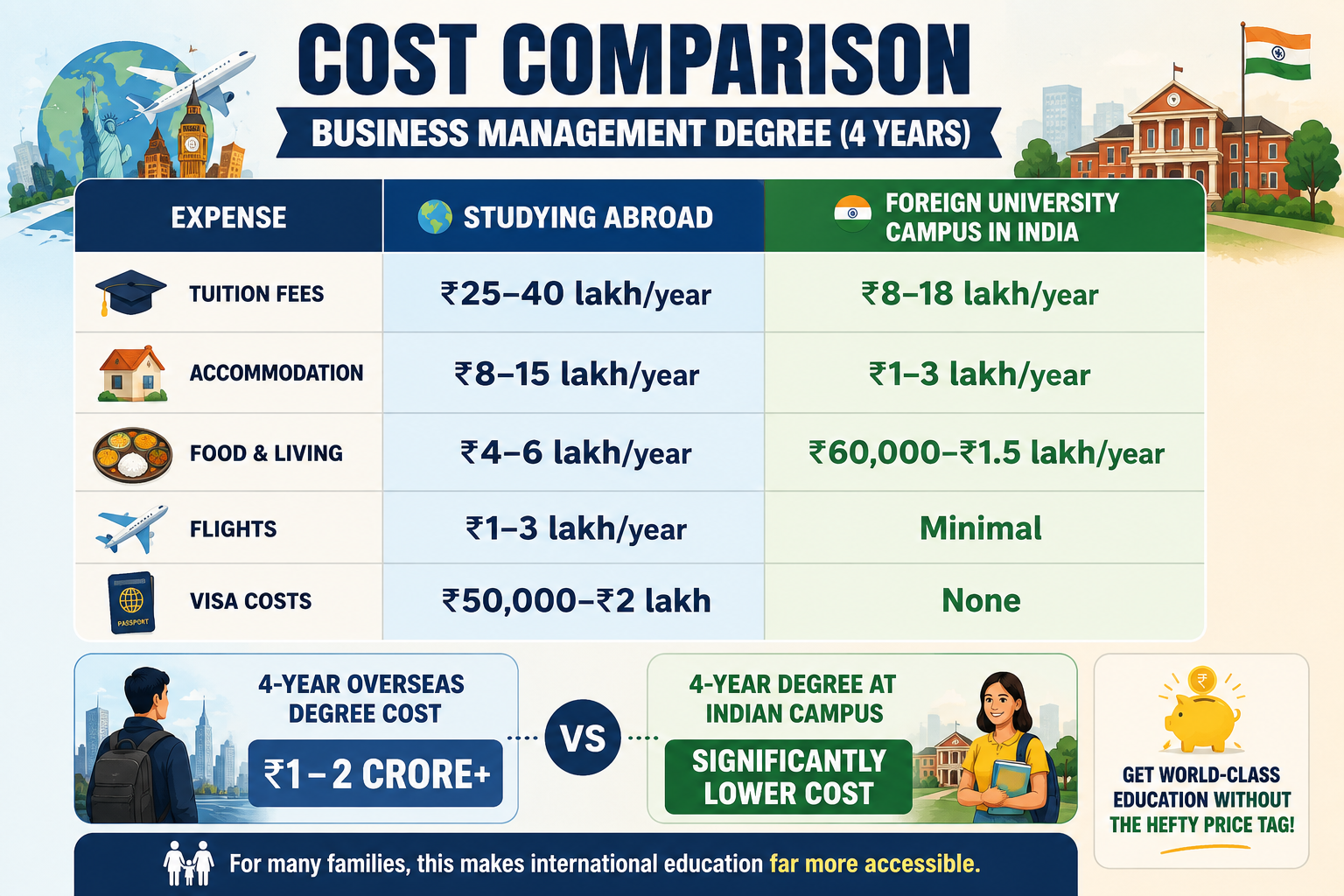
Cost Comparison
Perhaps the biggest advantage of studying at a foreign university in India is its affordability. While students still earn an internationally recognised degree and benefit from a global curriculum, they avoid many of the major expenses associated with studying overseas. Costs such as international travel, visas, higher accommodation charges, and expensive day-to-day living can significantly increase the total cost of an overseas education. By choosing the Indian campus of a foreign university, students can access a similar academic experience at a much lower overall cost, making international education a more practical and accessible option for many Indian families.
What About Faculty?
Students often assume professors from the main campus will teach every class.
In reality, branch campuses usually employ a combination of:
International faculty
Visiting professors
Local faculty recruited globally
Industry experts
Some courses may include virtual lectures from overseas professors.
The teaching quality ultimately depends on the university's academic standards.
Will There Be Student Exchange Opportunities?
Many universities are expected to offer:
Semester exchange programmes
Summer schools
International internships
Research collaborations
Credit transfer options
For example, a student could begin their degree in India and spend one semester or one year at the home campus.
However, these opportunities vary significantly by institution.
Research Opportunities
Research-intensive universities often invest heavily in innovation.
Students may gain access to:
Advanced laboratories
International research projects
Joint publications
Global academic conferences
Industry-funded innovation centres
If these investments are replicated in India, students could benefit from world-class research without leaving the country.
Career Opportunities
One concern students have is whether employers will value a degree earned at an Indian branch campus.
The answer depends on several factors:
University reputation
Student performance
Skills developed
Internships
Industry exposure
Employers increasingly focus on competencies rather than geography alone.
Graduating from a globally recognised university can strengthen a résumé, but internships, projects and practical experience remain equally important.
What You Might Miss by Not Going Abroad
Studying overseas is about much more than classrooms.
Students often gain:
Independence
Living alone teaches budgeting, cooking, problem-solving and responsibility.
Global Networking
Friends become future entrepreneurs, researchers and professionals across the world.
Cultural Intelligence
Employers increasingly value graduates who can work across cultures.
International Work Opportunities
Many countries offer post-study work visas, allowing graduates to gain international work experience.
These benefits are difficult to replicate entirely within India.
Advantages of Foreign Universities in India
Lower Costs
Students save significantly on tuition, accommodation and travel.
No Visa Stress
Visa delays, rejections and immigration policies become irrelevant.
Family Support
Students remain closer to family while receiving international education.
Global Curriculum
Students study updated international syllabi.
Better Accessibility
More students can now afford global education.
Industry Partnerships
Foreign universities often collaborate with multinational companies, opening internship opportunities.
Challenges Students Should Consider
Campus Size - Many branch campuses initially operate on a smaller scale than their home campuses.
Limited Alumni Network - Established overseas campuses often have decades—or even centuries—of alumni connections.
Indian campuses will need time to build similar networks.International Diversity
Student populations may initially be predominantly Indian.
Programme Availability
Not every course offered overseas will necessarily be available in India.
Who Should Choose a Foreign University in India?
This option may suit students who:
Want an international degree at a lower cost.
Prefer staying close to home.
Want access to global faculty and curriculum.
Plan to pursue higher studies abroad later.
Cannot afford full overseas education.
Who Should Still Consider Studying Abroad?
Studying overseas may still be the better choice if students:
Want complete cultural immersion.
Intend to work internationally after graduation.
Wish to build a global professional network.
Want access to larger research ecosystems.
Value the independence and personal growth that comes with living abroad.
What Parents Should Ask Before Applying
Before enrolling, families should verify:
Is the degree identical to the home campus?
Is the campus recognised by the UGC and relevant international accreditation bodies?
Are faculty members appointed by the university?
Are internships included?
Can students transfer to the home campus?
What placement support is available?
What scholarships or financial aid are offered?
Is the curriculum updated regularly?
What are the graduate employment outcomes?
Doing this research can help students avoid confusion between genuine branch campuses and institutions that merely partner with foreign universities.
The Bigger Picture: A New Era for Indian Higher Education
The arrival of foreign universities is more than just another admission option—it marks a significant shift in India's higher education landscape. Competition from globally recognised institutions is likely to encourage Indian universities to improve curriculum design, research output, industry partnerships and student services. It may also inspire greater collaboration between Indian and international institutions, leading to joint degrees, faculty exchanges and research initiatives.
At the same time, the success of these campuses will depend on maintaining the same academic standards, transparency and quality that students associate with the parent institution. Simply carrying a well-known international name will not be enough if teaching, infrastructure and student outcomes fail to meet expectations.
Final Thoughts
Foreign universities opening campuses in India represent one of the biggest changes in Indian higher education in decades. They offer students an opportunity to earn internationally recognised degrees at a fraction of the cost of studying overseas, making global education more accessible than ever before.
However, an international degree is not automatically the same as an international experience. While students may receive similar academic training, they may miss out on cultural immersion, independent living, global networking and post-study work opportunities that remain defining features of studying abroad.
For many students, a foreign university in India could provide the ideal balance between affordability and quality. For others whose goals include building an international career or experiencing life in another country, studying overseas may still be worth the investment.
Ultimately, the right choice depends not only on rankings or tuition fees, but also on your career ambitions, financial circumstances, learning preferences and the kind of life experience you hope to gain during your university years.