
As World Music Day is celebrated on June 21 each year, it serves as a reminder of music's unique ability to connect people across cultures, emotions, and experiences. Whether through a melody, a lyric, or a rhythm, music has the power to inspire, comfort, and bring people together.
Today, the music industry is larger and more diverse than ever before. With more than 700 million paid music streaming subscribers worldwide and rapidly growing digital music markets such as India, opportunities in the field extend far beyond performing on stage. Careers in music now span production, technology, business, education, therapy, gaming, film, television, and digital media.
For students who dream of building a career in music, talent is only one part of the equation. Professional training, technical expertise, and industry knowledge play an equally important role. As a result, universities and conservatories around the world offer a wide range of music degrees designed to prepare students for different career paths within the industry.
But why do so many different music degrees exist?
The answer lies in the evolving nature of the music industry itself. Music today is more than performance and entertainment. It is a multidisciplinary field that combines creativity with technology, business, education, healthcare, and research. From composing film scores and producing albums to managing artists and using music in therapeutic settings, there are numerous ways to build a career in the field.
Music degrees are generally divided into three levels:
Undergraduate Music Degrees (Bachelor's): Entry-level programs that typically last three to four years and provide foundational training in music performance, theory, composition, technology, or business.
Master's Level Music Degrees: Advanced programs that usually take one to two years and allow students to specialize in areas such as performance, composition, conducting, education, or music technology.
Doctoral Level Music Degrees: The highest academic qualifications in music, typically requiring three to five years or more of study. These programs focus on advanced artistic practice, research, scholarship, and university-level teaching.
Here is a guide to some of the most common music degrees available today and the careers they can lead to.
Different Types Of Degrees:
1. Bachelor of Music:
A Bachelor of Music (BM) is the most traditional and widely offered music degree. It is a professional undergraduate program that places a strong emphasis on practical training, with students often spending the majority of their time rehearsing, performing, composing, or refining their musical skills. Typically lasting three to four years, the degree combines intensive performance training with coursework in music theory, history, composition, ear training, and conducting. Throughout the program, students participate in recitals, ensemble performances, and juried evaluations that help prepare them for professional careers in music. Graduates often pursue careers as performers, composers, conductors, arrangers, or session musicians.
2. Bachelor of Arts in Music:
A Bachelor of Arts (BA) in Music combines music studies with a broader liberal arts education. Unlike the performance-focused Bachelor of Music, a BA allows students to explore music within cultural, historical, and social contexts while studying subjects outside the discipline. Alongside music theory, history, and performance courses, students may take classes in psychology, communications, literature, business, or sociology. The degree offers greater flexibility and is particularly well suited to students interested in interdisciplinary studies, double majors, or careers that connect music with other fields. Graduates may pursue opportunities in arts administration, music journalism, education, cultural research, music law, and other creative industries.
3. Bachelor of Fine Arts (BFA) in Music
A Bachelor of Fine Arts (BFA) in Music is designed for students who want to focus heavily on artistic expression and performance. While it shares similarities with a Bachelor of Music, a BFA places greater emphasis on creativity, stagecraft, and interdisciplinary arts training. Students spend a significant amount of time developing their performance skills while also studying composition, improvisation, music history, and music theory.
Many BFA programs are closely linked to theatre, dance, acting, and musical theatre. Students often participate in live productions, stage performances, ensemble work, and collaborative projects with performers from other artistic disciplines. This makes the degree particularly suitable for students interested in careers that combine music with performing arts.
Throughout the program, students build a professional portfolio through recitals, concerts, and creative projects. Graduates often pursue careers as performing artists, composers, theatre musicians, musical directors, and arts practitioners.
4. Bachelor of Science (BS) in Music
A Bachelor of Science in Music is ideal for students who are fascinated by the technical side of music. Unlike traditional music degrees that focus primarily on performance, a BS degree combines music studies with technology, engineering, acoustics, and scientific principles.
Students learn how sound works, how music is recorded and produced, and how technology shapes modern music creation. Coursework may include audio engineering, acoustics, digital recording, sound design, music software, and signal processing. Many programs also incorporate computer science, mathematics, and physics modules.
For example, students may learn how concert halls are designed for optimal sound quality, how microphones capture audio, or how streaming platforms process music files. Practical studio work forms a major part of the curriculum.
Graduates often work as audio engineers, recording specialists, sound designers, broadcast technicians, and music technology professionals.
5. Music Technology Degree
Music technology is one of the fastest-growing areas of music education. This degree focuses on the tools and technologies used to create, record, edit, and distribute music in the digital age.
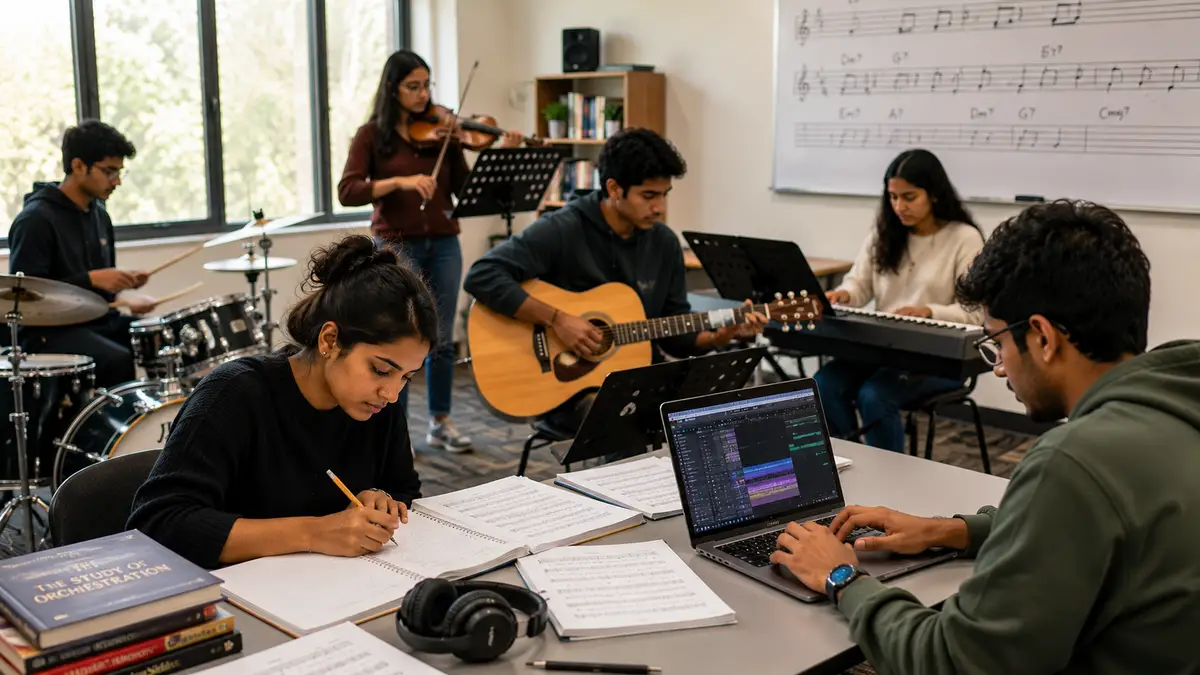
Students gain hands-on experience with digital audio workstations (DAWs) such as Pro Tools, Logic Pro, Ableton Live, and other industry-standard software. They learn music production, recording techniques, mixing, mastering, sound synthesis, and electronic music creation.
Many programs now include modules on artificial intelligence in music, immersive audio, virtual reality sound design, and music programming. Students frequently work on real-world projects such as producing original tracks, creating podcasts, designing audio for games, or building digital music portfolios.
This degree is ideal for students who enjoy both creativity and technology. Career opportunities include music producer, music technologist, audio programmer, sound designer, and recording engineer.
6. Music Business Degree
Not everyone in the music industry performs on stage. A Music Business degree focuses on the commercial side of the industry and teaches students how music becomes a successful product.
Students study artist management, music marketing, copyright law, royalties, licensing, event management, branding, and entrepreneurship. They learn how record labels operate, how artists build audiences, and how streaming platforms generate revenue.
For example, students may analyse marketing campaigns for major artists, develop concert promotion strategies, or learn how intellectual property rights protect musicians' work. Internships with music companies, festivals, and entertainment organisations are often an important part of the program.
This degree is ideal for students who love music but are more interested in management, business, and industry operations than performing. Career paths include artist manager, talent agent, concert promoter, music marketer, and label executive.
7. Music Education Degree
A Music Education degree prepares students to teach music in schools, colleges, community programs, and private studios. It combines musical training with teaching methodologies and educational theory.
Students study music theory, conducting, performance, classroom management, curriculum development, and educational psychology. They also learn how to teach different age groups and often complete supervised teaching placements in schools.
The degree focuses on helping students become effective educators while maintaining strong musical skills. Many programs require students to conduct choirs, bands, or orchestras as part of their training.
Graduates typically become music teachers, choir directors, instrumental instructors, curriculum specialists, or educational researchers.
8. Music Therapy Degree
Music Therapy is a unique field that combines music with healthcare and psychology. Students learn how music can be used as a therapeutic tool to support emotional, cognitive, physical, and social well-being.
The curriculum includes music studies alongside psychology, counselling techniques, anatomy, neuroscience, and clinical practice. Students learn how to design music-based interventions for individuals facing challenges such as anxiety, trauma, developmental disorders, dementia, or rehabilitation needs.
Clinical placements are an essential component of most programs. Students work directly with patients under supervision in hospitals, schools, rehabilitation centres, and healthcare facilities.
Music therapy is ideal for students who are passionate about both music and helping others. Graduates often work as music therapists, rehabilitation specialists, mental health practitioners, and community healthcare professionals.
9. Master of Music (MM)
The Master of Music is a postgraduate qualification for students who want to deepen their expertise in a specific area of music. It is commonly pursued after completing a bachelor's degree and typically takes one to two years to complete.
Students choose a specialisation such as performance, composition, conducting, music education, music technology, or musicology. The coursework is more advanced and research-focused than undergraduate studies, with greater emphasis on independent work.
Performance students may prepare major recitals, while composition students develop substantial original works. Research-oriented students often complete dissertations or scholarly projects.
The degree helps students refine their artistic identity and prepare for professional careers, advanced teaching positions, or doctoral studies.
10. Doctor of Musical Arts (DMA) / PhD in Music
The DMA and PhD represent the highest levels of academic achievement in music. Although both are doctoral qualifications, they serve different purposes.
A Doctor of Musical Arts (DMA) focuses primarily on advanced artistic practice. Students spend years refining their performance, conducting, or composition skills while completing extensive creative projects and public performances.
A PhD in Music is more research-oriented and explores areas such as musicology, ethnomusicology, music theory, cultural studies, and music education. Students conduct original research and contribute new knowledge to the field.
For example, a PhD candidate might study the evolution of Indian classical music traditions, while a DMA student may present a series of professional-level performances and compositions.
These degrees are typically pursued by aspiring university professors, researchers, professional composers, conductors, and leading performers.
How Music Degrees Differ from Traditional Degrees
Unlike many academic programs, music degrees combine classroom learning with intensive practical training. Students spend hours each day rehearsing, performing, composing, recording, or studying music theory. In most conservatories and music schools, performance evaluations, recitals, and portfolio submissions carry as much weight as written examinations.
Music students are assessed through:
Solo and group performances
Recitals and juries
Composition projects
Studio recordings
Music theory examinations
Research papers
Final performance showcases
This practical approach helps students build industry-ready skills long before graduation.
What Is Typically Included in a Music Degree Syllabus?
While curricula vary by specialization, most music programs include:
Foundation Subjects
Music Theory
Ear Training
Sight Reading
Music History
Harmony and Counterpoint
Conducting
Composition
Practical Training
Instrumental Performance
Vocal Training
Ensemble Performance
Stage Presence
Improvisation
Technology Modules
Digital Audio Workstations (DAWs)
Music Production Software
Sound Recording
Mixing and Mastering
Audio Engineering
Industry Modules
Music Copyright
Artist Management
Event Management
Music Marketing
Entrepreneurship
Many universities now include AI-assisted music production, immersive audio, gaming sound design, and streaming economics as part of modern music curricula.
Skills Students Develop During a Music Degree
Music education teaches far more than performance.
Students develop:
Creativity
Critical Listening
Collaboration
Time Management
Communication Skills
Leadership
Technical Audio Skills
Project Management
Problem Solving
These transferable skills are valued across media, entertainment, education, and technology industries.
Beyond Becoming a Singer: Career Options for Music Graduates
Many students assume music degrees only lead to performing careers. However, graduates today work in a variety of sectors.
Performance Careers
Recording Artist
Session Musician
Orchestra Performer
Singer-Songwriter
Musical Theatre Performer
Technology Careers
Sound Engineer
Audio Programmer
Music Producer
Mixing Engineer
Sound Designer
Business Careers
Artist Manager
Talent Agent
Concert Promoter
Music Marketing Specialist
Label Executive
Academic Careers
Lecturer
Researcher
Music Teacher
Conservatory Faculty
Healthcare Careers
Music Therapist
Rehabilitation Specialist
Community Arts Practitioner
The Growing Scope of Music Education
The modern music industry extends far beyond the recording studio or concert hall. Streaming platforms, gaming, film production, digital content creation, and music technology have opened new career pathways for graduates. Whether students aspire to perform, teach, produce, research, or innovate, there is now a music degree tailored to almost every musical ambition.
World Music Day is the perfect reminder that music is not only an art form—it is also a dynamic academic discipline with diverse career opportunities.