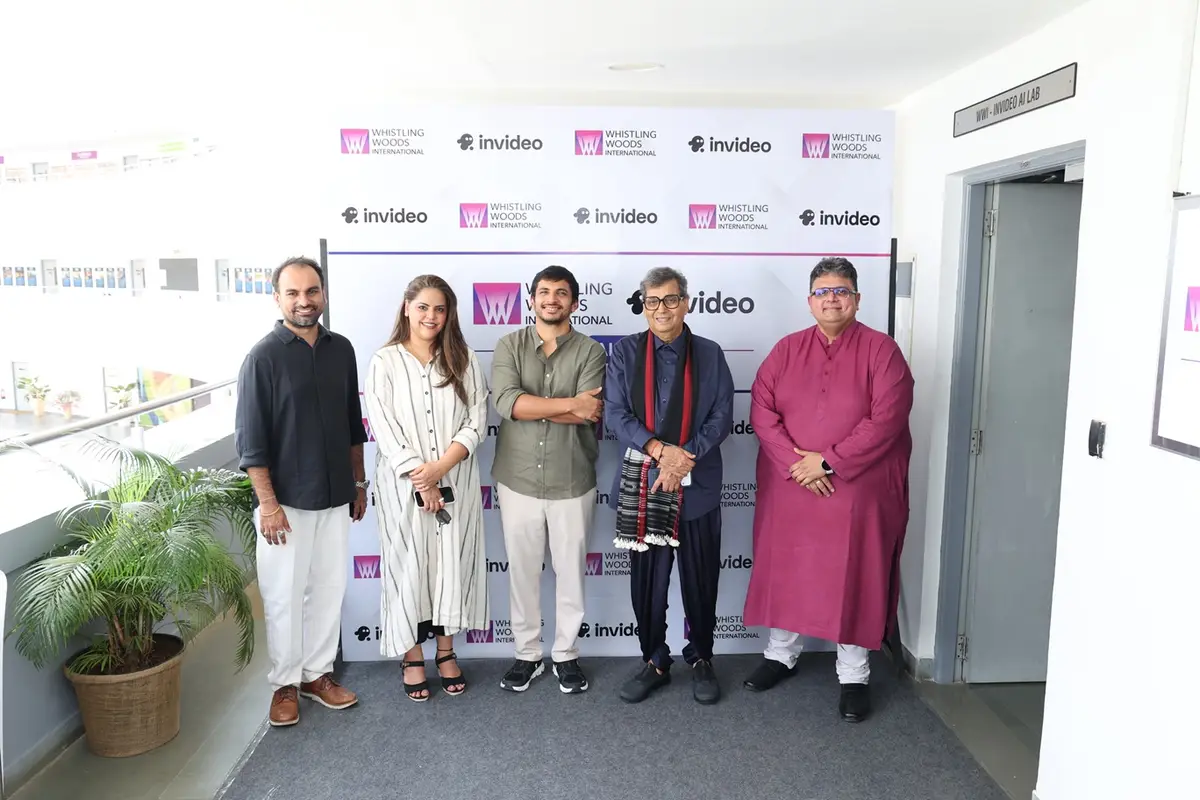
For every aspiring and established filmmaker in the industry, there is always something new to learn and adapt. One such new technology was introduced at the Whistling Woods International Institution by Meghna Ghai Puri, Chaitanya Chinchlikar, and Subhash Ghai in collaboration with Sanket Shah, the CEO at InVideo AI Lab.
This technology helps every student understand, learn, and use AI in whatever creative field they aspire to excel in for their filmmaking career, whether it is production, direction, editing, or storytelling. At Youth Incorporated, we had an opportunity to cover the exclusive launch event as a media partner. We got to see and understand the labs, their purpose, and the expected outcome of this very first-of-its-kind inclusion in the filmmaking curriculum, alongside the very minds who brought it to life.
In Conversation With:
Chaitanya Chinchlikar - Vice President, CTO & Emerging Media Head at Whistling Woods International.
Subhash Ghai - Director, producer, actor, lyricist, music director and screenwriter. He has worked on several films, notably including Khalnayak, Pardes, Aitraaz, and Karz.
Sanket Shah - Co-Founder and CEO of InVideo
Catch the excerpts from the exclusive interview below.
Chaitanya Chinchlikar - So, AI is going to be a part of the world of audio-visual narrative storytelling; this is called filmmaking, and it is going to be a part of it. So, we need to make sure that students who are finishing their education in media and entertainment, generally, but specifically in film, are well-versed in how to use it, understand it, and approach it as a tool, which is what this partnership is doing. We want to work together to make sure that students have access to all the latest tools and platforms and workflows that are out there in the industry. That is how it will benefit the students.
Q: How do you think that it will benefit the students in today's world? [To Subhash Ghai]
Subhash Ghai - See, in my journey, I always think about the past, present and the future.
Future, you are always concerned. Through InVideo, the team has done a great job at connecting the world and educating people about AI, which is not a future; it is the present. And I feel, imagine, education blends with AI and AI blends with education, how India is going to be. It's going to be just greater than what we think it will be. But the only thing that we need is a storyteller; we need creative people. We have technology, and our initiative is to educate the young generation with them.
Q: What about the misuse that comes with the benefits?
Sanket Shah- See, everything is misused. But what you have to look at is the absolute positive side of it. AI in filmmaking is for the people who know their craft, understand it and are educated enough to use it. The misuse is not going to last. We will keep blocking it.
Q: Sir, what will be the duration of this course?
Chaitanya Chinchlikar: It is not a separate course. AI is being integrated into the way filmmaking is taught. There are three key components of filmmaking:
Creative Fundamentals – Storytelling, framing, composition, writing, visuals, and sound. These principles remain constant regardless of technological change.
Workflows – The process of turning an idea into a finished story. While creative fundamentals stay the same, workflows evolve. AI is now enhancing these workflows and creating new ways to develop and produce content.
Tools – Technologies used during the filmmaking process. These change regularly, and AI is the latest addition to the filmmaker's toolkit.
Then they understand, I want to make a film; where and when can I, should I, use these new tools and these new workflows which are available to me in the form of AI. It's not like it's going to be used all the time by everybody for everything. AI should be viewed much like visual effects. Some projects may use it extensively, while others may need it only in specific areas. The choice depends entirely on the story being told and the filmmaker's creative vision. Just as film schools teach animation, VFX, virtual production, and other emerging technologies, it is important to educate students about AI and its applications. The goal is not to replace creativity but to expand creative possibilities. AI should not be seen merely as a way to save time or reduce costs. Its real value lies in enabling creators to achieve things that were previously impossible. Think along the lines of: Now I have AI, what can I imagine now that I couldn’t in the past? The focus should always remain on the story. AI can help bring ambitious ideas to life, but storytelling continues to be the most important part of filmmaking.
Q: Has AI Lab been introduced to the ongoing batches as well, or is it just for new students?
Chaitanya Chinchlikar: AI is not entirely new to the media and entertainment industry. Technologies such as photogrammetry, green-screen replacement, virtual production, and world-building have been in use for years. AI-powered technologies are already widely used across the industry. In fact, we have been teaching many of these technologies for the past 15–20 years. As these innovations are now being grouped under the broader AI umbrella, WWI has integrated AI education across all its programs rather than creating a separate course. Students in every discipline—from cinematography and editing to animation and media studies—need to understand how AI can enhance their specific craft and workflow. If the entire industry is using these technologies, it is our responsibility to teach them. In fact, AI is already being widely used in fields such as journalism and media communications. Alongside AI adoption, the institute is also focusing on content authenticity and verification. The other important aspect is content provenance—knowing whether a piece of content is real or AI-generated. WWI is India's only educational institution that is a member of the global C2PA initiative, which develops standards for verifying the authenticity of digital content. We are also testing the world's first camera equipped with C2PA standards, the Sony PXW-Z300. Every frame carries metadata showing where and how it was captured, allowing creators and audiences to verify that the content is authentic and not AI-generated. This ensures that we are preparing students for both AI creation and AI verification.
Q: How will this AI integration affect the film’s budget? [towards Subhash Ghai]
Subhash Ghai - The budget will be affected; it will be reduced. But what is important is that the story and the execution remain unaffected; the quality should remain good. Because lesser budget will bring more competitors.
Q: Will your new films have AI?
Chaitanya Chinchlikar - It is not an either-or situation; it is an inclusive situation.
Subhash Ghai - And we will also be learning so many things from the younger generation. So, whether old generation or new generation, a man like me will also learn.
Q: What is the future of filmmaking? Will AI reduce human jobs in this industry?
Subhash Ghai - It's like, when I was a student, I used to go to the public library. And there were thousands of books. Everything is about information.
So I had a very tough time selecting my books. And I had to contact the librarian about the subject I needed material related to. It all depends on my demand.
So AI has become a society’s right. It has become a huge library of content. But then it is a library. You may select the wrong book for the right subject, and you go absolutely disastrous.
So it depends on your wisdom, skill, creativity, focus, what to pick and what not to pick. If you pick the wrong thing, you can be in disaster. So I must educate myself in my skills on how to use AI in storytelling.
Q: Chaitanya, just a little bit for you, because you are the CTO. So I mean, AI means GPUs and all that. How many GPUs are you planning to install? Are you planning to install just any one?
Chaitanya Chinchlikar- So we are on the standard AI stack. At the bottom is electricity. Then you've got infrastructure. You've got GPUs. You've got models. You've got, now in between there are agents, right? And then there is application.
As a media and entertainment industry on the applied side, we will work with models. We will work with agents. And maybe when we start to do a lot of R&D, which we already are, we may get into models as well. We are not going below that stack because that's not our expertise. That's not what we do. We don't manufacture cameras.
We teach students how to use it in the best way possible by partnering with the world's best camera manufacturers. The same thing replicated for this workflow or this piece of technology, right? So I'm not in the business of setting up data centres or even working on models. I mean, we've not started yet to work on models.
We may have in the past. In the future, I don't know. But at this point, we are only on the applied side because we are an applied arts industry.
The media and entertainment industry is an applied arts industry. We are the psychiatry to the psychology. So that's what we will continue to make sure that students know how to do it.
Q: So I just want to know, as a 25-year-old filmmaker, Subhash Ji, what AI tools would you feel that would have been helpful to you?
Subhash Ghai - Main abhi bhi 25 hu. See, it is always human imagination.
And human imagination, from horses to ratha to well, to radio and satellite, all these things, will grow after every 30 years, 10 years. The question is, how do I touch your heart? With what kind of story, what kind of communication do I say? How can I improve your health, mind, harmony and happiness?
Q: So storytelling will never be replaced by AI?
Subhash Ghai - Never, I don't think so. Never.
Q: Sanketji, what would you think would be the limitations to this? Like benefits, we have talked about a lot. Any limitations that you would like to talk about?
Sanket Shah - I mean, there are limitations today of everything. And they will just keep improving. What we like to think about is, this is the worst it will ever get. Today is really the worst that it will ever get. So it is just going to keep improving, keep evolving.
And you just want to know that, what is it unlocking? And I think that unlocks are coming every few months. Definitely.
Q: Any specific modules that you would be introducing that you would like to talk about?
Chaitanya Chinchlikar- So, I mean, at this point, it is too vast. Because we have, say, 8 specialisations within filmmaking. We have 4, 5 within animation. We have 3 within gaming, 7 in our media and communication program. So it is there in everything, right? But broadly, how we are going to treat it is, like I explained to you. There is a creative core, there are workflows, and there are tools.
And then there is helping students understand when and where and how to use these tools and work. And it is really that which is critical, which will actually change every 6 months.
Q: So, in contribution to the same point, the AI usage of it, the detection, will there be guidelines put in by you?
Chaitanya Chinchlikar - Already. Already in place. So, there are 6 broad risks in AI. There are 6 broad categories of ethical risks in AI, right? So, one is content provenance.
There are lots of them. So, we have an in-house doctrine for risk assessment for AI in all these 6 categories. And then we have an internal AI team that looks at all of these and puts in guidelines to make sure that we are not and that we are mitigating all those risks.
Because you can't just run around and do whatever you want, right? You have to be a responsible institution. Which is why we have done things like partner with C2PA and, you know, work with companies that are also responsible AI. So, you know, we must do that.
Q: What metrics will you use to measure the outcomes of the AI lab and filmmaking? How do you grade students or even graphic-kind-of films?
Chaitanya Chinchlikar- So, we have an assessment matrix on how do you... Because with every workflow, assessment patterns change. Because we've been doing academics now for 20 years, we know what is to be included. So, for example, there's going to be much more process assessment.
There's much more decision-making assessment. Why did you choose to use this tool? What was the reason that you did this? Okay, if you used an agent, why? If you used a prompt instead of an agent, why? This is going to be based on the process, not necessarily on the output only.