

Global Capability Centres (GCCs) were first established in India in 1985. Texas Instruments set up its first GCC in Bengaluru, followed by Citicorp Overseas Software Limited [COSL] in Pune in the same year.
On September 30, 2026, DoorDash opened a hub in Hyderabad with 500 employees, planning to make it a firm with 3000 employees in the next 2 years. It also had a small data and software analytics office set up in 2021 in Pune when it acquired Chowbotics.
DoorDash is not launching its company in India. They are just using this centre as an offshore facility to handle Customer Experience & Integrity (CXI) through general and administrative teams. This is their 3rd centre, followed by Arizona and Mexico.
DoorDash is joining companies such as Costco, McDonald's, Charles Schwab, Marriott and Southwest Airlines [amongst another 430-500] that have recently expanded their GCC operations/presence in Hyderabad. And it is definitely not the only one.
Starbucks recently announced that it will establish a GCC in Chennai, creating almost 800 jobs. It plans to expand and eventually bring third-party work in-house.
With that announcement, we have the right to ask: why are global companies increasingly building key parts of their operations in India?
What is GCC?
To perform functions and execute operations for their global business, multinational companies develop offshore offices in other countries. These offices are company-owned or company-controlled. The primary reason for this is to obtain talented individuals from talent-rich hubs like India at a lower cost. It speeds up the digital transformation.
The employees are hired to control internal operations like software engineering, IT support, finance, human resources and legal compliance. And other than the basic back-office tasks, they also have teams for advanced research, AI development, data analytics, and product design.
Before GCC, companies had to hire third-party vendors, like outsourcing them for certain tasks and services. These companies were handling sensitive code and data of the company while also serving competitors. There was a huge risk of leaks. They were also expensive, with fees added to the pay of workers. Even then, they were just focused on finishing the contracts, with zero loyalty.
GCC bridges this gap. The workers, codes, information, budgets- everything is under the company's direct control. Employees are made to sign the NDA; they care for the company, they are accustomed to the company’s culture, and they work for long-term success. And now, moving from the traditional setup, India's GCC story is increasingly about ownership and strategic capability rather than just lower operating costs.
There is a simple distinction between a Call Center/BPO and a Global Capability Centre. Call Centres/BPOs just fulfil a function, whereas a GCC runs an entire offshore business operation or capability hub. So it's not just simple customer service, calls, and support, but it's more of high-skilled professional and technical roles in the field of IT, software, finance, analytics, R&D, engineering, HR, legal, cybersecurity, etc.
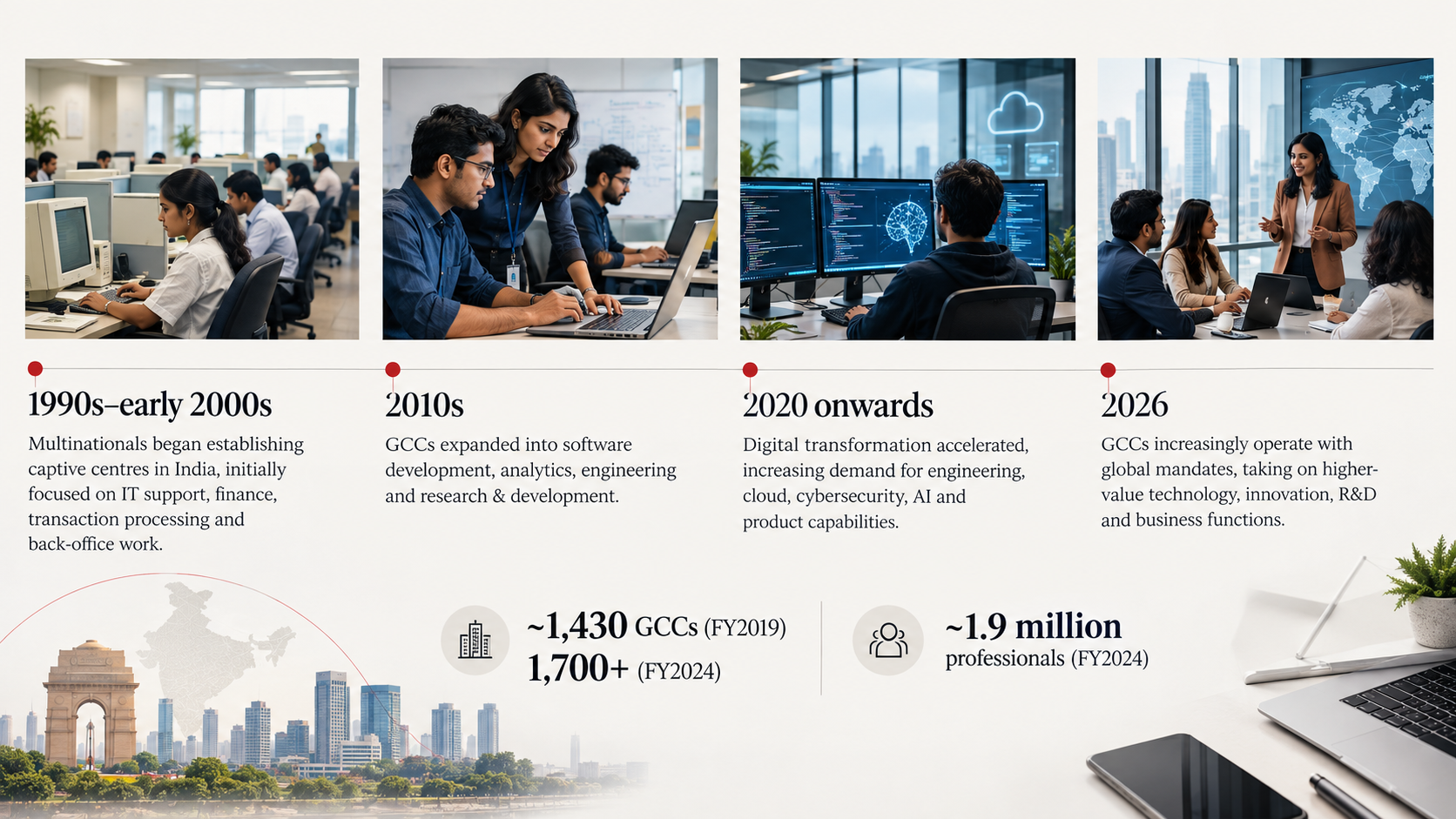
How Did India Become A GCC Hub?
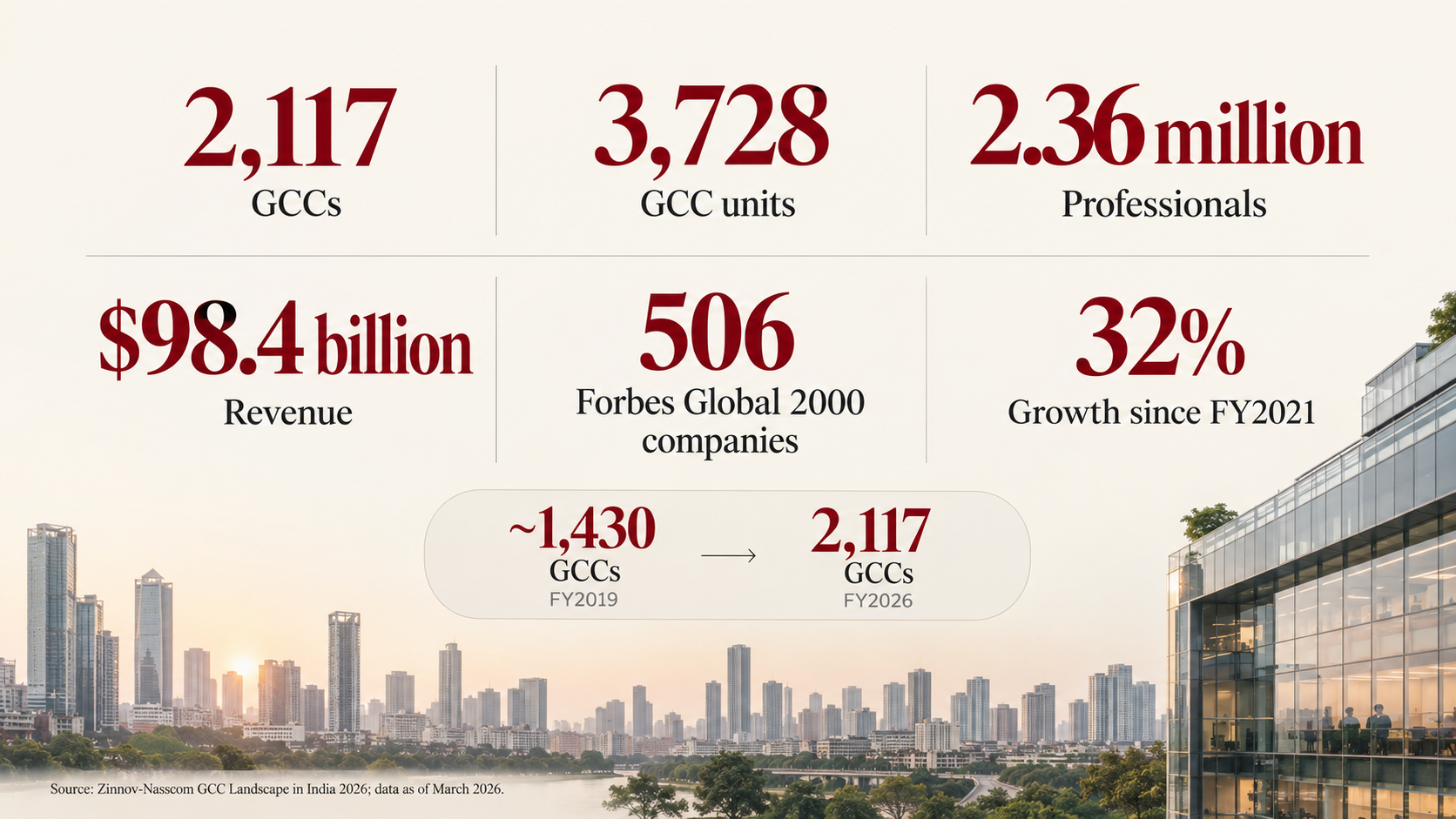
The Numbers: How Big Is India's GCC Industry Now?
Why Are Companies Choosing India?
India holds the highest number of GCCs in the world, holding over 55% of the global market share. Why? Because:
Talent: Indian professionals account for 28% of the global STEM workforce and 23% of global software engineering talent. We have a large pool of talented and distinguished individuals.
Cost: Initially, every company wanted Indian workers because it was cheaper. Data entry and payroll were done by Indians at lower prices. But currently, India is looked upon as a centre for skilled individuals, and companies are no longer concerned about cost-cutting.
Technology Ecosystem: India already has an established ecosystem for AI, Cloud, IT, Fintech, Cybersecurity, Engineering and Data. This makes it very easy for companies, cutting their time and energy compared to starting from scratch.
Scale: India not only has specialised talent, but it also allows these companies to build their own specialised centres of excellence. This ensures that even though the companies are in a foreign land, everything is to their satisfaction.
The advantage is no longer simply that India can do the same work for less; increasingly, companies are coming to India because they can find capabilities that are difficult to scale elsewhere.
Why do GCCs Matter to India?
As youth, we are often looked upon as the backbone of the economy. A country’s development is highly based on the growth and upbringing of its youth. GCCs matter to India for this specific reason. An average Indian should care about these because:
Economic Impact: GCCs are a $100 billion ecosystem. They create millions of skilled jobs for the country’s youth. They are a source of foreign multinational investments. Setting up these centres also accounts for the increase in demand for commercial real estate. In addition to this, GCCs can create growth in technology and professional services.
Talent Impact: GCCs are now working beyond the traditional services of data entry, payrolls and basic IT jobs. They create opportunities in the field of engineering, finance, IT, analytics, cybersecurity, product management, global leadership, operations, and R&D. The demand for this in the country makes it possible for the younger generation to develop and grow in these fields.
City-level Impact: GCCs are not just confined to Bengaluru. Other cities like Hyderabad, Delhi, Pune, Mumbai, Chennai, Coimbatore, Kochi, Ahmedabad, Jaipur, Indore and Bhubaneswar are also emerging as hubs. These cities are seeing a wave of announcements, and this demonstrates the continuing geographic spread.
What GCCs Want From India's Next Generation of Talent?
As the GCCs continue to evolve in India, the experts suggest that the coming generation can take full advantage of this opportunity by making sure they have the following skills:
You need to have basic business and technology knowledge. It is fine if you cannot code, but you should have hands-on experience with AI, digital transformation, data and automation to some extent.
Instead of just executing instructions, you should be a capable strategic thinker, working on global business platforms.
You should have the ability to understand data and analyse it to make correct decisions.
You should know how to use AI effectively for different fields like marketing, finance, operations, HR, etc.
You should be a team player. Cross-functional management is important as many different teams require coordination under one roof.
You should be well-versed with the stakeholders globally, and your communications with them should be impactful and influential.
You need to be able to adapt to new technology quickly and be a problem-solver instead of a process follower.
The Future: Where Are GCCs Heading?
With the fast and furious emergence of AI (Artificial Intelligence), the threat to menial jobs is alarming. AI in GCCs can automate repetitive work, reducing the requirement for certain transactional roles, changing existing job descriptions, and increasing productivity.
While this may sound like a negative, on the positive side, AI is creating demand for AI/ML engineers, data scientists, AI product managers, cybersecurity specialists, AI governance professionals, cloud engineers, and domain experts.
These are some established GCC’s in India: JPMorgan Chase, Goldman Sachs, Morgan Stanley, BlackRock, Wells Fargo, HSBC, Deutsche Bank, Barclays, Citigroup, American Express, Standard Chartered, MUFG, UBS, Fidelity and Franklin Templeton. Further added more than 100 GCCs expansions in FY2026, and new entrants included companies such as Charles Schwab, BASF, eBay and Revolut.
India's GCC story is no longer simply about how many companies are setting up offices here. The more important question is what those offices are being trusted to do. If the current shift continues, India's GCCs could move further from executing instructions created elsewhere to designing products, developing technologies and making decisions with global impact. For young professionals, that could mean a job market where the most valuable skills are not limited to coding or traditional IT, but extend to AI, creativity, domain expertise, problem-solving and global business understanding.