


When people hear the word criminology, their minds often think of crime dramas, forensic labs, courtroom thrillers, or detectives solving high-profile murder cases. Popular shows like Crime Petrol, CID, Delhi Crime, Mind Hunter and many others on OTT Platforms have made the field fascinating especially to the youth. Today with the rise in crimes in cities world-wide it is necessary for students to learn criminology in order to understand crimes, criminal behaviour, root cause of crimes and understanding of law enforcement.
In television shows we have always watched criminologists as professionals who spend their days chasing criminals, finding clues and uncovering mysteries of a crime. While these portrayals may be entertaining, they barely scratch the surface of what criminology is really about. So let's find out!
What is Criminology?
Criminology is an interdisciplinary field that studies crime, criminal behavior, victims, justice systems and the social, psychological and economic factors that contribute to criminal activity. It is a field that combines sociology, psychology, law, public policy, forensic science, and research to understand why crimes occur and how as a society we can prevent them.
Today crimes are not just limited to theft, robbery, kidnapping or violent offences. Today a number of crimes like cyber crimes, financial fraud, human trafficking, environmental crimes, terrorism, animal cruelty, online harassments, digital scams, identity theft and terrorism are increasingly growing. Due to technology and the development of new apps, updates, phishing scams, money laundering scams have risen due to easily available data and lack of cyber security. This has also led to a specialized field of cyber criminology. In a country like India with the new features, apps, and data easily available security is a major lapse that has led to hackers stealing your data. Criminology helps study the behaviours of hackers, scammers and other digital criminals. They analyze patterns of cyber-criminals, understand how people are targeted and also help prevent scams from happening.
Today India has registered approximately 29.44 lakh cyber security incidents compared to previous years. Cyber fraud accounts for losses exceeding ₹22,495 crore. The crime rate index in India is 418.9 per 1 lac people. Despite overall crime rate dropping yet the number of cybercrimes and crimes including juveniles has been on a rise. Uttar Pradesh, Maharashtra, Madhya Pradesh register the highest number of reported cases.
Governments, businesses, and international organisations require professionals who understand these evolving threats. This growing demand has expanded career opportunities far beyond traditional policing. Criminology is divided into four types: Classical, Positivist, Critical, and Integrated. It is also divided into branches like penology, victimology and biocriminology.
Lets understand what each branch means:
Penology: Penology is the subfield dedicated to the philosophy, theory, and practice of how society manages, suppresses, and punishes criminal behavior.
Victimology: Victimology is the study of victims of crime, their experiences, rights, and the psychological, social and legal impact of criminal acts. It also focuses on victim support, compensation and crime prevention.
Biocriminology: Biocriminology examines how biological and genetic factors, together with environmental influences, contribute to criminal behaviour. It studies brain development, genetics and neuroscience to better understand why certain individuals may be more susceptible to criminal activity.
Criminology is the scientific study of crime and criminal behaviour. It seeks to answer important questions such as:
Why do people commit crimes?
What social conditions encourage criminal behaviour?
How can governments reduce crime?
What happens to victims after crimes occur?
How effective are prisons and rehabilitation programs?
How can technology help prevent crime?
Unlike criminal justice, which focuses on enforcing laws and operating legal systems, criminology emphasizes understanding the causes, consequences, and prevention of crime through research and analysis. Most Criminology careers inside India sit inside police, prosecution or NGO roles.
Unlike criminal justice, which focuses on enforcing laws and operating legal systems, students in criminology learn to evacuate crime trends, analyse evidence, and study criminal psychology.
How to become a Criminologist?
To become a criminologist one needs to complete their 12th graduation in any field be it arts, science or commerce. Then get a degree in BSC in Criminology or a related field like BA in Psychology, Sociology or Law. You can then pursue a degree in a Masters field for an advanced job role. Most universities require a 45% passing mark.
Popular Courses in Criminology
Students can pursue:
BA in Criminology
BSc in Criminology
BA Criminology and Criminal Justice
BSc Forensic Science with Criminology
MA Criminology
MSc Criminology
PG Diploma in Criminology
Certificate Courses in Cybercrime Investigation
Diploma in Criminal Psychology
Skills You Develop During a Criminology Degree
A criminology programme equips students with both analytical and practical skills that are valuable across industries. Then they must enroll in a bachelors degree
Some key skills include:
Critical Thinking
Data Analysis
Written and Verbal Communication
Research Skills
Problem-solving
Ethical Decision-making
Understanding Human Behavior
Active listening
Observation
Legal comprehension
Career Opportunities Beyond Crime Shows
A Criminology degree opens doors to various jobs in the government, corporate and non-profit sectors. Many entry level job salaries range from Rs 20,000 to Rs. 50,000. Professionals with specialised certifications, advanced degrees, or experience in cybersecurity, digital forensics, or intelligence can earn significantly higher salaries.
1. Crime Analyst
Crime analysts study crime data, identify trends, and help law enforcement agencies allocate resources effectively. They work with geographic information systems (GIS), statistics, and predictive policing tools. The salary can range from ₹4–7 LPA for entry and mid level jobs.
Responsibilities
Analysing crime patterns
Preparing intelligence reports
Identifying high-risk areas
Supporting crime prevention strategies
2. Criminal Profiler
These professionals analyse behavioural patterns to assist investigations and understand offender psychology. While highly specialised, profiling combines psychology, criminology, and investigative research.
3. Cybercrime Investigator
With digital crime increasing worldwide, cybercrime investigators have become one of the fastest-growing professionals in the security sector. ₹5–10 LPA can be the entry level job salary.
They investigate:
Online fraud
Hacking incidents
Identity theft
Data breaches
Cryptocurrency crimes
Social media scams
4. Forensic Consultant
Although forensic scientists conduct laboratory testing, criminology graduates often work alongside forensic experts by interpreting evidence within criminal investigations and supporting legal proceedings.
5. Intelligence Analyst
Government agencies employ intelligence analysts to identify threats related to terrorism, organised crime, cyber threats, and national security. Entry level salary ranges from ₹6–10 LPA.
Their work involves:
Information gathering
Risk assessment
Pattern analysis
Strategic reporting
6. Victim Advocate
Victim advocates provide emotional, legal, and practical support to individuals affected by crime.
They help victims:
Navigate legal systems
Access counselling
Understand their rights
Receive rehabilitation support
7. Correctional Officer and Rehabilitation Specialist
Modern correctional systems focus not only on punishment but also on rehabilitation.
Professionals develop:
Educational programmes
Counselling services
Behavioural interventions
Reintegration plans
8. Policy Researcher
Governments and think tanks employ criminologists to evaluate crime policies and recommend evidence-based reforms.
Policy researchers examine:
Juvenile justice
Prison reforms
Domestic violence laws
Drug policies
Community policing
9. Private Investigator
Many graduates join private investigation firms that handle:
Corporate fraud
Insurance investigations
Missing person cases
Background verification
Intellectual property theft
10. Corporate Security Specialist
Large corporations hire criminology graduates to assess risks, prevent internal fraud, and strengthen workplace security. The salaries range from ₹5–9 LPA for entry level job.
Responsibilities include:
Fraud prevention
Security audits
Risk management
Employee investigations
Compliance monitoring
11. Fraud Investigator
Banks, insurance companies, and financial institutions employ fraud investigators to detect suspicious transactions and financial crimes. Their salary ranges from ₹4–8 LPA for an entry level job.
12. Academic Researcher or Lecturer
Those interested in teaching can pursue postgraduate studies and contribute to research in criminology, criminal psychology, public policy, or sociology.
Criminology in the Age of Technology
Technology has transformed crime—and criminology.
Today's professionals study:
Artificial intelligence in policing
Digital forensics
Cybersecurity
Online radicalisation
Cryptocurrency fraud
Dark web investigations
Surveillance ethics
As governments invest in digital policing and cyber defence, criminologists with technological expertise are becoming increasingly valuable.
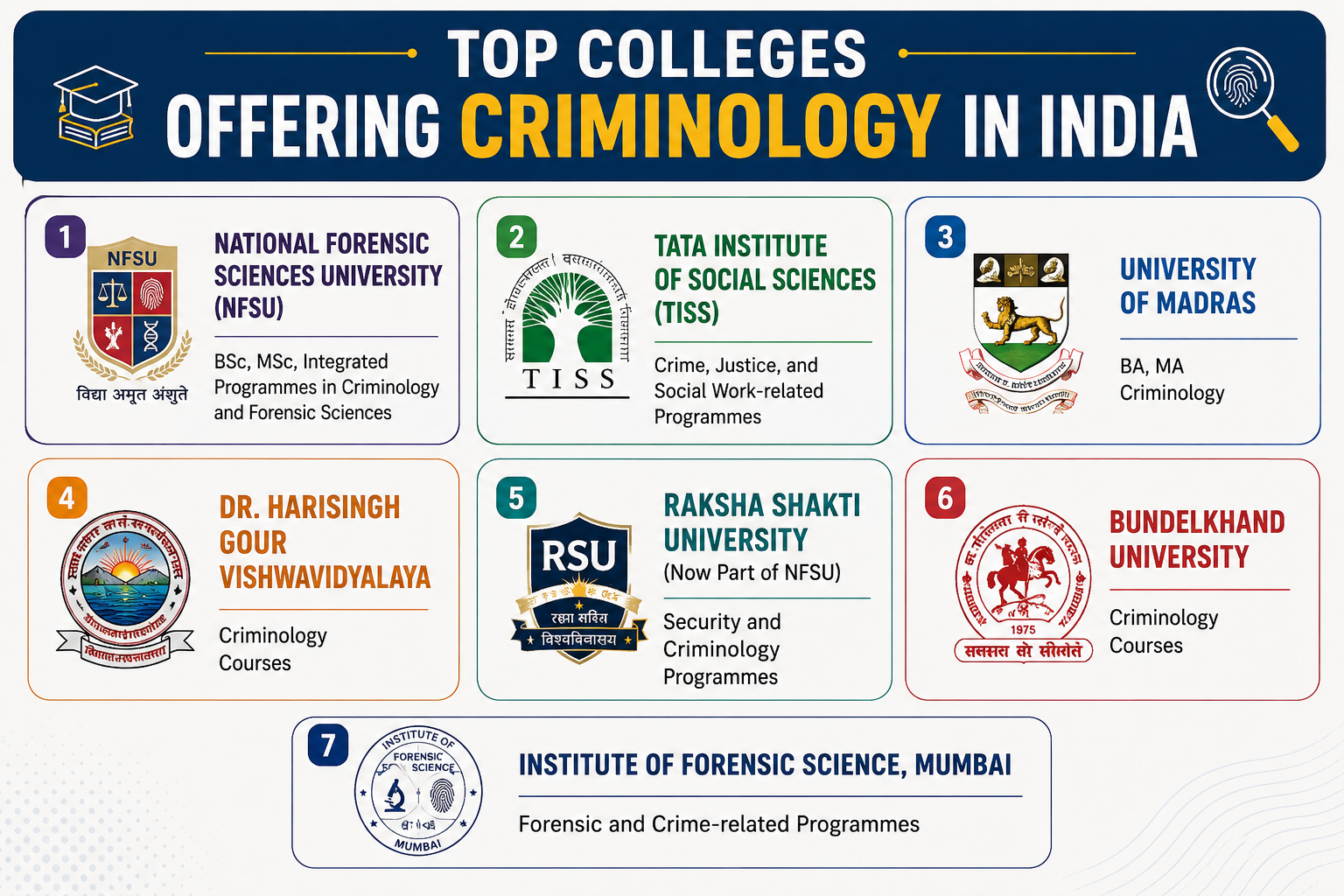
Top Colleges Offering Criminology in India
Future Scope of Criminology
The future of criminology is expanding rapidly.
Growing areas include:
Cybersecurity
Artificial intelligence and crime prediction
Financial crime investigation
Digital forensics
Homeland security
International policing
Human rights
Criminal justice reform
Counter-terrorism
Public policy research
With increasing digitalisation and evolving crime patterns, governments, corporations, financial institutions, NGOs, and international organisations continue to seek professionals who can understand and respond to emerging security challenges.
Is Criminology the Right Career for You?
Criminology may be an excellent choice if you:
Enjoy solving complex problems
Are curious about human behaviour
Want to contribute to safer communities
Like research and analytical thinking
Have an interest in psychology, sociology, or law
Want a career that combines social impact with investigative work
The field demands patience, objectivity, ethical decision-making, and a willingness to adapt to changing forms of crime. While it may not always resemble the fast-paced world portrayed in television dramas, it offers intellectually stimulating work with the opportunity to influence justice systems, support victims, and shape policies that improve society.
Crime stories may capture our imagination, but the real work of criminologists goes far beyond dramatic investigations and courtroom revelations. Today's criminology professionals are researchers, analysts, policy advisors, cybercrime specialists, victim advocates, and security experts working to understand crime, protect communities, and build fairer justice systems.
As technology reshapes the nature of crime and societies seek smarter, evidence-based solutions, a criminology degree offers students a versatile and meaningful career path. For those driven by curiosity, critical thinking, and a desire to make a positive impact, criminology can be much more than a subject of fascination—it can be the foundation for a rewarding and future-ready profession.