
When your hand goes towards your phone first thing in the morning, you require a face or a fingerprint to unlock it. You can deny location access for various apps, and when you scroll past a post criticising a government policy and still share it, it is the Constitution working for you even before you get out of bed.
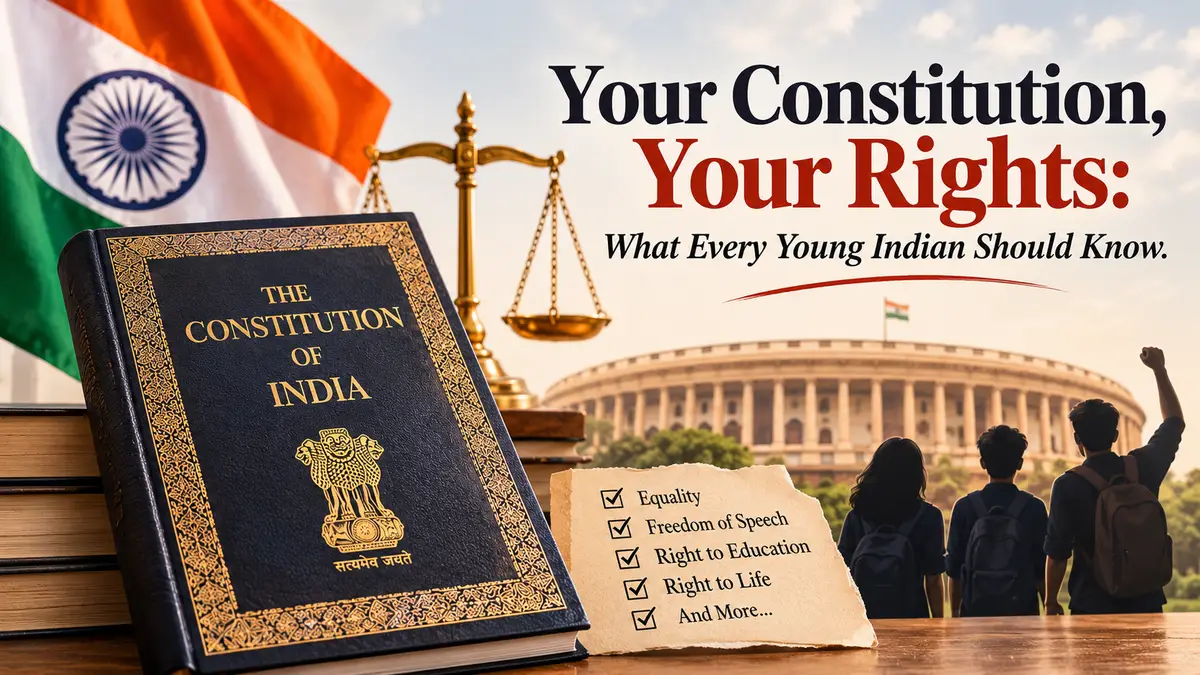
77 years ago, a document was drafted that protects you and your privacy at every step. Most of us remember 26th January as Republic Day- the day when the Constitution came into force. But 26th November is the day when it was actually adopted. On this Constitution Day, we are going to talk about the promises made in that document and what you can do when someone breaks those promises.
As one of the most diverse countries in the world, India needs a comprehensive set of rules and regulations to help the nation run smoothly. The committee took 2 years, 11 months and 18 days on calculation to draft the Constitution post-independence. It had 22 parts at the start and currently has 25 parts after all amendments.
Why Does 26 November Matter?
After almost 3 years of drafting the Constitution by the committee headed by Chairman Dr B. R. Ambedkar, it was adopted by the Government of India on this date. It officially came into effect on 26th January 1950, which we now celebrate as Republic Day. The date was chosen to commemorate the 1930 Purna Swaraj Declaration.
In 2015, under the leadership of Prime Minister Narendra Modi, 26th November was declared as Samvidhan Divas [Constitution Day] to foster civic awareness, marking the 125th birth anniversary of Dr Ambedkar. The Constitution stands on four pillars: Justice, Liberty, Equality & Fraternity.
Justice: Social, Economic & Political Fairness for every citizen.
Liberty: Freedom of all kinds for all citizens, irrespective of their religion or culture.
Equality: Same opportunities for all, irrespective of their background.
Fraternity: Respect for every individual, promoting brotherhood and national unity.
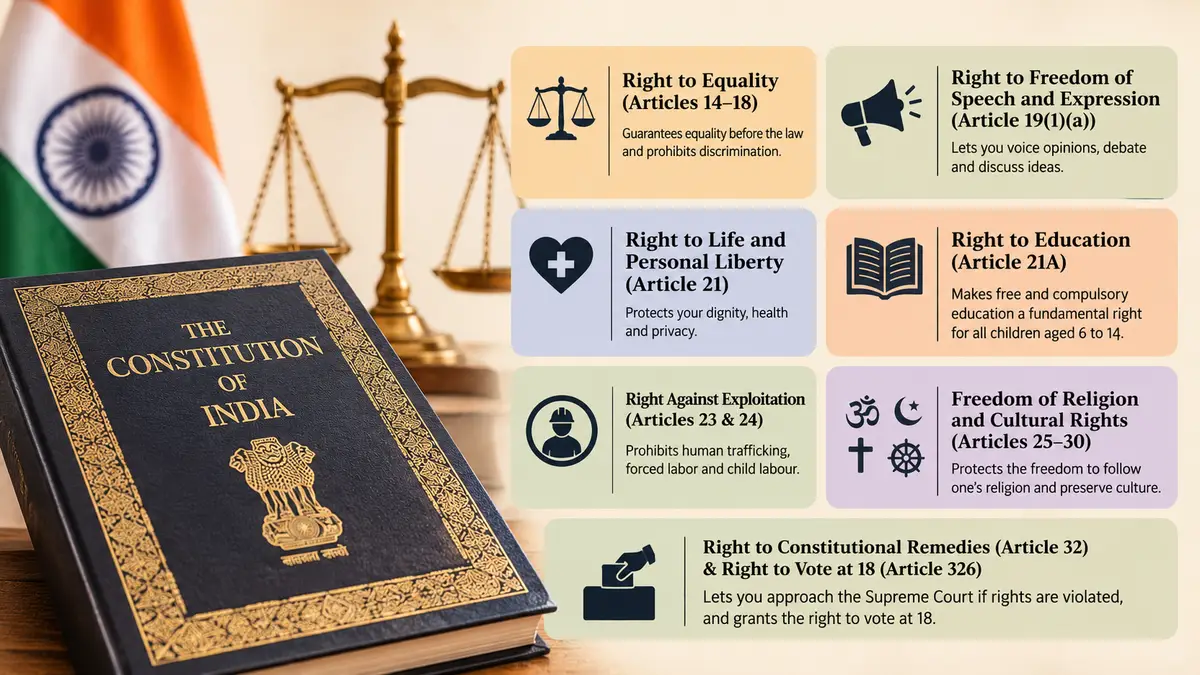
What Are Your Fundamental Rights?
The Constitution provides 6 fundamental rights to every individual. They are:
Right to Equality: Articles 14-18 in the Constitution talk about no discrimination based on sex, religion, birthplace or caste. There should be equal opportunities in all sectors for citizens. The articles also mention the complete abolition of untouchability.
Example: Not being denied admission in college based on caste.
Right to Freedom: Articles 19-22 talk about the freedom of speech, expression, peaceful assembly, association, movement, residence, profession, protection of life and property, and safeguarding personal liberty.
Example: Being allowed to meet a lawyer and have an explanation in case you are detained.
Right Against Exploitation: Articles 23 & 24 talk about the abolition of trafficking and child labour. No child under the age of 14 should be working in any type of hazardous factory or mine.
Example: A 12-year-old child is not apt for being a labourer in a fireworks factory.
Right to Religion: Articles 25-28 talk about the freedom to choose, not choose, practise, and follow any religion or faith. No one can force their beliefs on others.
Example: One cannot be barred from accepting a different faith from one their family follows, or from choosing none.
Right to Cultural and Educational Needs: Articles 29 & 30 talk about the freedom to protect the language, script and culture of minorities in all ways. They can even set up and run their own educational institutions.
Example: A school managed and run by a linguistic minority cannot be shut down or forced to follow generic boards.
Right to Constitutional Remedies: Article 32 talks about how we have the right to exercise all these rights, and in case of violation of these fundamental rights, we can appeal to the Supreme Court.
Example: Filing a petition when a right is denied will be accepted by the law without any bias.
Rights That Matter To The Youth
The Constitution is for the people and by the people. Despite being half a century old, the Constitution still stands strong, with only a few amendments brought in due to changes in time and surroundings. It still proves to be strong in protecting the rights of young people.
What To Do When A Right Is Denied?
The Indian Judicial System comes to your aid when any rights are violated. You can seek immediate help from the system when you feel that your liberties are threatened. Follow the basic steps:
Document everything: Take notes, screenshots and timestamps at every step. Every record, notice and written proof should be secured at your end. The system does not work with words; it works with evidence.
Ask for information: If you do not come from a legal background, learn by asking someone who does. It is better to know before assuming. Determine if the violation is regarding a right, some office/administration, or other denials. You can also ask for public records. Gather everything that is required.
Do not get involved in physical confrontations: Record and mention when such situations arise, but in no case should you take things into your own hands and escalate things by being physically abusive.
Approach the right body: Schools, colleges and corporates have teams to register and help you in difficult times. Approach them and try to resolve the issue. Go to the police and file FIRs if necessary. You can also ask for aid from Human Rights, National or State Commissions based on the nature of your problem.
Get free legal help: Article 39A and the Legal Services Authorities Act, 1987 provide free legal aid to eligible people, including women, children, SC/ST communities and low-income households.
Go to the Court: Article 32 (Supreme Court) and Article 226 (High Courts) allow petitions for enforcement through writs such as habeas corpus (produce a detained person) and mandamus (order an official to do their duty). Public Interest Litigation (PIL) lets anyone raise an issue affecting the public.
Rights Come With Duties
As responsible citizens, or as future responsible citizens, it is important to understand that we also have duties towards the nation. The Constitution does not just talk about the rights that we have and how we can enjoy them, but it explicitly states 11 duties that we are expected to perform as law-abiding citizens of the nation.
These duties include protecting the dignity and respecting the Constitution, the national flag, the national anthem, and cherishing the philosophies and morals of the freedom struggle. It includes defending the sovereignty, integrity and unity of the nation. It also states that there should be no misbehaviour in any form towards women; we should promote universal brotherhood, conservation of heritage and culture.
We should strive for excellence to make the nation proud. We should create more opportunities and educational pathways for children aged 6-14. We should protect nature at all costs. We should stop violence, protect public property and develop a spirit of humanity and reform.
The Constitution also provides us with the right to speak freely online. But it is our duty not to misuse that right. It is important to state trustworthy facts and timelines with accurate details while stating your opinion on anything.
The Constitution begins with "We, the people". This Constitution Day, make sure you're one of the people who know what it says: all 12 schedules and about 470 articles. Find the document and read it to be well prepared and informed.