
Image Credits: AI-Generated
Imagine getting 7 powerful leaders to agree on all world problems and solutions. That is a challenge in every G7 Summit.
The G7 Summit is a group of 7 powerful economies in the world. It does not have a permanent secretariat, nor do they have any treaties signed. Despite this, it is one of the most significant forums to shape international policies. The G7 Summit was formed to talk about economic stability, security, trade, technology and geo-political crisis.
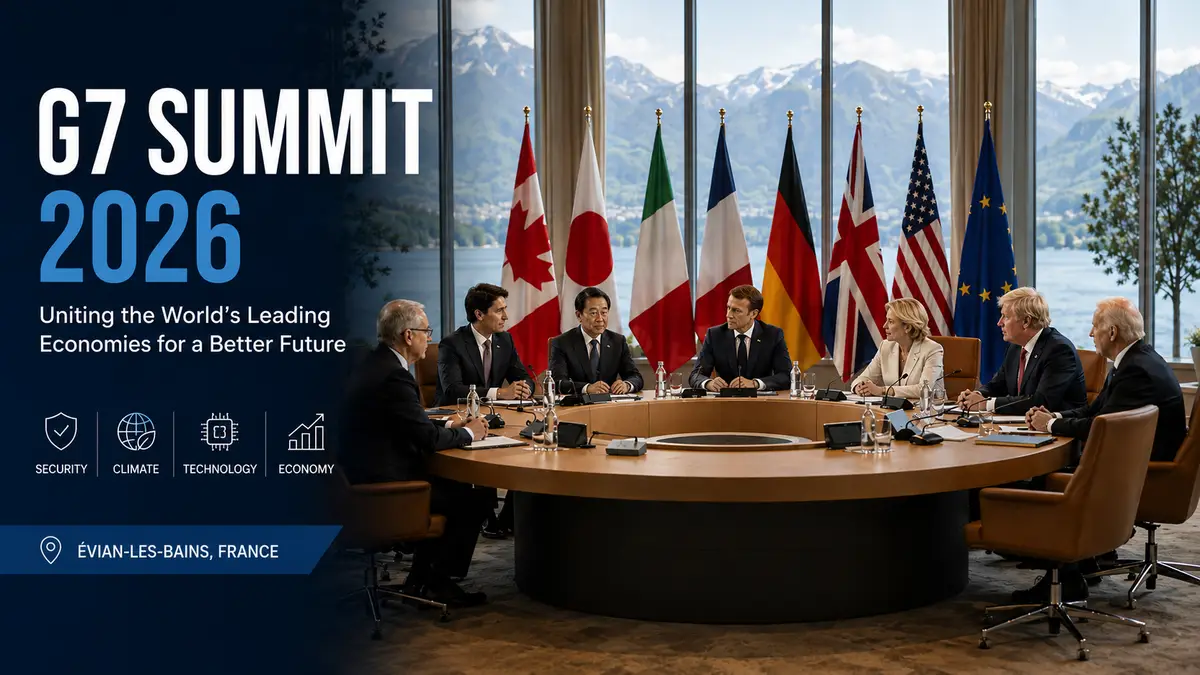
The 52nd G7 Summit - 2026 was held in Évian-les-Bains, France. The Summit happens over a span of three days. Since it is not a formal forum, the dates are not fixed. The place for the Summit is based on an annual rotation of the member countries, and when the host is available, the summit is conducted.
Mostly, the event takes place in May or June, citing good climate. The agenda is also laid down by the host country. The place decided for the summit is generally very secluded, keeping in line with the security of the leaders. However, some nations use places as per the significance of the agenda. For example: Japan chose to host the summit in Hiroshima to talk about peace.
What Is the G7?
While the letter ‘G’ stands for group, the number 7 is variable. It changes as per the addition or reduction of countries in the group. At present, the Group Of 7 [G7] consists of:
Canada
Japan
Italy
France
Germany
United Kingdom
United States
Other countries are not a part of the Summit, but they are invited to speak, with the European Union being majorly present for discussions every year.
Why Was the G7 Created?
Every traditional policy for governing the nations was rapidly failing with the onset of the 1970s. The global economy was at risk. The growth was stagnant. With the Arab Petroleum Exporting Countries refusing to give oil to the nations supporting Israel, the prices skyrocketed. Unemployment and inflation, which the leaders believed would not occur at the same time, happened at the same time.
Every nation had its own battles to fight. The government missteps gave rise to stagflation. That is why the G7 Summit was created. France, Germany, Italy, Japan, the United Kingdom, and the United States wanted to meet without the bureaucracy of larger organisations to discuss about urgent global issues.
From 15-17th November, 1975, the first summit with these 6 nations was held. Canada joined in 1976, making it the G7 from G6. Over time, the issues regarding security, climate change, technology and international crises also found their way into the conversations. Briefly, the G7 also became the G8. Russia joined in 1998. By 2014, Russia was suspended from the group because of the annexation of Crimea. It has since been G7 again.
How Does The G7 Work?
Unlike the United Nations or the World Bank, the G7 Summit does not work with legally binding rules, laws or contracts. They have no headquarters. Everything is merely based on discussions within the world’s most advanced economies.
Annual Rotating Presidency
The G7 summit does not have a permanent head. Every year, one nation gets to be the president. The role of that leader is to:
Finalise what matters and agenda needs attention on
Organise meetings regarding these agenda items with concerned ministers throughout the year
Invite guest countries and international organisations
Host the leader’s summit that we widely see
Meetings Throughout The Year
Contrary to what we see on Instagram and News Channels, the G7 Summit is not just a three-day affair; it goes on throughout the year. Leaders from all the nations, their government officers and concerned ministers have meetings to discuss global issues like:
Financial & Economic Policies
Foreign Trades and Affairs
Climate Changes
Health
Energy Crisis
Technology & Development
These meetings ensure that everyone has the same interests and make it easier to give joint statements.
Joint Statements
After the end of each summit, the leaders issue a joint statement. They talk about:
Priorities
Policies & Commitments
Solutions to Global Crisis
Future fields for cooperation.
G7 vs G20: What's the Difference?
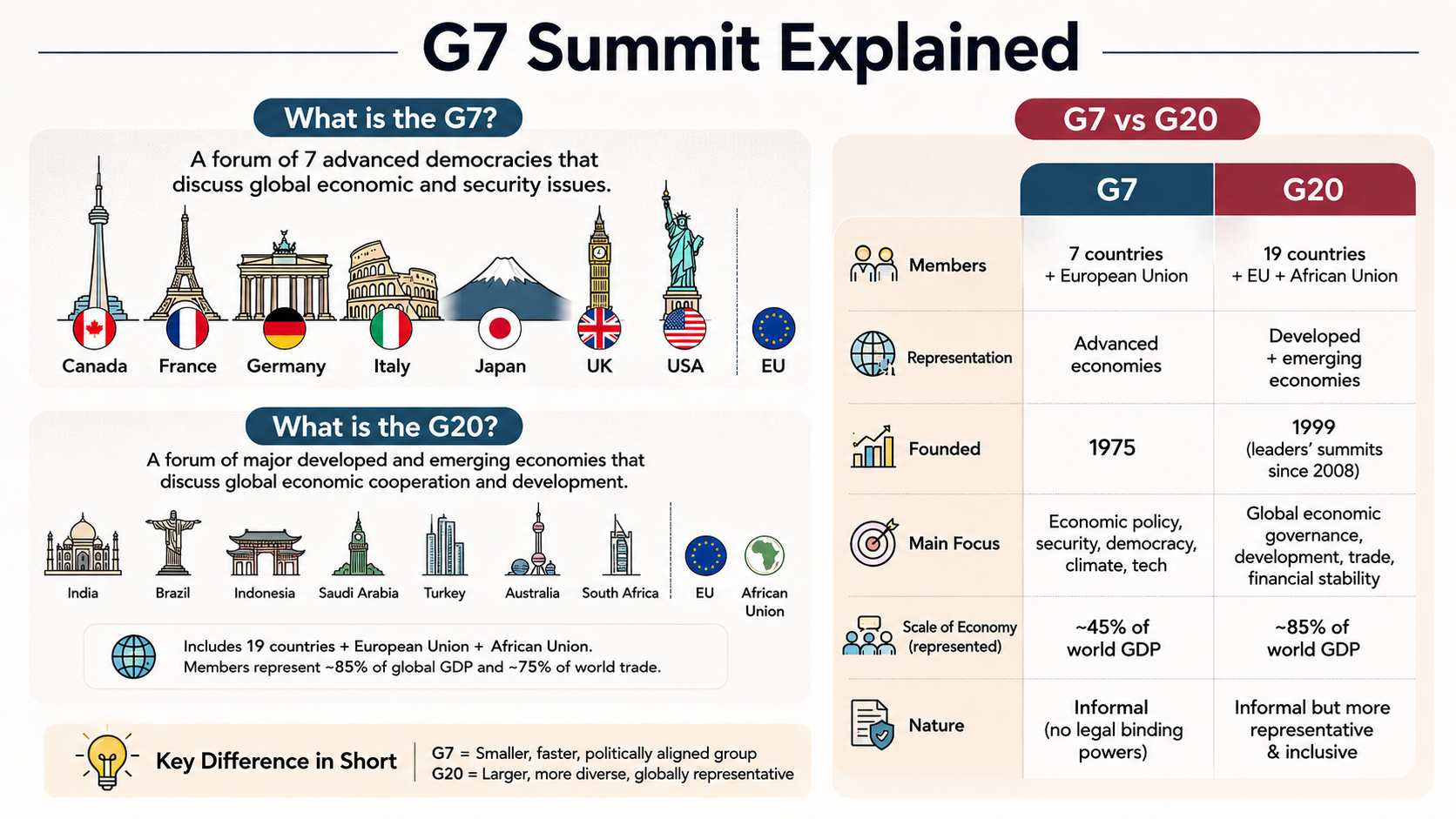
Image Credits: AI-Generated
Major Outcomes of the 2026 G7 Summit
Under the leadership of Emmanuel Macron, the 52nd G7 summit was hosted in France. The first country to host the summit was also France. The following were the major outcomes of the summit:
Ukraine
The central agenda for the summit was ensuring more support for Ukraine. Ukraine president also participated in the discussion. The summit worked its way through to ensure more defence aid, expanding sanctions against Russia and even reaffirmed their support for Ukraine's territorial integrity and sovereignty.
China
Another significant point was becoming less dependent on China for resources such as lithium and nickel. The summit stands united for the creation of an initiative for more minerals that are critical for electric vehicles and defence systems. The primary supplier at the moment is China. With the geopolitical crisis, it is only apt to have multiple sources of all scarce resources. The nations decided to stockpile, implement better investment strategies in mining and recycling, supply chain monitoring and collaborate with the International Energy Agency.
Artificial Intelligence
AI and its increasing use in every field is not unknown to the leaders of the nation. It is rightfully a great aid to mankind, but it does come with a few cons. The agenda in the summit relating to AI was how to make it more secure. The trustworthiness needs improvement. There should be more accountability. The summit also discussed economic opportunities and energy demands of AI.
Security & Supply
The geopolitical crisis coming in because of the Russia-Ukraine War was an eye-opener. It is very difficult for nations to rely on one supply chain for significant resources. Economic security, risks associated with excessive dependency on a single nation, and regional stability in the Middle East are a few other things that were discussed in the summit.
India's Participation at the G7 Summit
Even though India is not a member of the G7 Summit, it has been invited to the event 12 times to discuss global issues. For most of the time, it was invited as a special guest and sometimes as an outreach partner.
The first invite went under the leadership of Atal Bihari Vajpayee in 2003, and then for a few years from 2005-2009 under the leadership of Dr Manmohan Singh. From 2019-2026, India has been invited under the leadership of PM Narendra Modi.
These invitations highlight India’s positioning in the global supply chains and partnerships for technology, energy security and international diplomacy.
Criticisms and Future of the G7
Nations forming the G7 contribute a significant share of Global GDP. They shape decisions for trade, innovations and defence budgets. Despite all major economies not being included, it still affects the following sectors:
Global financial markets
International sanctions
Climate commitments
Supply chain policies
Artificial Intelligence governance
Energy Security
And because of these, the summit is criticised as they exclude major economies, lacks legally binded enforcements and often gets perceived as Western-centric.
Even then, the G7 summit can be looked at as a boardroom meeting for the most influential economies in the world. And the consensual decisions that come out of that meeting will continue to shape major decisions globally.