
Getting a driving licence in India could soon involve a few more steps, but the process may also become easier in certain areas. The Ministry of Road Transport and Highways (MoRTH) has proposed a series of changes to the country's driving licence rules, ranging from separate colour schemes for Indian and foreign nationals to a higher passing score for learner drivers. The draft also looks at the documents applicants need to submit, the personal information printed on licences and the fees charged for online services.
For millions of Indians who apply for, renew or update their driving licences every year, these changes could make a noticeable difference. While some proposals focus on road safety and preventing document fraud, others aim to reduce paperwork and make government services more accessible. Here is a closer look at what the government wants to change and what it could mean for motorists.
Indian and Foreign Nationals May Get Different Colour-Coded Driving Licences
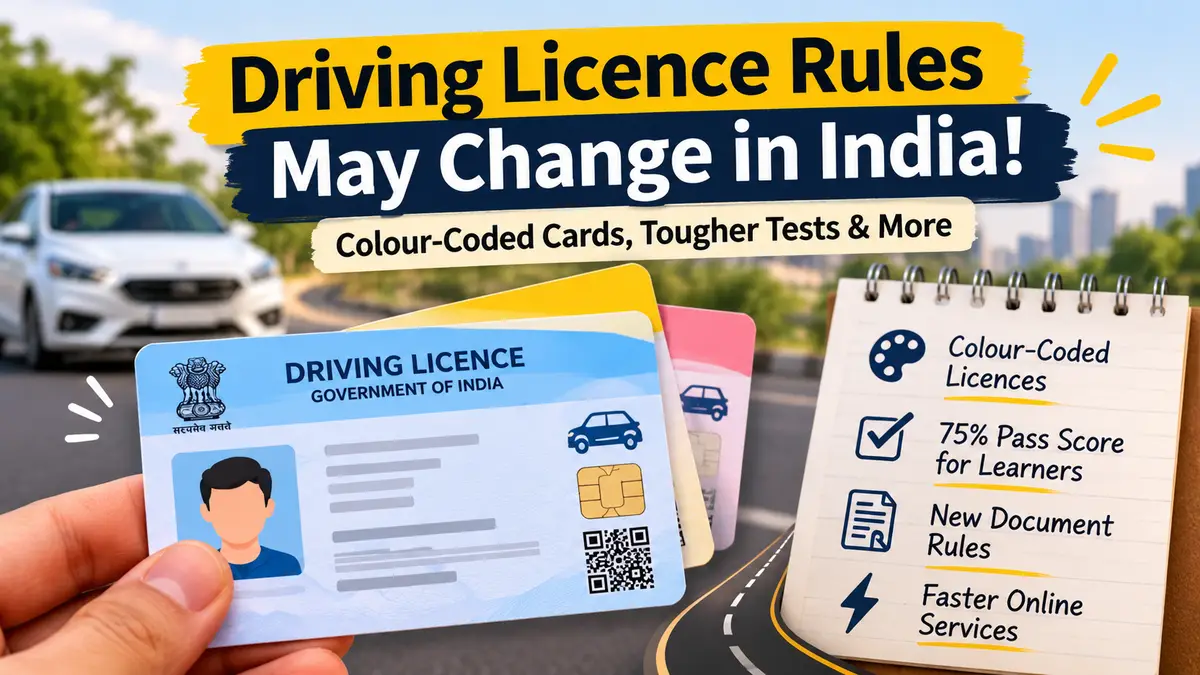
One of the more noticeable proposals is the introduction of separate driving licence formats for Indian citizens and foreign nationals. Under the draft amendments, licences issued or renewed by licensing authorities would follow different colour schemes depending on the nationality of the holder. The cards would be issued in a laminated or Polyvinyl Chloride (PVC) format under Form 7, with nationality also appearing among the details displayed on the licence. The idea is to make the two categories easier to distinguish through their appearance and printed information. The proposed licence format also brings changes to the information carried on the card. Apart from the holder's name, photograph and other identification details, the government wants to make blood group, mobile number and emergency contact information mandatory.
Another important change concerns the existing machine-readable zone. The draft proposes replacing it with a QR code-readable zone, which could hold additional information about the licence holder. The proposed fields include medical information, allergies, medication details, organ-donor status and records relating to driving disqualifications.
These additions could be useful during emergencies, particularly when a road accident victim is unable to communicate. Emergency contact details and relevant medical information could help responders obtain important information more quickly. However, the inclusion of personal and medical information also makes data protection and access to such details important considerations.
Learner Drivers May Face a Tougher Assessment
Getting a learner's licence could become slightly more demanding if the proposed assessment changes are approved. The ministry wants to increase the qualifying score for the online safe-driving tutorial assessment from the existing 60% to 75%. For example, someone who previously needed to answer 12 out of 20 questions correctly would now need to get at least 15 right, assuming the assessment uses 20 questions.
The draft also proposes making the safe-driving tutorial at least 30 minutes long. Currently, applicants have seven days to complete the tutorial, but the proposed amendments would extend this period to 15 days. The assessment would cover important aspects of road safety, including traffic signs, driving rules and a motorist's responsibilities after an accident.
The higher passing score is intended to ensure that new drivers have a better understanding of road regulations before getting behind the wheel. It also puts greater emphasis on learning traffic rules rather than treating the learner's licence process as just another online formality. For someone applying for their first licence, this means spending more time understanding road signs, traffic signals, right-of-way rules and safe driving practices instead of simply preparing to clear an assessment.

Changes to Documents Required for a Driving Licence
Another significant part of the proposal concerns the documents applicants can submit as proof of identity, age and address. The draft seeks to revise the existing list of acceptable documents and remove the provision that allows certain affidavits sworn before a magistrate or notary to be used as supporting evidence. Life insurance policies are also proposed to be removed from the accepted list. Instead, applicants would have to rely on documents that can be independently verified. These include Aadhaar cards, passports, voter identity cards, e-ration cards and government-issued identity documents.
For proof of age, the proposed list includes passports, birth certificates and mark sheets or certificates issued by recognised educational boards, universities and institutions. Electricity and household gas bills not older than three months would also be accepted as proof of address. Foreign nationals applying for a driving licence in India would additionally need to provide proof of their legal presence in the country, along with residence documents.
The proposed changes are aimed at reducing the possibility of incorrect information entering the licensing system. They could also make document verification more consistent across licensing authorities. However, applicants who do not have Aadhaar or other commonly used identity documents may need to check the revised list carefully before submitting an application.
Online Licence Services Could Become Cheaper and Faster
While some proposed changes make the assessment process stricter, the government is also looking at reducing the inconvenience associated with licence-related paperwork. Under the draft, selected online driving licence services completed through Aadhaar authentication would be exempt from fees. The ministry has also proposed removing charges for changing personal details, including the holder's name and address.
At present, changing certain particulars on a driving licence generally involves a fee of ₹200. If the proposal is approved, applicants could save this amount when requesting eligible changes. The draft also introduces a fixed timeline for processing applications. Licensing authorities would have to approve or reject applications to change driving licence details within 15 days. If an application is rejected, the authority would have to provide the reason.
There is another useful provision for people shifting homes. If an application for an address change remains undecided for 30 days, it would be treated as approved under the proposed rules. The amendments also propose bringing several licence-related services together through a new Form 2A, covering applications such as renewal, duplicate licences, addition of vehicle categories and changes to personal details. For motorists who have previously spent weeks following up with transport offices for relatively small corrections, these changes could make the process considerably less frustrating.
What Happens Next?
The proposed amendments are part of a larger effort to update the Central Motor Vehicles Rules, 1989. Apart from the changes that have received attention, the draft also includes provisions concerning the automatic removal of permanently surrendered vehicle categories from a licence within seven days of an application. A person surrendering a vehicle category would also face a one-year restriction on obtaining a licence for that same category. The draft notification was published in the Gazette of India on October 21, 2026, inviting objections and suggestions from the public within 30 days. The government will consider the feedback before deciding on the final amendments.
For existing licence holders, there is no immediate reason to apply for a new card or change any details simply because of this announcement. The proposed formats and requirements will become applicable only after the amendments are finalised and officially notified. If approved, the changes could make driving licences more informative, improve the verification of applicants and encourage better awareness of road safety. At the same time, the proposed inclusion of additional personal and medical information will require careful handling.
A driving licence is more than a document that allows someone to operate a vehicle. It is also an important identity and regulatory document. The proposed changes suggest that the government wants it to serve that purpose more effectively, while making the application and updating process less cumbersome for motorists.