


What is market research?
Starting any business without market research is like shooting an arrow without knowing where the target is.
To sustain, survive or grow in any industry, every business requires strong market research. Market research is basically gathering comprehensive data on potential customers, buyers, and rival companies. The analysis of this data helps a company bridge the gap between demand and supply. It makes one aware of the prices, how much customers are willing to pay, and how other companies are handling the hurdles that come in the way.
By doing proper market research, any small or big company can effectively cut down various unnecessary costs. It directly affects the profitability of the company. There are four main types of research:
Primary research comprising new data
Secondary research comprising old data
Qualitative research comprising small groups analysing consumer behaviour
Quantitative research comprising large data collection groups
Why should you care about market research?
Market research is a shield against expensive business mistakes. For young and inexperienced individuals, market research helps in saving time, money and energy being spent on building things that no one might want. For entrepreneurs, market research can help in securing funds and saving capital. For influencers or content creators, market research helps in producing data that can establish valuation for sponsorships. For freelancers, market research can help in knowing the current market rates for the services they provide. For students, it helps in understanding what the future looks like in terms of degrees and jobs, and that enables them to make the right career decisions.
Why Is It Important To Do Market Research?
Market research came into existence in the 1920s. Over the years, people kept testing and gathering what consumers liked or disliked, what ads worked, and how people changed their spending habits. With all of that data, funnels and systems were built with trial-and-error methods to reduce risk to a business. The following are the main advantages of market research, which makes it a very important step in the growth and survival of a business:
Understanding the consumer: Market research helps in understanding the demand chain. The best way to grow any business is understanding the traits of the consumer, knowing what they want, when they want and how much they are willing to pay. This understanding makes it easier to develop products or services dedicated to catering to such consumers, yielding trust and monetary returns.
Tracks competitors: Market research not only gives you a clear picture of your business dynamics, but also gives you ideas about other people handling the same business as yours, that is, the competitors. Every business has its own way of dealing with downfalls. Market research helps not just with learning from your competitors but also helps in following good trends that they start or good ideas that they work on. It definitely gets good results.
Lowers risk: Market research is inevitably one of the most accurate sources to reduce risk factors in any business. By completely understanding the demand chain, organisations can know when or how many resources to use. This shortens wastage and time and energy both.
Step-By-Step Guide On How To Do Market Research
Before starting any small or big business of your own, follow these steps:
Define Your Goal:
Market research starts with asking yourself 3 basic questions. You first need to know what your target audience is. If you are willing to serve the younger generation, your products and services should align with the trends that they follow; if your products or services are for the elderly, you need to have campaigns that are suitable for that age group. The same applies to pricing. The second question is, what is the problem that you are trying to solve? Every product and service that you plan to sell through your business should be solving a local, national or global problem. Inventions without visions or no concrete reasons often end up failing in the long run. And thirdly, try to find one concrete reason as to why you want to do this. Every dream and business works, survives and grows with intention. Chasing a goal without knowing why you are chasing it is a great recipe for disaster.
Identify Your Audience:
Identifying your audience does not just involve knowing their age and gender. It involves knowing their needs, habits and buying behaviour. You can learn how to track your audience with the following steps.
Create business profiles of high-end/repeat customers and keep in touch with them.
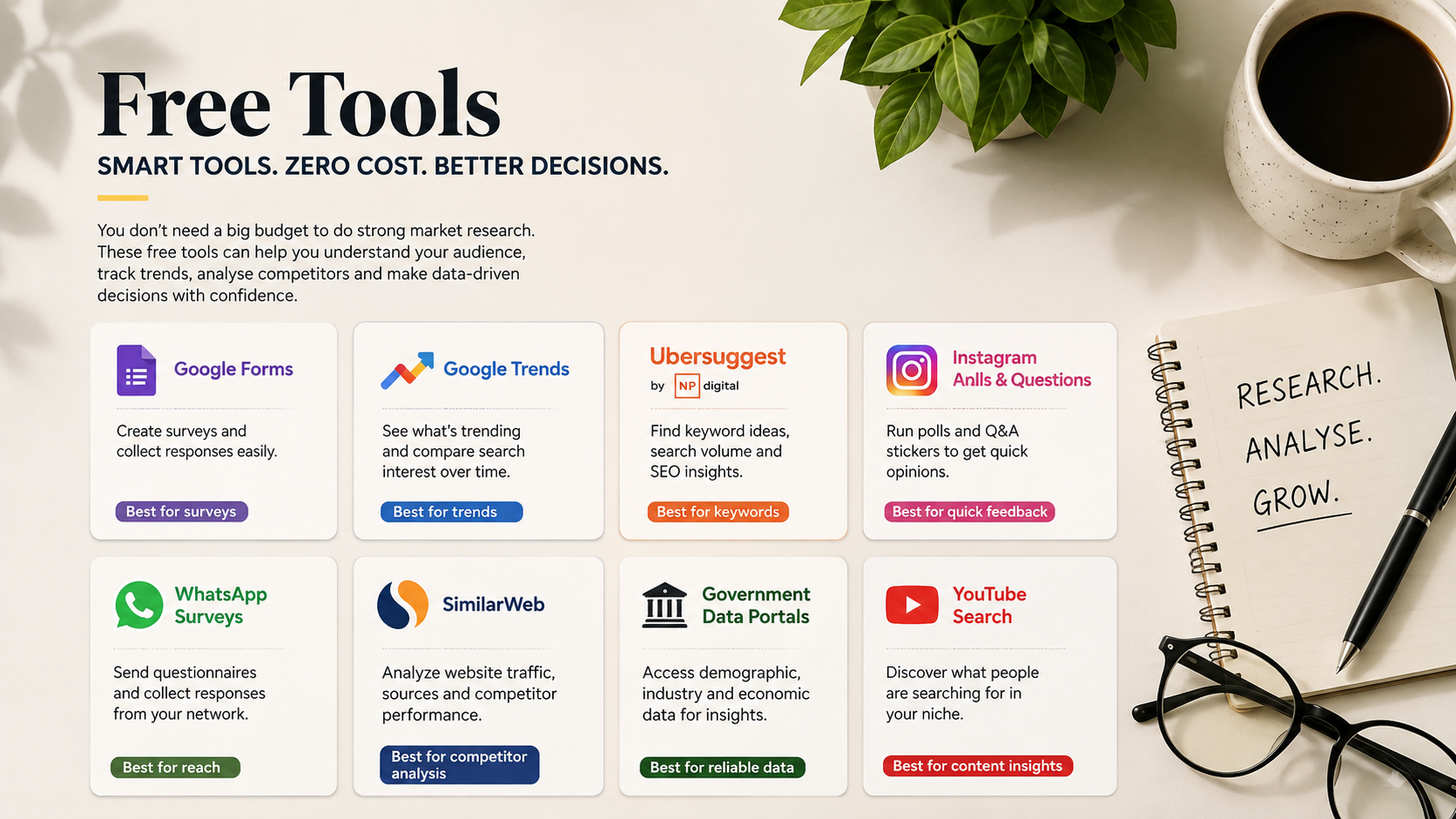
From time to time, create Google Forms and do short surveys on what people are looking for.
Use Instagram’s story poll and quizzes to ask them to choose from 1 or 2 products.
Interview customers and work on what they suggest
Check your competitive brands on other E-commerce platforms to see what their customers are saying
Study the reviews for directions on how to go forward
Knowing what the consumer wants, the problems they have, and the type of money they are willing to spend is the key to success.
Research Your Competitors
Take advantage of having healthy competition by knowing how your competitors work. Learn from their strategies, keep a check on where they go wrong and try avoiding the same mistakes.
Search marketplaces, Google, and Instagram for similar products.
Make a list of 5-10 direct competitors
Compare the prices, customer reviews, brand language and offers.
Track their social media
From these details, compare where your brand lacks. Use spreadsheets to make the process easier.
Collect Primary Data
Primary data collection is done through new customers in the following ways:
Use surveys via Google Forms
Instagram Story Polls
Whatsapp Questionnaires
One-on-one interviews with someone from the industry/customer
Test selling to a limited audience
This will ensure that you are completely aware of the current situation of the market.
Use Secondary Research
For good market research, it is also important to know about the situation and behaviour of consumption in the past. That is secondary research done through:
Google Trends helps in knowing whether a product is growing or declining
Government websites and reports for demographics and industry data
Industry reports to understand the market size
News websites for tracking customer behaviour
Search engines to know what people are actively searching for
This information exists online and saves a lot of time and energy.
Analyse What You Found
Getting 1,000 responses will be worthless if you don’t know what they mean. To make the best conclusion:
Put everything into a spreadsheet
Compare and segregate similar answers and data
Look for repeated problems or preferences
Compare what the customers say to what they actually buy
Identify everything in a pattern
Do not focus on one individual response
If a particular piece of data suggests that most people have an issue with the product/service being overpriced, it becomes more important for you to make an affordable decision, rather than an innovative one.
Test Before You Invest
The last step toward this is testing your product or service before putting in your entire budget. You can do that by:
Creating a sample product
Launching it for a limited time
Creating a social media page to gauge interest
Take pre-orders
Offering it to a limited audience/buyers and collecting their honest feedback
Everyone would say good things about your ideas, but the important thing is to discover if they would pay for it too.
Real-Time Examples Of Brands That Do Market Research
To understand this concept better, below are a few examples of brands that we come across in day-to-day lives who use amazing strategies to know and abide by what their consumers want. This is the reason why they have survived in the market for so long. Let’s have a look:
Starbucks: Starbucks have a loyalty reward programme, and they always do a limited edition check on a few customers before dropping a new item on their menu, based on their feedback.
Dove: For their beauty campaigns, they do global surveys for all skin types. These surveys promote self-esteem and are always purpose-driven, making the brand a household name.
LEGO: Conducted a global, multi-year ethnographic study of children playing to completely redesign its toy lines for girls.
Nike: Hosts exclusive focus groups with elite athletes and everyday runners to test shoe durability and style feedback.
Sephora: Tracks customer purchase history via its Beauty Insider program to send highly personalised product sample recommendations.
Last Word
While doing market research, do not fall prey to silly mistakes like:
Asking only friends
Using questions that can only be answered with good
Ignoring or being sensitive to negative feedback
Copying competitors from top to bottom
Failing to analyse the collected data accurately
To make any business decision, good market research is significant. Money is not the only factor for successfully growing a business. Your first step should be talking to real people, identifying their problems, going to the root cause and finding a solution to that. You can then see what competitors are doing/where they lack, what the audience is willing to pay and then develop a business plan. This will save you from wasting big budgets.