
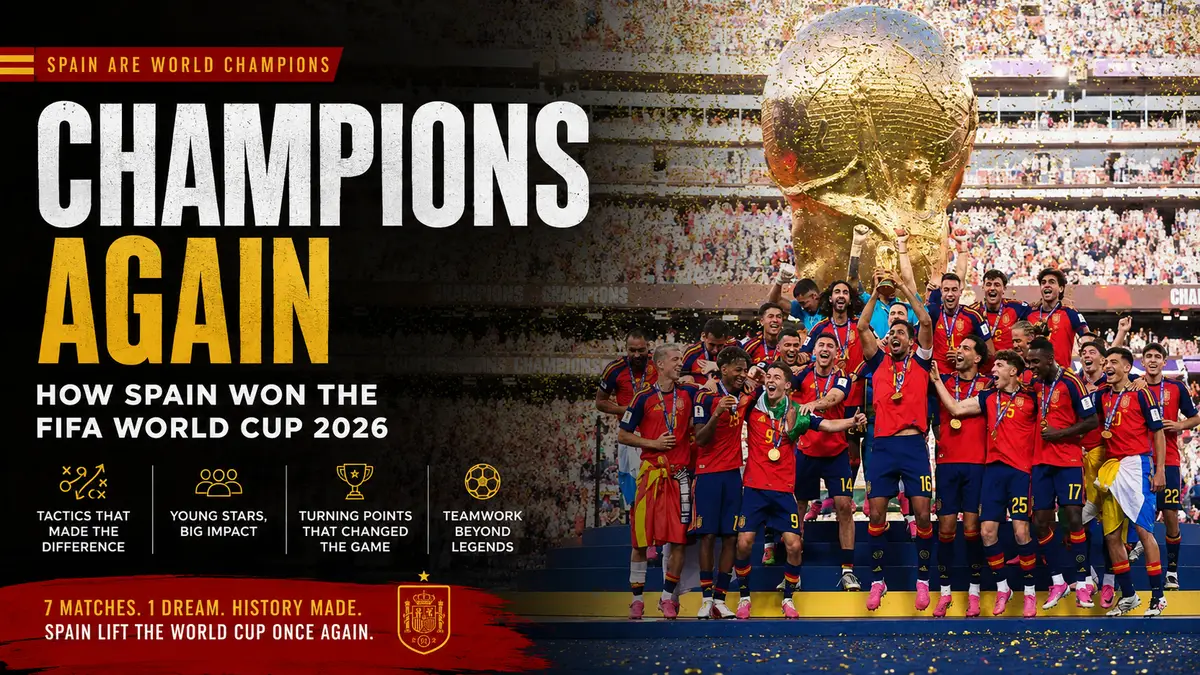
The 2026 FIFA (Fédération Internationale de Football Association) World Cup season has finally come to an end after a rigorous fight from 48 teams. Spain lifted the trophy for the second time, following a 15-year gap after their 2010 win against the Netherlands. The players, the determination, the memes, the goals, the tears and every nerve-biting moment for the past month are still registered in every football fan’s mind.
We often register wins as a one-match event. But this one was written with blood and sweat from years of determination and practice. Spain has given a new turn to how football is perceived by the world, going beyond a sport that is just remembered for Ronaldo and Messi.
The Road To The Final
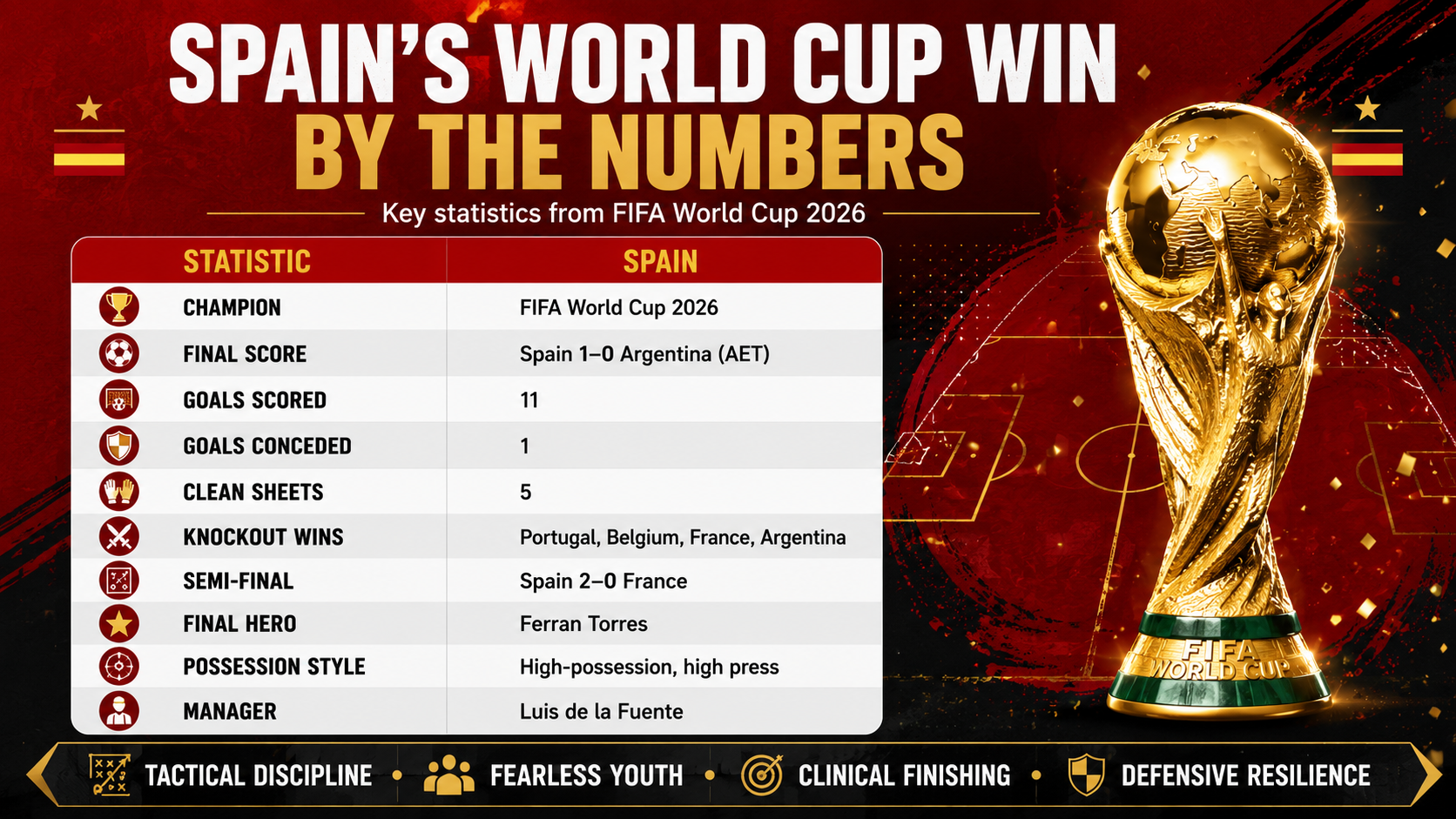
To reach the glory title, Spain had to play a total of 7 matches.
Group H (3 matches): Spain played against Saudi Arabia, Uruguay, and Cape Verde and topped the chart with 7 points.
Round of 32 (1 match): Spain played against Austria and secured a 3-0 win.
Round of 16 (1 match): Spain played against Portugal and secured a 1-0 win.
Quarterfinal (1 match): Spain played against Belgium and secured a 2-1 win.
Semifinal (1 match): Spain played against France and secured a 2-0 win
Final (1 match): Spain played against Argentina and secured a 1-0 win after extra time.
Why Was Spain Different?
Tactical Discipline
The defensive anchor Rodri held his ground and served as a primary block to move the opponents to non-threatening areas on the field.
The lethal attacks from teams like France and Argentina were waved off by organised central defenders, and discipline was maintained throughout the match by fullbacks, unlike the ones that get pinned high up on the pitch.
Players like Yamal and Olmo were well utilised for rotations on wings that stretched the opposition centre-backs, created crossing opportunities and opened up half-spaces.
They blocked from the front in a unified set-up rather than pressuring individual defences.
It was a team effort, everyone maintaining their own format and discipline instead of a leader leading the whole pact.
Young Stars Stepping Up
Lamine Yamal
As destiny would have it, a child who was once bathed by Lionel Messi in a charity photoshoot beat him to hold the World Cup. Lamine Yamal was 7 when he started playing, and at 19, he is already a part of the 2-time world cup winning team. He scored a goal against Saudi Arabia, won the decisive penalty in the semi-finals, and logged 44 accurate passes in the final. His performance at this age, in contrast with the players who have been in the sport for years now, just shows that football is in great hands for the future.
Nico Williams
In the final moments of the World Cup match, Nico Williams provided the assist on the final winning goal against Argentina. He is a promising player recognised for his speed and dribbling skills. He is now under a € 95 million contract with the Athletic Club for 10 years. He is loyal to Bilbao despite multiple transfer interests.
Pau Curbarsi
Pau received the best young player award in the FIFA World Cup 2026. Despite his age, he has contributed massively to Spain’s win against Argentina this season. He aided with 46 defensive contributions, 31 clearances and 7 clean sheets in 8 matches. He is one of the strongest players being considered for both the Barcelona and Spanish national teams.
Ferran Torres
Ferran Toress was the key player in the final played by Spain against Argentina. He was the one who scored the winning goal in extra time. He is likely to be offered a better contract by Barcelona following his outstanding performance this season. His goal in the 106th minute of the match was not just a lucky moment but the result of years of determination and hard work put into practice.
Rodri
Rodri is one of the only 11 men to win the World Cup, the Ballon d'Or, and the UEFA Champions League. He is considered one of the greatest defensive midfielders. As the captain, he led Spain to win its second World Cup title. He made 41 defensive contributions and maintained a 93.2% pass accuracy rate. In the final minutes of the game, he was a guiding force for the team. He won his first World Cup Golden Ball.
The other players of the team contributed equally to the historic win. The veterans brought experience and guided the team in crisis management, while the new talent brought energy and pace. The combination of such teams is a delight to watch and inspires the generations to come.
The Final: A Battle of Two Eras
Messi’s Experience
The heartbreaking 1- 0 defeat to Spain led to tears in Lionel’s eyes. The moment was very emotional. This season was, either way, very fruitful for him. The 39-year-old player set a personal record of scoring 17 goals in the tournament, which was later broken by Mbappé. Throughout the tournament, 8 goals and provided 4 assists. His contributions this season also include being a catalyst in Argentina’s dramatic 2-1 comeback win against England in the semi-final, providing 2 crucial assists after going behind.
Spain’s Relentless Pressing
Spain was not relying on one player for any of the matches they played. They relied on the discipline of every player. The relentless pressing from all directions made the opposition weaker instead of just targeting one. They had suffocating midfield control, aggressive counter-pressing immediately after losing the ball, also known as gegenpressing and high defensive lines. This left the opponents with virtually zero shots on target. They also had a collective forward movement press from the front, forcing defenders from the opposite team into rushed clearances or long balls that are easily mopped up by centre-backs like Aymeric Laporte.
Argentina Defending Deep
Owing to Spain’s renowned possession-based style, the Argentina team counteracted it with a deep defensive shape to limit the space that Spain had to play through balls into dangerous areas. The compacted central areas forced the players to either take long shots or rely on crosses. This technique, however, put their forwards in isolation with no attacking presence and very few shots on goal. Due to late-game fatigue and persistent pressure, the defensive system eventually broke down, leading to their loss in the final against Spain in the FIFA World Cup 2026.
Ferran Torres Extra Time Winner
He came off the bench as a 62nd-minute substitute. The match was 0-0 after the game ended. The coach brought him in for some fresh energy in the game, and that is exactly what he delivered. Nico Williams was the assist, and as soon as he leapt the ball high and gave it a header knock back into the penalty box of the field. The ball landed to an unmarked Ferran Torres, who then kicked the ball right into the net with his left foot, right past the diving goalkeeper and two defenders.
Passing Of The Torch From One Generation To Another
In the final moments of the game, Argentina’s veteran players struggled hard to keep up with the energy and pace of the young players of Spain. It was evident in their game. Lionel Messi, playing at the age of 39, has played football for over two decades. The players playing against him in the World Cup were mere Toddlers when he started the journey, infact they idolised him. This game by Spain was a clear example to benchmark that football was no longer going to be defined by pro players. The game was now going to be in the hands of new generations. In his final moments on the field, Lionel was seen on his knees staring into space with tears in his eyes, while Spain celebrated. He was hugged by the young chaps from Spain; they bid him a good farewell. He showed great sportsmanship by congratulating the young stars too.
Statistics That Tell The Story
What This Means For World Football
Spain’s team haven’t just lifted the trophy; they have changed how other football teams will prepare for success in the coming decade. They have made it very clear by setting an example that experience is not the only key to being at the top. Their tactical intelligence, relentless spirit, energy, determination and the ability to keep fighting till the last moment will carve a path for the coming generations. They have dignified the importance of player development, adaptability and long-term planning.