Sports in India have a second name: Cricket. For decades, Indian sports have been defined by Sachin Tendulkar, cricket and a few other prominent players. Many other sports were played in the country, but neither the recognition nor the craze matched the love for cricket; for some people, it is a religion.
The scene, however, has broadened in the last few years. Young athletes have experimented and made their places in many of the lesser-known sports in the world, embarking on a journey to make India proud on every level. Apart from all the different forms and types of cricket matches, the indian sporting ecosystem has seen a considerable rise in the focus of the audience on sports involving women and kids.
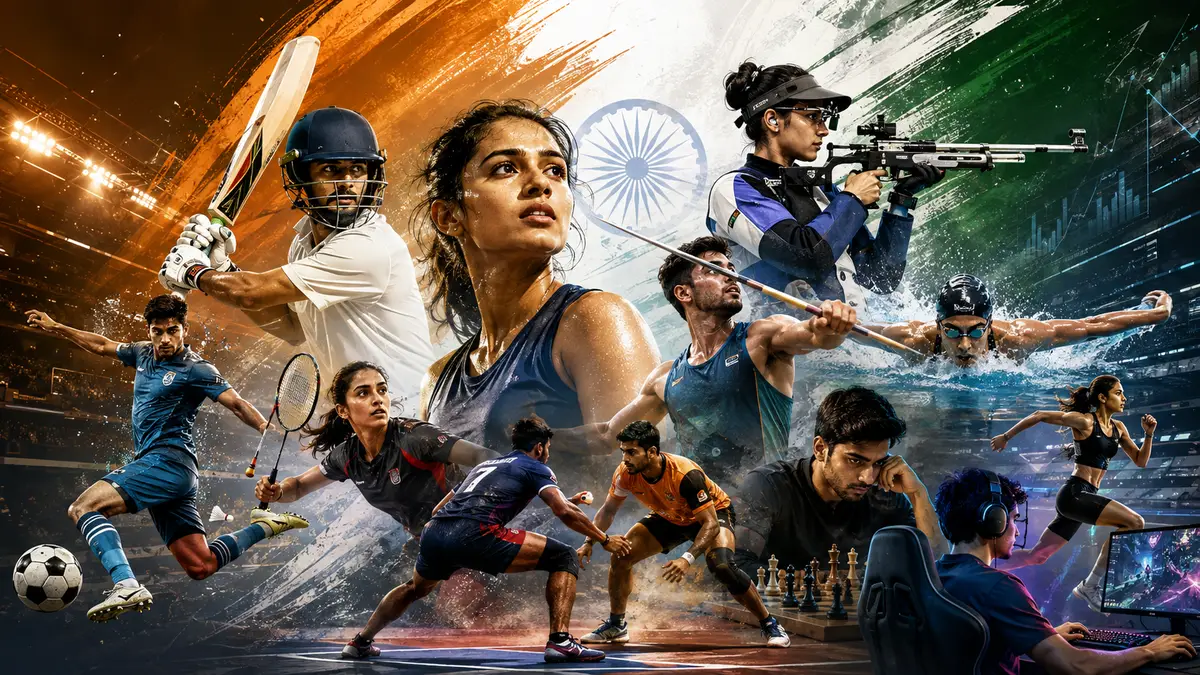
The spectrum has widened to include hockey, badminton, chess, kabaddi, swimming, squash, javelin throw, long jump and much more. In this article, we are going to have a look at the current sports situation, in light of National Sports Day 2026, celebrated every year on August 29.
Cricket Still Rules — But the Sporting Conversation Is Expanding
The viewership and revenue that cricket brings are insane. There is no second thought to it. No matter how big or small the match is, no matter who is playing, cricket brings sure-shot viewership and revenue.
Instead of competing with cricket or reducing any form of progress coming from the sport, the modern Indian system is focused on making other sports reach the same level. They are doing this in the following ways:
More professional leagues: To provide a professional platform for other sports, franchise models are now being created for kabaddi, badminton, hockey, football and others.
Greater visibility for Olympic sports: With technological advancements, global achievements in wrestling, shooting, boxing, etc, have been put into the spotlight.
Increased sports infrastructure: Not just in metropolitan hubs but even in two-tier cities, stadiums and sports arenas are being built to enhance and motivate the younger generation. The government schemes and initiatives play a major role in making this happen.
Private academies: From childhood itself, kids start training through private academies for sports like tennis, swimming or basketball.
Corporate sponsorships: Apart from cricket, brands are diversifying their marketing by promoting other sports as well.
Growing interest among young athletes: Sports are not just looked at as a hobby; parents are allowing children to explore their interests and participate in multiple sports, unlike before.
Sports Science & Performance Technology: To improve athlete health and maximise their output, recovery labs, GPS tracking and data analytics are taken into consideration.
Which Sports Are Growing Other Than Cricket?
The sports landscape has many veteran players, but the monetary sponsorships and popularity came much later. Since the awareness of many sports was negligible, it was not possible to fund them. The government didn’t support it much either. But with the power of media, social media and the experimental generation, many sports have gained prominence in the Indian Sports scenario. Let's have a look:
Badminton:
After cricket, badminton is the second most popularly played sport in India. Unlike other sports, badminton requires minimal basic setup. Prominent players like Saina Nehwal and P V Sindhu made India proud, representing the nation on the global stage. It has also changed public perception of the sport as a career option.
Facilities have expanded across the nation through government initiatives, schemes, programmes, and Prakash Padukone’s own contributions. Cities like Bengaluru, Pune, Hyderabad, and Mumbai have seen a considerable rise in the growth of badminton arenas, joining elite clubs like Guwahati’s National Centre of Excellence.
The financial visibility required for commercialisation is developed by the Badminton Association of India through professional leagues and targeted funding. In addition to this, India has made its mark as it is now going to host 4 BWF World Tour Tournaments annually. This year, it was conducted in New Delhi after a 17-year gap. Corporate hubs and offices are also building arenas for employees to play badminton for their health and team building.
Kabaddi:
To think that a sport played in the villages of India in mud as a pastime would one day be a multi-crore commercial asset is truly fascinating. Kabaddi is the second largest show watched on TV and digital platforms after cricket in India. It is a high-octane sport.
Kabaddi has gained massive popularity because, unlike other sports, it has a domestic fanbase and audience in tier 2 and tier 3 locations. It is in direct competition with FIFA when it comes to viewership. The opening nights and matches of the Pro Kabaddi League [PKL] are reasonably popular amongst viewers.
Even though Kabaddi only attracts one-third of the viewership as the Indian Premier League [IPL], the costing id one-tenth. This attracts a lot of big names for sponsorship. For a 3-month tournament window, commercial contracts are worth more than 2 crores for several seasonal/international players.
World Super Kabaddi League [WSKL] is bringing together 20 nations to form a standard rule set. It may soon be an Olympic sport as well, following Iran’s performance that shook India in the Asian Games. Meaning, new countries are also joining in and loving the sport.
Football:
Another of India’s most-watched sports, football has found a permanent place in the hearts of millions of Indians. It is a dual-income sport, where the passion for international events surpasses the one for domestic leagues.
The international viewership for the Premier League has gotten huge in the past few years. Contributing to a massive 25% viewership, it is coming from tier 2 cities like Rajasthan, Bihar, Jharkhand, and Uttar Pradesh, which have doubled their viewership share. During the FIFA World Cup this year, the peak viewership happened between 12:00 AM and 4:00 AM at night, showing the dedication of the Indian fanbase.
In tier 2 cities, domestic matches have created quite the stir. Kerala once recorded 22000 spectators. Smaller non-IPL cities like Jamshedpur and Kochi have taken full advantage to promote this sport in their cities. In addition to that, the India Super League [ISL] is the 12th most-watched sports league globally. For grassroots programmes, organisations like Reliance Foundation Development League [RFDL] are training players through academics and tournaments.
Hockey
The word hockey rings a bell in our minds. And a synonym for it is the name Major Dhyan Chand. Hockey has been an integrated part of the Indian Sports Ecosystem. During 1928 - 1956, India won six consecutive Olympic gold medals, a total of 8, with 1 silver and 4 bronze.
But with the transition from natural grass to artificial turf, the game got tougher. The men's hockey team last won the World Cup in 1975 and a gold medal at the Olympic Games in Moscow in 1980. After which, a 41-year drought was broken by the Tokyo 2020 and Paris 2024 Olympic Games.
The teams are managed by Hockey India and receive consistent Government funding. Both men's and women's hockey teams have consistently climbed back up to 4-5th position consistently maintained. For domestic and international players, high-intensity match exposure and financial stability came from reviving franchise setups like the Hockey India League. Younger players are being found from non-metropolitan cities by sub-junior and junior championships.
Weightlifting, Wrestling, Shooting and Boxing
Apart from the said sports, the Olympic medal aspirations are led by weightlifting, wrestling, shooting, boxing and many other sports. India has delivered in every field. Prominent names in every category have made the Indian Sports Ecosystem go from just cricket to several other sports, inspiring children to build careers around these.
Programs like Target Olympic Podium Scheme [TOPS] prove to be a backbone for promising athletes by giving them the required training support and financial backing. India has also been performing well at the Commonwealth Games, securing 4th position this year. Other sports like swimming, archery, and chess have also seen contributions from Indian players on the global stage.
Khelo India Is Changing The Grassroots Pipeline
The initiative of forming the Khelo India organisation by the government is one of the main reasons why every sport is emerging in the nation with new talent. The initiative ends decades of mismanagement and mess in the system. The strategy is simple:
School → District → State → Khelo India → National level → International competition
Grassroots participation is the key to finding raw and natural talent which seldom makes it to noticeable boards. This programme works on finding the talent, training them, funding them, making good infrastructure for them, hosting games for them and focusing on the tribal games for their growth too.
Every year, different cities in India get to host games on different dates. The government has sanctioned ₹22 crore for the 8th Khelo India Youth Games. This will give India a better chance at participation in international games. It also encourages the youth to look at sports as a career and not just a hobby.
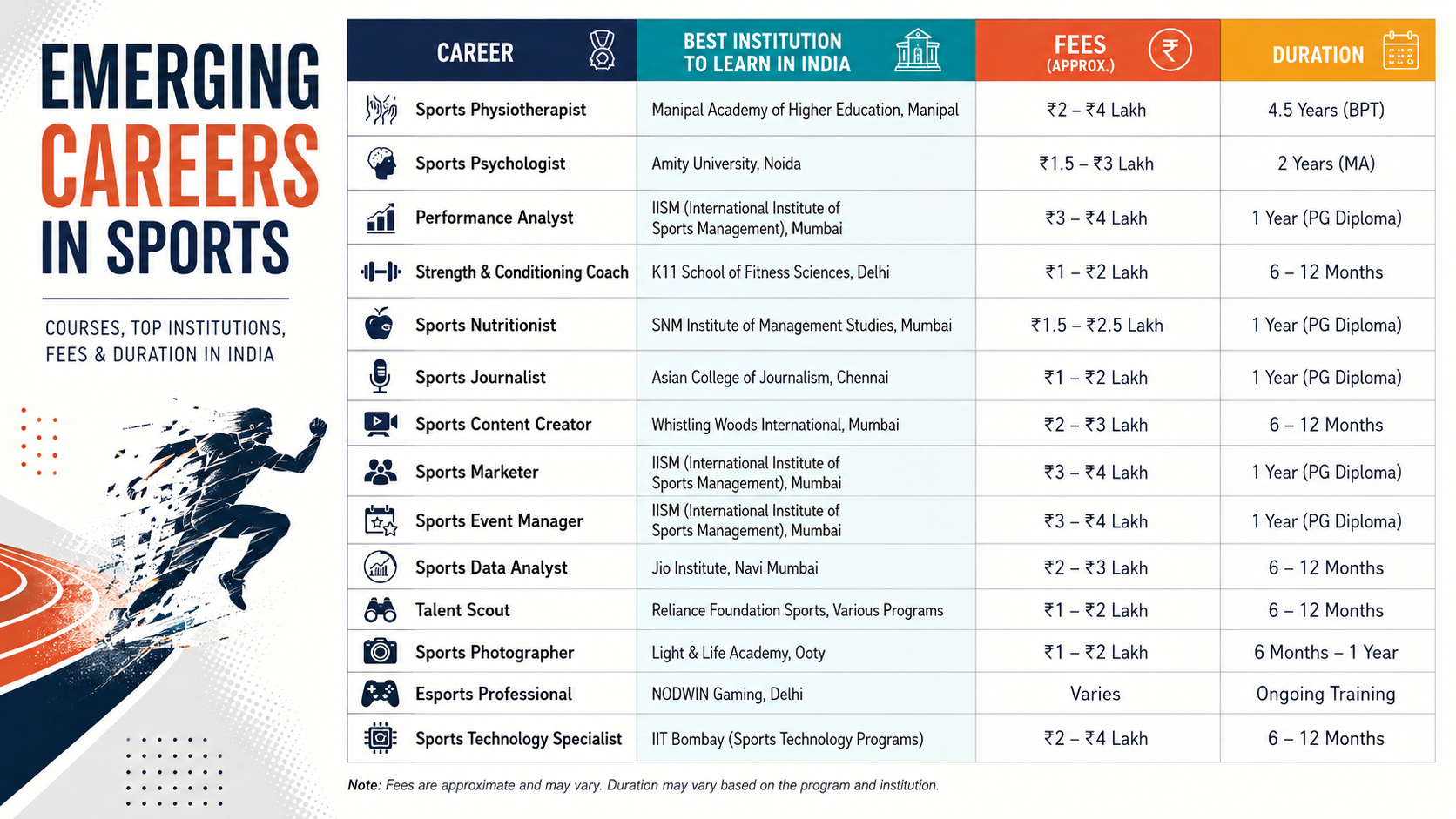
List Of Emerging Careers In This Field
Taking Forward
The future probably isn't:
Cricket → decline → another sport takes over
Instead:
Cricket + Olympic sports + indigenous sports + emerging sports + technology + professional leagues
Technology is changing how athletes and sports personalities train. There is video analysis for matches, wearable technology for athletes to monitor health, data analytics help with performance tracking, AI-assisted coaching, sports medicine, recovery monitoring and biochemical analysis. This ensures better training and performance on all levels, helping athletes give their best.
Women in sports are also stirring a great conversation. Tennis, badminton, cricket, hockey, badminton, boxing, wrestling, athletics and weightlifting are all sports where women have dedicatedly trained and made a place for themselves with hard work, making the nation proud.
India’s strategy is not just producing/funding sports persons. It is building an ecosystem to host international sporting events through incredible infrastructure. Through programmes like Khelo India, they are aiming to be a leading sports nation by tackling problems like unequal infrastructure, coaching quality, financial sustainability, and athletic welfare.
India's next sporting revolution won't be about replacing cricket. It will be about giving every other sport a bigger place in the story. It will not be done through changes inside the stadium but through small changes like those on the school ground, local academies and neighbourhood courts where people start believing that they can be the person playing the sport and not just a spectator.