
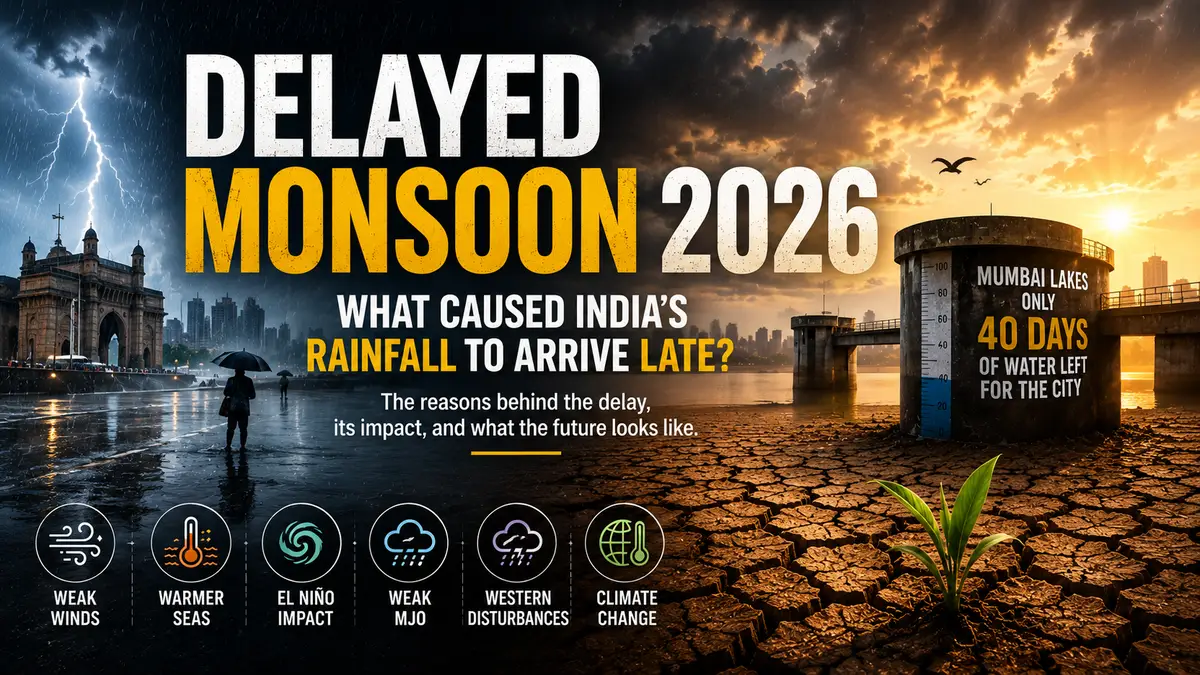
Mumbai lakes only have 40-days of water left for the city.
A news headline that got everyone in panic mode. For Indians, especially in the south-west region, monsoons are not just a weather condition. It is an emotion. And the delayed arrival of the monsoon quickly puts crop yields, water availability, electricity generation, and food pricing in jeopardy.
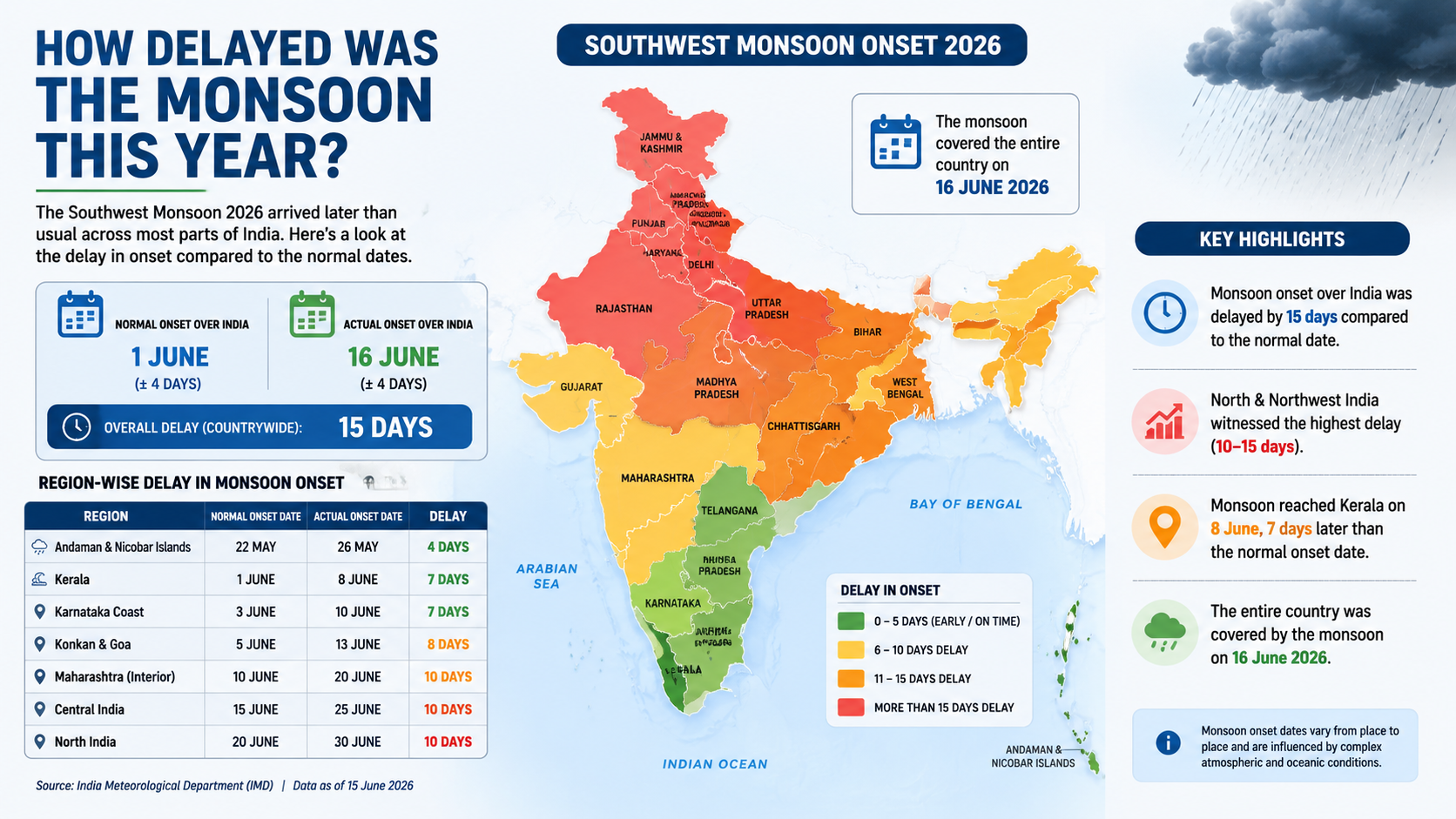
Every year, the onset of June marks the onset of the monsoon in Kerala. This year, it was delayed by 2 days. In several parts of Maharashtra, including Mumbai and Pune, the monsoon's advance slowed significantly, delaying it by nearly two weeks in some areas. What caused this delay, and what effects does this delay bring?
Why Is The South-West Monsoon Important?
The monsoons in the south-west and south-east regions are more significant because they account for the region's major water requirements. Vital Kharif crops require timely rainfall. Nearly 50% of the net sown area in the nation thrives on rainwater. Agriculture is said to be the backbone of the country’s economy.
Delayed rainfall often gives rise to food inflation and price rises that can affect the rural population. The overall GDP is negatively affected because of this. Furthermore, these rains are significant for winter irrigation. They recharge the reservoirs, groundwater tables and lakes, from which the water supply goes for drinking purposes.
Hydroelectric plants work when heavy monsoon rains fill the catchment areas. This energy generation can reduce the usage of coal and thermal power, whereas weak monsoons can create challenges with the energy and power grid. So, a delay in monsoons directly affects the overall functioning of rural and urban areas.
How Delayed Was The Monsoon This Year?
Main Reasons Behind The Delay
Climate change has been a persistent problem all around the world. The early or late arrival of monsoons can cause damage. The delayed monsoons in India this year happened because of the following reasons:
Weak Cross-Equatorial Winds
Monsoons depend on moisture-laden winds. For India, they mainly come from the Arabian Sea, the Bay of Bengal and the Indian Ocean. The winds that blow from the southern hemisphere to the equator in the Indian subcontinent were weak this year because of El Niño, and that caused the delayed monsoons in the country.
Unfavourable Sea Surface Temperature
The marine heatwaves over the Arabian Sea caused abnormal warming of the Indian Ocean, which caused a rise in temperature. With the southwest monsoon changing its route, stalling and moving to central India, there was no cooling period, no cloud cover, and increased dry spells. This caused a rise in ocean temperatures. A mysterious large patch of cooling water was discovered in the Atlantic, which caused further temperature changes. Along with that, since the monsoons were delayed, the excessive demand for irrigation reduced the groundwater levels and induced human-driven evaporation. This, in turn, raised the ocean temperature.
Emerging El Niño Conditions
El Niño is the phenomenon characterised by a rise in sea surface temperature, specifically in the central and eastern tropical Pacific Ocean, caused by westward-flowing winds along the equator towards the Pacific Ocean. These winds can cause a change in weather patterns. In this phenomenon, the winds can start flowing in a completely different direction. This might not be a particular reason, but on a smaller scale, it contributes to the delay of the southwest monsoons in India.
Weak Madden-Julian Oscillation [MJO]
Unlike El Niño, which is stationary, MJO is a moving phenomenon. It comes in two phases: active and suppressed. The active phase brings heavy rainfall, and the suppressed one brings clear skies and dry air. This year, the MJO’s phases were not supportive of widespread rainfall during the onset season, delaying the tropical monsoon.
Influence Of Western Disturbances
Western Disturbances are extra-tropical storms that are responsible for sudden winters, pre-monsoon rainfall and snow in the northern parts of the country. They should go inactive by March. But they didn’t. And that resulted in unseasonal heavy rainfall in certain parts of the country. They delayed the monsoon of 2026 by altering the moisture-laden winds and atmospheric pressure. It was like a tug of war between WDs and the southwest monsoon winds.
Increasing Weather Variability
The rise in ocean temperatures and changing atmospheric pressures has given rise to irregular monsoons. Scientists believe that this is due to the deteriorating health of the climate. While we can’t have one strong reason, this factor has made monsoons primarily erratic in South Asia.
Some people often confuse heat from war and weapons, contributing to these rising temperatures. They are not necessarily wrong. The rise in heat and temperature because of military activities accelerates global warming in the long run because they emit greenhouse gases, which in turn affect El Niño and eventually the monsoons. But the scale is wrong.
Scientists don’t affirm these theories because it is not possible to prove them. It is simply explained with this example: a cigarette causes air pollution, air pollution causes climate change, and climate change affects the weather. But you cannot conclude that one cigarette can cause a storm.
What Does The Future Look Like?
The profound impact of delayed monsoons and overall climate change is visible to all of us. The crop yield gets affected, and there is a delay in the sowing season. The water reservoirs are emptied, resulting in water shortages. A shortage of crops means a shortage of food. Food inflation occurs, and rural income is affected. There is an increase in cooling systems due to prolonged heat.
With these uncertainties, the IMD forecasts state that there is a 90% chance that we don’t receive normal levels of rainfall this year. Across the country, we might experience irregular rainfall, or maybe heavy rainfall towards the end of the season of June-September. To combat this, it is better to stay prepared.
As responsible citizens, we can make sure that we contribute to making monsoons better. A little step from our end will go a long way. Some practices that we can do:
Rainwater Harvesting - Storage in houses or societies and replenishing the groundwater levels.
Prevent Stormwater Pollution - Keep plastic and debris from local drains to ensure no waterlogging and flooding in urban areas.
Afforestation - Plant trees that help the soil.
Minimise Carbon Emissions - Learn about your carbon footprint and reduce it for a better climate.
Advocate for Wetlands and Mangroves - Fight for them and preserve them from being destroyed.