What is the fastest way to become your own boss? Apply for 50 jobs, get rejected from 49 and start your own business before the last company replies.
For many young Indians, this is a reality. After spending years of time, money, and effort to get a top-class education, they are left without employment. Even with the right skills and degrees, it can be very difficult to find a stable job.
The nation has been facing this problem for a few decades now. India ranks highest for the number of youth at present in the country. It is a home to nearly 356 million young people, aged from 10 to 24. This younger generation requires work and sources of income. But the nation didn’t have enough sectors that could enable jobs for both the rural and the urban population.
Micro, small and medium-sized enterprises [MSMEs] have been in existence for a long time, and these businesses are solving the unemployment problem much quicker than the big businesses. To honour these contributions, worldwide, as suggested by the United Nations General Assembly, 27th June has been chosen as the MSME Day since 2017.
Why MSMEs Matter More Than Ever?
While traditional jobs operated only in major cities, MSMEs operate in urban, semi-urban, and rural areas. This makes employment opportunities more accessible to local communities.
MSMEs provide a learning graph and experience to first-time workers and freshers to make a pathway for long-term career growth.
While big MNCs might hire people with LOR’s or experience, MSMEs hire first-time workers, some even teach them while working.
They support vocational and technical talent over degrees and certificates, giving a chance to people who might not have theoretical knowledge but have full on-site experience of the required job.
They give encouragement to entrepreneurship and even create opportunities in emerging industries.
MSMEs are often said to be the engine of employment, rightly so, because they create jobs in all sectors and skill levels.
How Can I Classify My Business Under MSME?
If you are running any type of business, whether it is product or service-based, you can get it registered under MSME. This will ensure that you have legal aid in any case of misfortune, and you get access to all the benefits. Based on the turnover, your business can be classified into 3 major categories:
Micro Enterprises: It requires an investment of ≤ ₹1 Crore, Turnover: ≤ ₹5 Crore
Examples: Local grocery shops, bakeries, beauty salons, tailoring units.Small Enterprise: It requires an investment of ≤ ₹10 Crore, Turnover: ≤ ₹50 Crore
Examples: Travel agencies, vocational institutes, packaged food production, printing presses.Medium Enterprises: It requires an investment of ≤ ₹50 Crore, Turnover: ≤ ₹250 Crore
Examples: Mid-sized IT solution providers, logistics companies, specialised manufacturing and assembly units
Once you have this information cleared, you have to get the necessary documents: Aadhar Card, PAN Card, Business Account Detail, Business Address Proof, NIC-2-digit code, and investment and turnover values. You can then visit the Udyam Registration Portal to apply.
In case you do not have a GSTIN or other formal documents, you can use the alternative Udyam Assist Platform for the Udyam Assist Certificate.
Government Initiatives & Tax Benefits Supporting MSMEs
MSMEs in India started getting recognised in 1999 with the establishment of the Ministry of SSI and ARI to provide dedicated attention to that sector. In 2006, the MSMED Act was passed to classify these enterprises. And a newer formulation was done in 2020.
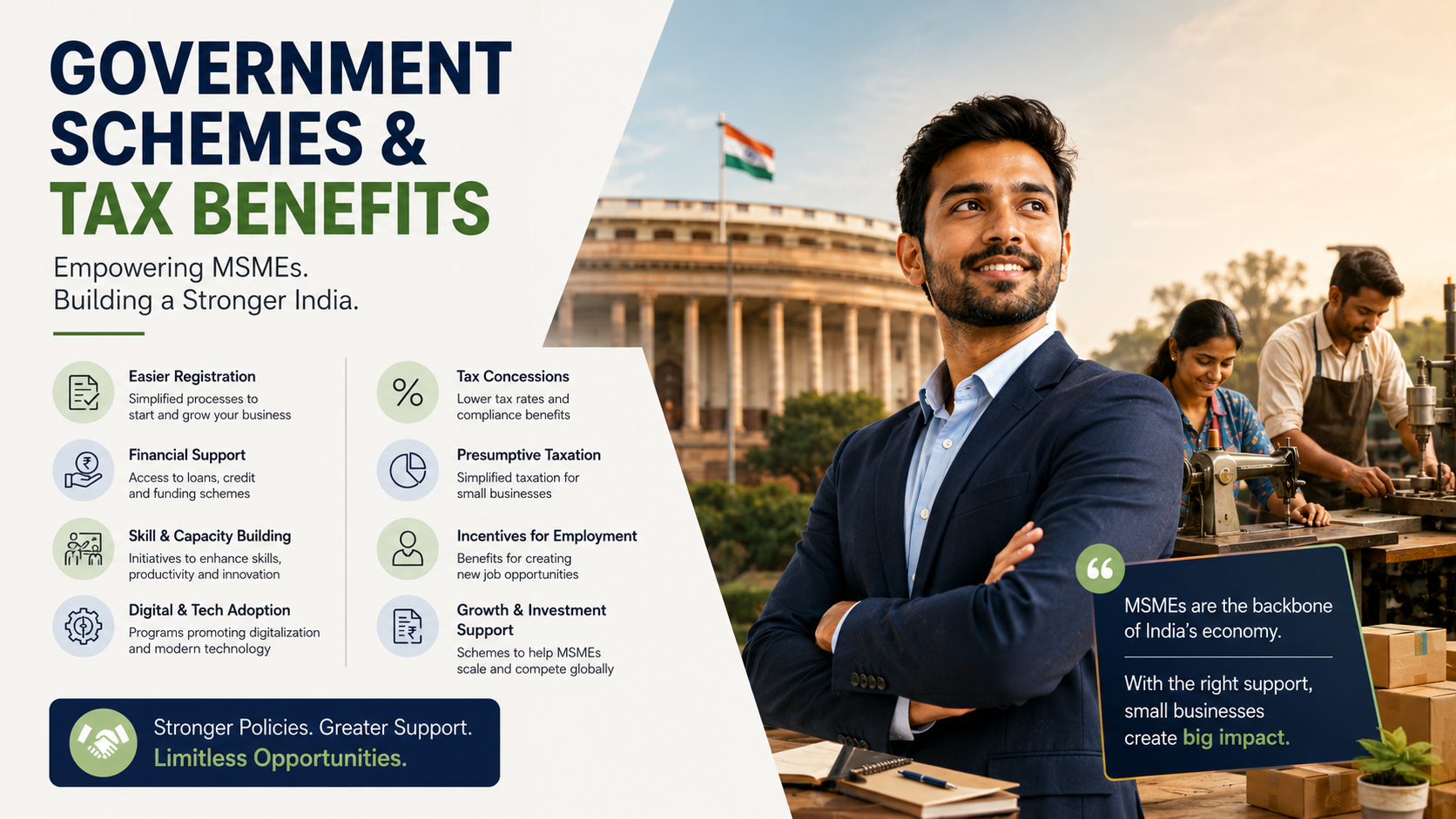
MSMEs are currently accounting for 90% businesses in the world, with 70% employment worldwide. Our government, over the years, has taken MSMEs' contribution into the spotlight and provided a lot of schemes and benefits, which include:
Registration is made easier
Loans and credits are more readily available through different programmes
Incubation Centres for all kinds of startups
Initiatives for skill development
Digitalisation and technology adaptation programmes
There are 15 major flagship schemes by the government and dozens of sub-schemes under it to make sure that an individual can learn the skill, get funding or capital, run a business, grow the business, get tax benefits and manage the profit. There is a scheme for every step.
The Government also provides Direct and Indirect Tax Benefits to MSME owners. This reduces the burden and makes the loan/funding repayment easier and more manageable. Some of them include:
Concession on tax rates
Presumptive taxation
Startup tax exemption
Deductions on new employment
Composition schemes
Higher registration threshold
E-invoicing exemption
Business loan deduction
Capital Gains Reinvestment
The Wide World of MSMEs: Sectors Fueling India's Economy
Every business starts with small steps and is an MSME before booming. When we first think of MSMEs, we picture small offices, manufacturing units and small workforces. But in reality, MSMEs are the backbone of the economy. Almost every sector has MSMEs. Below are a few sectors that are currently making it big in the market:
Manufacturing Industry: You can start with a room in the house or a warehouse. Plenty of industries require manufacturing or raw materials.
Technology & Services: You can work as a freelancer from the comfort of your home as an engineer, consultant or even as an analytical scientist.
Retail & Commerce: Everything has a D2C story now. You can do e-commerce businesses or wholesale ones. The tools available are very convenient to use.
Agriculture Food: Anything and everything involving food can be made into a business. Sourcing raw materials, cooking, preserving, storing, selling and even farming.
Healthcare & Wellness: There are so many options here- medical shops, clinics, laboratories, gyms, yoga centres, and so much more.
Education & Creative: The fastest way to grow a business is content marketing. You can also earn by educating the students. It also includes publishing or skill development programmes.
Infrastructure & Logistics: It involves all the construction and design. Also includes the logistics industry.
Green Economy & Tourism: It involves businesses that recycle waste or manage hotels with hospitality.
What comes under these categories, and what different sectors you can choose from, are mentioned here:
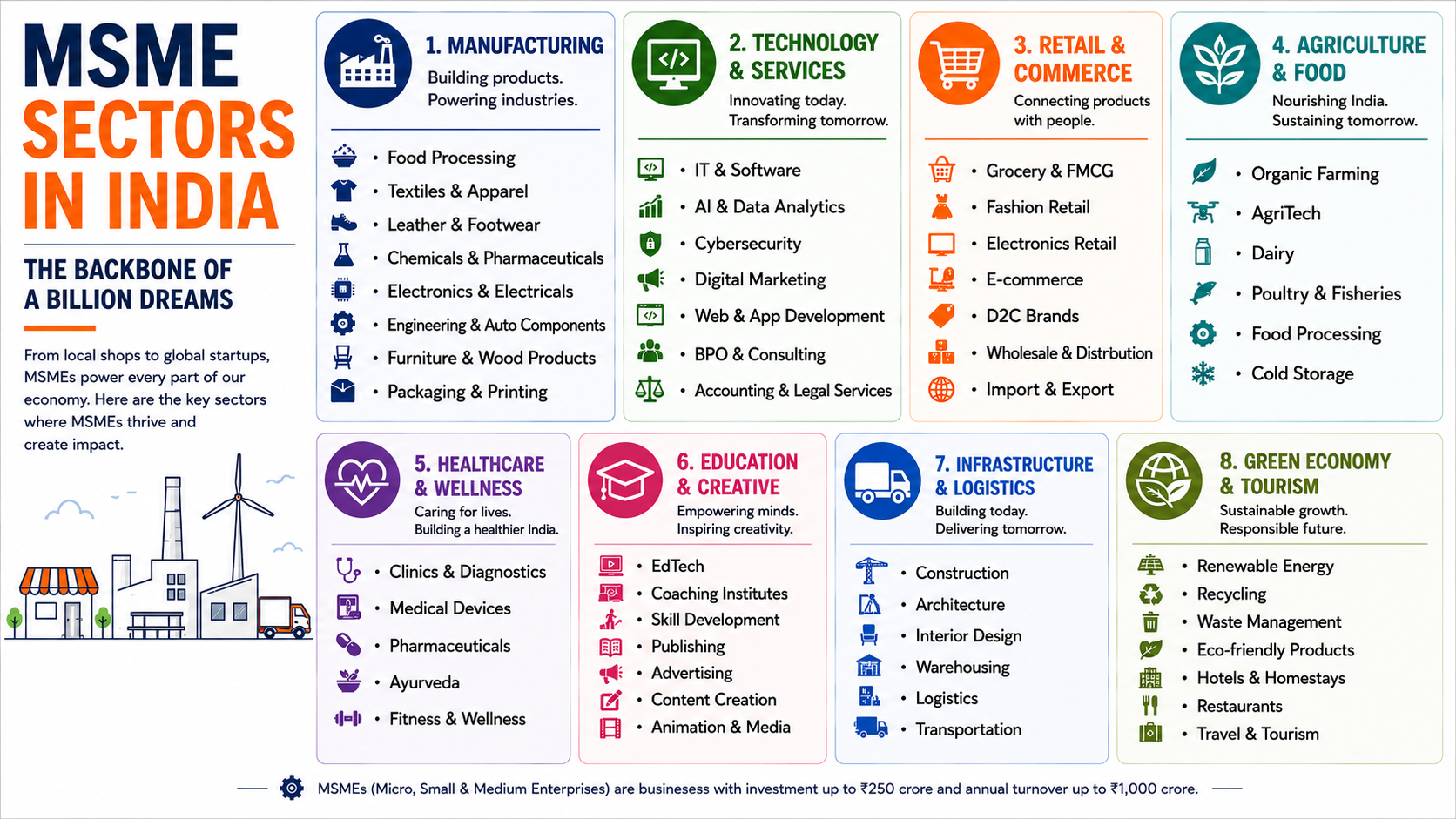
The youth today can choose to start a business in any of these sectors. They can find all the needful resource at their disposal. It just requires discipline and hard work. You can specialise in a single stream and learn how to monetise it from your home. There are so many different businesses that have unorganised markets. Young entrepreneurs can dwell in such enterprises and create something entirely new.
The Future Ahead
MSMEs face quite a few challenges. Despite so many schemes, they often have problems with funding. MSMEs in some sectors also face problems in finding skilled labourers. They often lack resources to invest in advanced technology, and competing with global companies becomes difficult.
While they cannot solve the unemployment problem alone, MSMEs remain a significant part of the solution to this problem. Youth unemployment requires a lot of other changes in the core infrastructure, starting from the education systems themselves. But the power of MSMEs is the ability to create quick jobs in every sector across various industries.
If they get stronger policy support and a skilled workforce, MSMEs can help bridge the gap between job seekers and employment opportunities.
As India prepares to become a developed country, the MSMEs' role is going to get more significant, as they don’t just create job opportunities, they are empowering the youth to think differently and become innovators and change makers.
On MSME Day 2026, it is not just a moment around the globe for small businesses. It is about young minds whose ambitions, ideas and entrepreneurial thinking will shape the country’s future.