

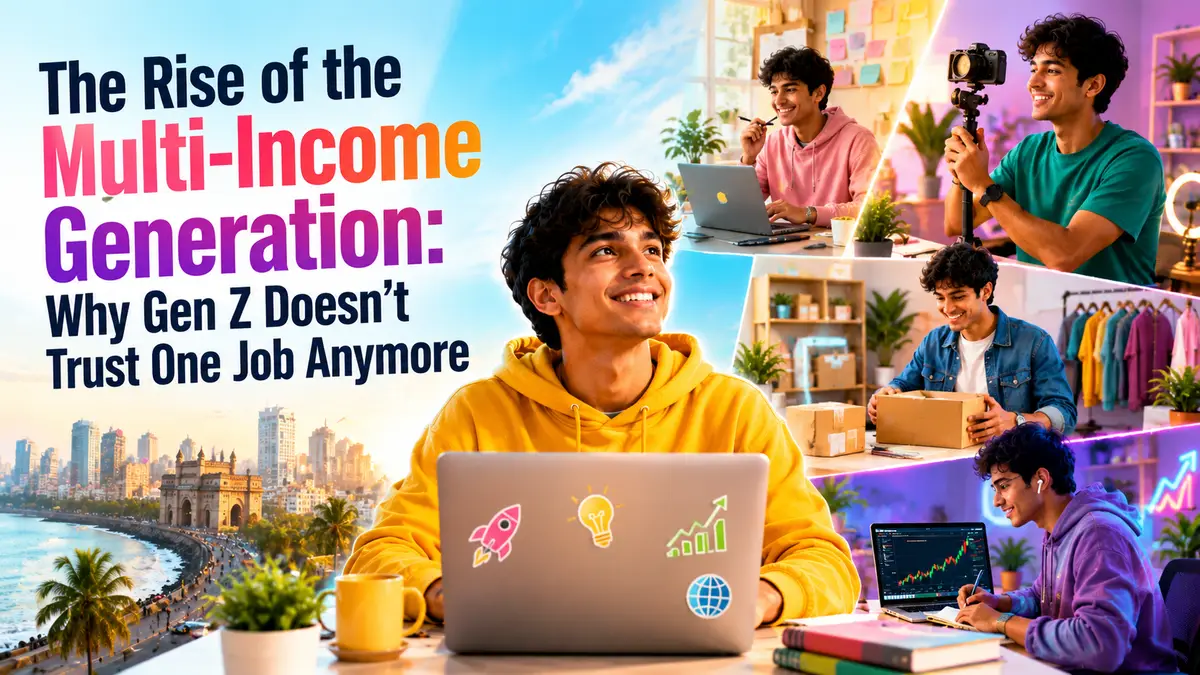
If you talk to a student in Mumbai today, their routine might surprise you. Morning could be a freelance writing deadline. Afternoon might be running an Instagram page or small online store. Evening could be an internship task. Night? Maybe learning investing, editing, or building a skill on YouTube.
And strangely, this doesn’t feel “extra” anymore. It feels normal.
Something has shifted quietly in how Gen Z looks at work. A single job doesn’t feel like enough safety anymore. Not emotionally, not financially, not realistically.
We are watching the rise of what people are now calling the multi-income generation.
Why does one job don't feel safe anymore? A few years ago, the advice was simple: study well, get a degree, find a stable job, and stick to it.
But Gen Z grew up watching something different.
Layoffs in big companies. Startups shutting down overnight. AI replacing tasks that once needed entire teams. Salaries are not rising as fast as living costs in cities like Mumbai, Delhi, or Bangalore.
Even “safe jobs” don’t feel that safe anymore.
Inflation has also quietly changed things. Over the last few years, prices of rent, food, travel, and education in India have kept rising in the 4–6% range annually. It doesn’t sound dramatic on paper, but in real life, it shows up every month when expenses keep increasing faster than income.
So the mindset naturally changes.
It’s no longer just: “What job will I get?”
It becomes: “What else can I do if one income stops?”
The internet changed everything quietly. This shift wouldn’t have been possible without the internet.
Today, a student doesn’t need permission to earn. They just need a skill and a platform. Writing, designing, coding, editing, tutoring, content creation — all of it can turn into income. A student in Mumbai can work for a client in London. A designer in a small town can sell templates globally. A college student can build a page on Instagram and monetize it.
Work is no longer tied to a building or a city.
That’s a big deal. Because for the first time, income is not fully dependent on traditional jobs.
Why Gen Z prefers multiple income streams It’s not just ambition. It’s also a protection.
Think of it like this: if one source stops, another can support you.
So instead of relying on one salary, young people are combining things like:
Internship stipend + freelance work
Job + weekend side projects
College + tutoring + content income
It’s less about “hustle culture” and more about not being stuck.
The mindset shift: trust is lower, independence is higher There’s also a psychological shift happening.
Earlier generations often trusted long-term employment. Loyalty mattered. Staying in one company was seen as a success.
Gen Z has seen layoffs happen to loyal employees too.
So the thinking becomes:
Not “Will this job last forever?” But “What happens if it doesn’t?”
That question changes everything.
It pushes people to build backup plans early instead of waiting for stability to come from one place.
The rise of small, skill-based careers Another big reason is how easy it is to learn skills now.
You don’t need a formal path to start earning anymore.
People are building small income streams like:
Freelance writing turning into strategy work
Designers selling digital products
Students running niche pages or communities
Developers doing part-time remote projects
Careers are no longer straight lines. They look more like layers building on each other.
But it’s not as easy as it looks online, this lifestyle looks flexible and exciting. In reality, it can be messy.
Multiple incomes also mean:
Unstable money in the beginning
Constant pressure to manage time
Burnout if boundaries aren’t set
No fixed structure like traditional jobs
So while it offers freedom, it also demands discipline most people don’t talk about.
Education vs reality gap Most education systems still prepare students for one-job careers.
But students are already moving ahead of that system.
They are learning on YouTube, freelancing during college, building LinkedIn profiles, and experimenting with income streams before graduation.
In a way, they are preparing for a world that schools are still catching up to.
Conclusion The rise of the multi-income generation is not about rejecting jobs.
It’s about rejecting dependence on one job.
Gen Z is building something different — a mix of skills, income streams, and digital identity that doesn’t rely on one employer.
Especially in places like Mumbai and other Indian metro cities, where cost of living is rising and industries are changing fast, this shift makes sense.
Stability today doesn’t come from a single salary.
It comes from flexibility, skills, and the ability to create more than one way of earning.
And that is why Gen Z doesn’t just want a job anymore.
They want options.