
An Indian student today may spend years preparing for board examinations without ever learning how to manage a budget, present an idea, repair a basic electrical fault or turn a creative interest into a small business. These are not necessarily skills that replace academic learning, but they can make the difference between knowing something in theory and understanding how it works in everyday life.
The question has become more relevant as India pushes to bridge the gap between education and employment. Through its multi-billion-dollar skilling initiatives, the country aims to prepare millions of young people for the workforce as part of its vision for Viksit Bharat @2047. The effort reflects a growing concern that academic qualifications alone may not equip students with all the practical skills employers need. But should this preparation begin before Class 10?
India's education system is beginning to make more room for that kind of learning. The National Education Policy (NEP) 2020 recommends introducing vocational education from Class 6, while the Central Board of Secondary Education (CBSE) already lists skill subjects for Classes 9 and 10, including artificial intelligence, information technology, financial markets, tourism and healthcare. That raises a question parents and students may not have considered seriously before: should children start learning job-related skills before Class 10, or is that simply one more thing to fit into an already demanding school schedule?
What India's New Skilling Push Actually Means
The policy is not asking every 12-year-old to choose a profession. The idea is to introduce students to different kinds of work before they feel pressured to pick a stream or career. Under the NEP 2020 framework, students in Classes 6 to 8 are encouraged to take part in 10 bagless days, during which they can learn from local professionals such as carpenters, gardeners, potters and artists. The Ministry of Education says these activities are intended to make learning more practical and give children exposure to different skills.
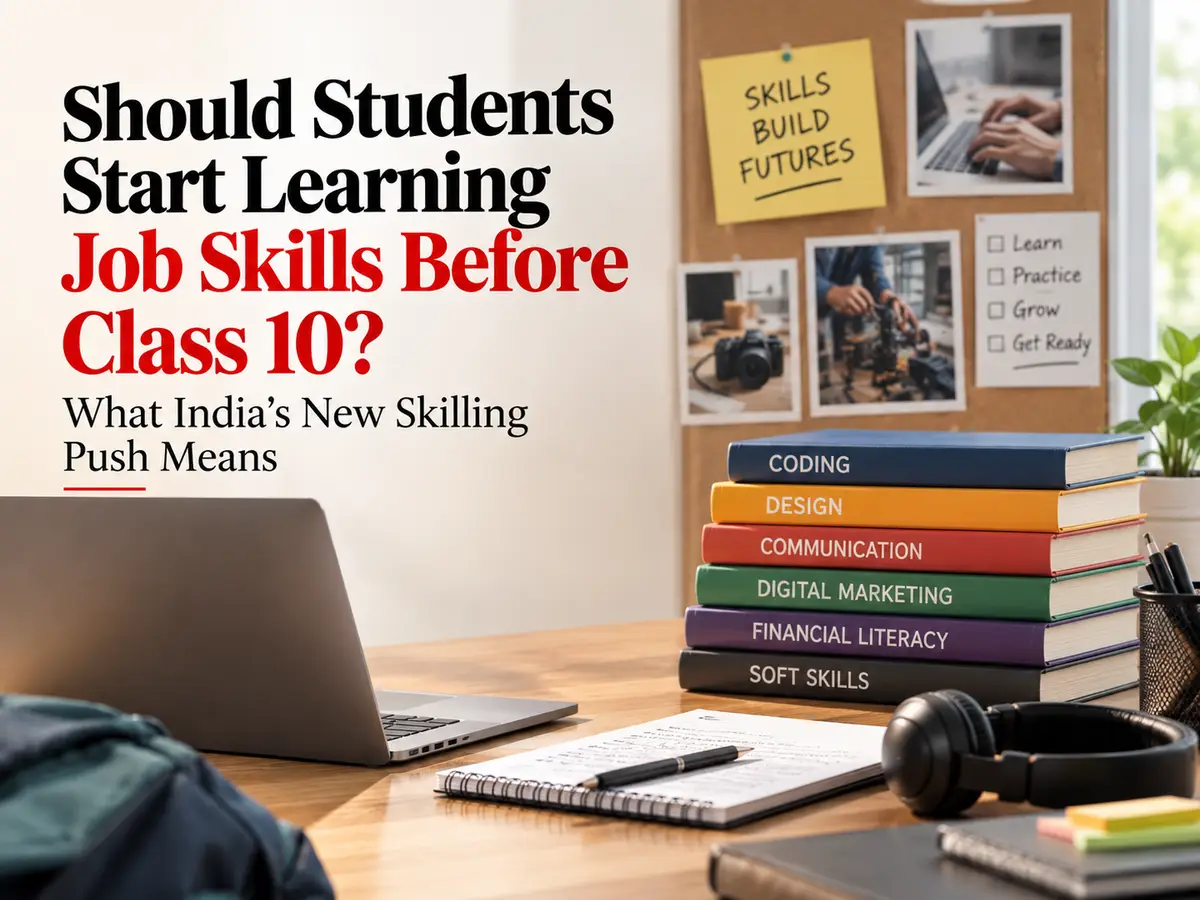
By Classes 9 and 10, students can explore more structured vocational subjects. CBSE's 2026–27 curriculum includes options such as artificial intelligence, data science, financial markets, automotive studies, healthcare, tourism and design thinking. These subjects are not meant to replace mathematics, science, languages or other academic foundations. They add another way to learn and apply knowledge.
There is also evidence that the push is reaching schools, although coverage remains uneven. A July 2025 government update reported that vocational education had been implemented in 24,560 schools, with more than 31.9 lakh students enrolled. The scheme had approved 29,342 schools for this integration. These figures show progress, but they also highlight the work still needed to ensure students have access to useful training regardless of where they live.
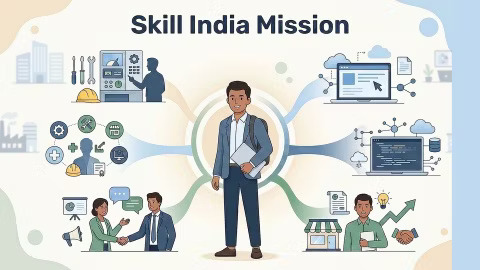
India’s Skilling Push: From Classrooms to Careers
India’s skilling push brings together several initiatives designed to help young people develop practical, job-ready skills alongside their academic education. These programmes focus on modernising vocational training, providing workplace experience and introducing students to emerging industries.
PM-SETU (Pradhan Mantri Skilling and Employability Transformation through Upgraded ITIs): The scheme aims to modernise 1,000 government Industrial Training Institutes (ITIs) through a hub-and-spoke model. Its proposed training areas include artificial intelligence (AI), cybersecurity, electric vehicles, robotics, drones and semiconductors.
PMKVY 4.0 and community skilling: The Pradhan Mantri Kaushal Vikas Yojana supports skill-based training, while Jan Shikshan Sansthan offers vocational learning at the community level. The National Apprenticeship Promotion Scheme (NAPS) also encourages practical, workplace-based training.
PM Internship Scheme: The initiative aims to give young people hands-on experience in companies across different sectors, with monthly financial assistance of ₹5,000–₹9,000 under the announced scheme structure.
Vocational learning in schools: Efforts to introduce vocational skill labs and facilities focused on animation, visual effects, gaming and comics aim to familiarise students with practical skills and emerging career options at an earlier age.
India Skills Accelerator: A collaboration between the Ministry of Skill Development and Entrepreneurship and the World Economic Forum, this initiative seeks to improve coordination between government, industry and training providers so that skill development keeps pace with changing employment needs.
Together, these initiatives reflect a broader shift in India’s approach to education and employment. The focus is increasingly on helping young people understand how their knowledge can be applied in the workplace, explore different career paths and develop relevant skills before they enter the job market.
Learning a Skill Is Not the Same as Being Ready for a Job
There is a difference between introducing students to a skill and preparing them for employment. A few lessons in coding will not make a student a software developer, just as a short module on finance will not qualify them to manage investments. The value lies in helping them discover what interests them, understand how work is done and build habits they can develop further.
Skills such as communication, problem-solving, teamwork, digital literacy and financial awareness can be useful across almost every profession. Practical learning can also help students connect classroom concepts to everyday situations. A gardening project, for instance, can teach biology, measurement and planning. Running a small school event can introduce budgeting, teamwork and communication.
The challenge is making these opportunities meaningful. In September 2026, India Today reported on vocational education efforts in Delhi government schools, including employer partnerships and student internships. The report also highlighted a persistent problem: vocational work is often viewed as a fallback for students who are not academically strong, rather than as a valuable career pathway. That perception needs to change. Skilled trades, technical work and practical expertise can lead to serious careers, but schools must show students what those paths look like, what further training they require and how people can progress in them.
Should Students Start Before Class 10?
A student in Class 7 should be able to try photography, basic coding, gardening, design or simple financial planning without feeling that the choice will determine their future. By Class 9 or 10, they may be ready to explore a subject in greater depth, especially if they have discovered a genuine interest. They should still have room to change direction later.
Schools and parents also need to resist turning skilling into another competition. If students are already overwhelmed by tuition, homework and board-exam preparation, adding multiple certificates and courses will not help. Practical learning should be built into the school experience, not become another expensive activity that only families who can afford private classes can access. Schools need trained teachers, working laboratories, local industry connections and clear progression routes. A vocational subject is of limited value if it exists only on paper or if students cannot see where it might lead. Students should also be taught that a skill requires practice and that a certificate alone does not guarantee a job.
The real promise of India's skilling push is that children can learn to do more than reproduce answers in an examination. They can experiment, make mistakes, work with others and discover abilities that a traditional classroom may not always reveal. Students do not need to start preparing for a job at 12. They need the chance to discover what they are capable of before they are expected to choose what they want to become.