

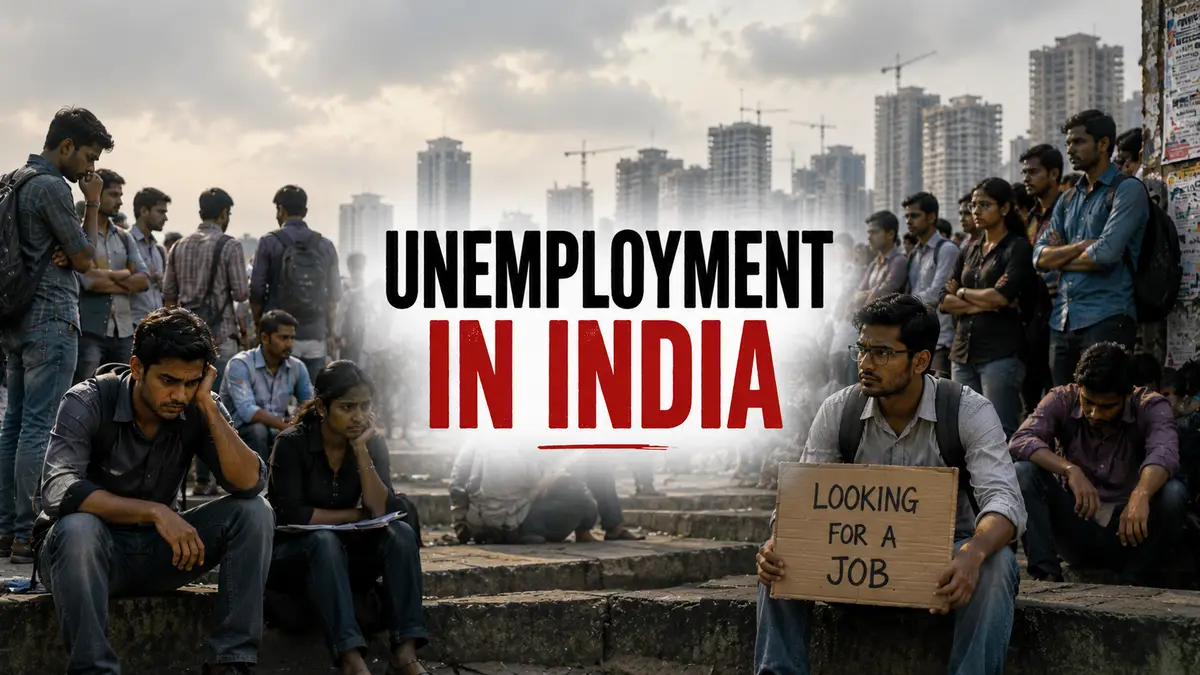
We spend all our lives studying, working hard, spending money on degrees and graduating from top universities. Degrees are looked upon as milestones, for millions of young people, graduation day is the beginning of a promising career. Lakhs of students also go abroad to secure their Master Degrees and return to their homeland to secure a good job (the typical Indian mindset) Yet in 2026, there lies a harsh reality of unemployment. For many students there are degrees in hand but no jobs in sight.
It boils down to the fact that a degree alone is not enough to secure employment. The state of working India report, suggests that 67% of unemployed youth between the ages between 20-29 are graduates. It is also said that the youth unemployment rate between Jan and March. Compared to 2025 the unemployment rate stood at 13.8% in April and climbed to 15.2% in March, 2026. The unemployment rate among males in the youth category was 13.6 per cent in April 2025 and female unemployment rate was the worst hit with the unemployment rate standing at 16.3% in November, 2025 and rising to 17.7% in March 2026.
Many are questioning whether AI is to be responsible for this unemployment. As the economy is increasing many are in the belief that there will be more employment chances but the reality says different.
Let’s have a look at what is affecting India’s Employment Crisis:
The Graduate Paradox:
India produces millions of graduates every year across the country in fields like engineering, business, arts, science, technology and commerce. Students are attaining good marks, high grade points and only landing themselves internships rather than a stable job. In order to find better job posts, students are trying everything, working hard, studying extra courses, giving top examinations and more. However the paradox is striking: while companies complain of talent shortages, thousands of qualified graduates remain jobless. The issue is not just lack of job opportunities but also a mismatch between the skills graduates possess and skills employers require. Many students leave college with A+ grades all due to theoretical knowledge and learning. Many colleges in India lack giving students opportunities to seek practical experience, industry exposure and digital skills. Traditional curricula and schools in rural India may progress slowly when it comes to keeping up with the evolving demands of time.
India, home to the world's largest youth population, is facing a growing employment crisis. While the economy continues to expand and new industries emerge, job creation has struggled to keep pace with the number of educated young people entering the workforce. As a result, many graduates find themselves trapped in a cycle of unemployment, underemployment, and uncertainty.
The Employability Challenge
A growing concern among recruiters is employability rather than education. Possessing a degree may require the ability to read, write and speak. Although it never reaches the stage where every student is given an opportunity to intern. Speaking from personal experience during college days there were times when students from the commerce section were given internships but students from the arts section who were studying media studies were not allowed for placements. There are other challenges where in employees
Fields such as artificial intelligence, data analytics, cybersecurity, cloud computing, digital marketing, and renewable energy are creating new opportunities. Yet many graduates lack the specialized skills needed to enter these sectors. Consequently, companies spend additional resources on training new hires or prefer experienced candidates altogether.
The result is a widening gap between education and employment. Graduates spend months—or even years—searching for suitable positions, while businesses struggle to find job-ready talent.
The Internship Trap
Students that have been unemployed for a while now find themselves stuck in an endless cycle of taking internships. While internships were originally designed to provide practical experience and serve as a pathway to employment, many youngsters jump from one internship to another without receiving permanent job offers.
Some internships offer little financial compensation while others require graduates to work full time for months without pay. Students take these up in hopes of seeking employment while out of 5 only 2 would guarantee future employment opportunities. This trend has created a workforce that is experienced enough to work but often lacks the opportunity to secure stable positions.
For many graduates, internships have become less of a stepping stone and more of a holding pattern.
Rising Inflation, Shrinking Opportunities
The employment crisis is turning into a serious issue due to the rising living costs. Indias inflation rate is gone up from 3.93% in May from 3.48% in April 2026. Whereas food inflation rose top 4.78% in May from 4.20% in April, increasing the cost of everyday essentials such as groceries, transportation and household expenses. Inflation plays a huge role when it comes to the factors affecting job employment. There is a huge pressure on young job seekers who are already struggling to find stable employment. For people who have not completed their graduation find it even more difficult to secure a stable salary. For the ones that travel to different cities in search of jobs and places where housing, transport, food and basic necessities gets expensive they face a double burden of limited opportunities, rising costs of living and more.
For unemployed youth, this means that the value of savings diminishes while the cost of searching for work rises. Many graduates are delaying major life decisions such as moving out, purchasing homes, pursuing further education, or supporting their families financially. The combination of unemployment and inflation creates a cycle of economic uncertainty that affects not only individuals but also the broader economy.
As India seeks to harness its demographic advantage, policymakers face a critical challenge: creating enough quality jobs while ensuring that rising living costs do not erode the purchasing power and aspirations of the country's young workforce. The future of India's growth story will depend not only on how fast the economy grows but also on how effectively that growth translates into employment and financial security for its millions of graduates.
Is Artificial Intelligence Taking Jobs?
One of the most debated questions surrounding unemployment today is whether Artificial Intelligence (AI) is replacing human workers.
The rise of AI-powered tools has undoubtedly transformed industries ranging from customer service and marketing to software development and finance. Routine tasks that once required large teams can now be automated, increasing efficiency and reducing costs for businesses.
However, experts argue that AI is not solely responsible for the employment crisis.
Historically, technological advancements have eliminated certain jobs while simultaneously creating new ones. The challenge lies in the transition. As AI reshapes the workplace, demand for skills such as data analysis, machine learning, cybersecurity, digital marketing, and creative problem-solving continues to grow.
The problem is that many graduates are not being adequately prepared for these emerging roles.
Rather than replacing workers entirely, AI is changing the nature of work itself. Those who can adapt and continuously learn new skills are more likely to thrive in the evolving job market.
Economic Growth Without Enough Jobs
India remains one of the world's fastest-growing major economies. New startups emerge every day, foreign investment continues to increase, and sectors such as technology, renewable energy, logistics, and e-commerce are expanding rapidly.
Yet economic growth does not automatically translate into employment growth.
Many modern industries are highly automated and require fewer workers than traditional sectors. While technology companies may generate billions in revenue, they often employ far fewer people than manufacturing or labour-intensive industries.
Economists increasingly refer to this phenomenon as "jobless growth"—a situation where the economy expands but employment opportunities fail to increase at the same pace.
This disconnect leaves many young people questioning whether economic success is truly benefiting the broader workforce.
The Rise of Underemployment
Even among those who find work, another challenge is emerging: underemployment.
Many graduates are accepting jobs that do not match their qualifications, skills, or career aspirations. Engineers are working in sales roles, MBA graduates are accepting entry-level administrative positions, and highly qualified individuals are taking jobs that require far less education than they possess.
While employment statistics may classify these individuals as employed, their potential remains underutilised.
Underemployment not only affects income levels but can also lead to frustration, reduced job satisfaction, and long-term career stagnation.
Mental Health and the Pressure to Succeed
Behind every unemployment statistic is a personal story.
For many young people, prolonged job searches bring feelings of anxiety, self-doubt, and uncertainty. Social media often amplifies these pressures, as peers share career milestones and professional achievements.
Family expectations can further intensify the burden. In many households, education has long been viewed as the guaranteed route to success. When employment does not follow graduation, young people often feel as though they have failed despite having done everything society asked of them.
Mental health experts have reported growing concerns about stress, burnout, and depression among unemployed youth, highlighting the emotional cost of the employment crisis.
What Needs to Change?
Addressing India's employment crisis requires action from multiple stakeholders.
Education Reform
Universities and colleges must align curricula with industry needs. Greater emphasis should be placed on practical learning, internships, project-based work, digital literacy, and emerging technologies.
Industry-Academia Collaboration
Companies and educational institutions need stronger partnerships to ensure students graduate with relevant skills and workplace exposure.
Skill Development
Continuous learning has become essential. Graduates must be encouraged to develop skills beyond their degrees through certifications, workshops, and professional training.
Entrepreneurship Support
Creating jobs can be as important as finding them. Increased support for startups, innovation, and small businesses can generate employment opportunities across sectors.
Greater Inclusion for Women
Policies aimed at improving workplace accessibility, safety, flexibility, and equal opportunities can help reduce gender disparities in employment.
The Road Ahead
India possesses one of the world's largest and youngest workforces—a demographic advantage that has the potential to drive economic growth for decades. However, this opportunity can only be realised if education, industry, and policy evolve together.
A degree should represent opportunity, not uncertainty.
For today's graduates, the challenge is no longer simply earning a qualification. It is navigating a rapidly changing world where adaptability, skills, and lifelong learning are becoming just as important as academic credentials.
The question facing India in 2026 is not whether its youth are educated enough. It is whether the economy can create enough meaningful opportunities for them to succeed.
Until then, countless young Indians will continue to hold degrees in their hands while searching for jobs that remain frustratingly out of sight.