
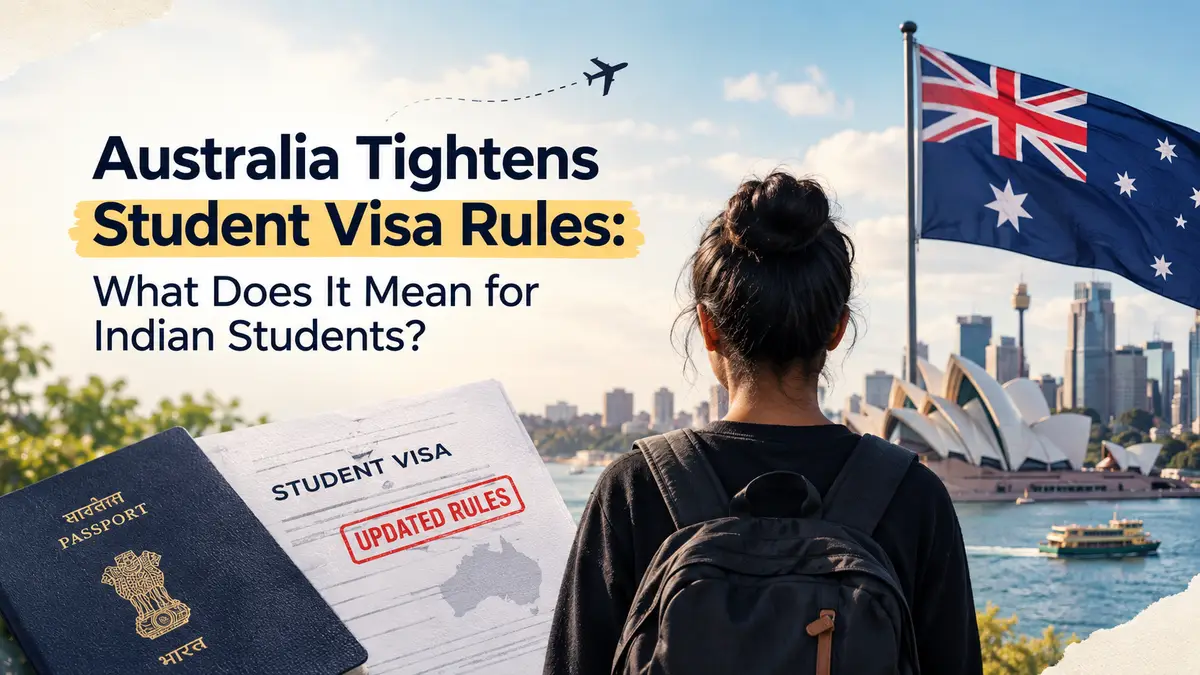
For an Indian student planning to study in Australia, the question is no longer simply which university to choose or how much tuition will cost. The visa process itself now requires considerably more attention.
Australia has spent the past two years trying to bring international education under tighter control, following the sharp rise in migration after the pandemic. The government has introduced changes to visa processing, financial and English-language evidence, course switching and the ability of students to bring family members. Some of the latest rules took effect in October 2026, while other changes are still being developed.
For Indian students, the changes matter because India remains one of Australia's major sources of international students. But the message from Canberra is not that Indian students are being shut out. Rather, Australia is becoming more selective about how its student visa system is used.
Why Is Australia Tightening Student Visas?
The changes are part of a broader attempt to manage migration while keeping Australia's international education sector sustainable.
Australia's 2026 National Planning Level is 295,000 new overseas student commencements, and the government has kept the same level for 2027; however, the Australian federal government aims to reduce net overseas migration from roughly 290,000 down to 225,000 by 2027–28 (with an interim target of 245,000). Importantly, this is not a simple cap on the number of students who can study in Australia. It is used as part of the system for prioritising offshore student visa applications based on education providers' allocations. Genuine students who meet the visa requirements can still apply.
At the same time, the government has been trying to address what it sees as misuse of the student visa system, including people using successive temporary visas to remain in Australia for longer periods or switching courses and providers primarily as a way of extending their stay. That is behind the latest restrictions announced in October.
From 2 October 2026, most temporary visa holders can no longer apply for a student visa while they are already in Australia. This includes people on Working Holiday Maker and Skills in Demand visas, while some specific groups, such as certain doctoral students and students affected by a provider default, remain exempt. Current student visa holders are also generally restricted from applying for another student visa onshore, subject to exemptions.
Indian Students Face Closer Evidence Requirements
One of the most important changes for Indian applicants has actually been in place since January 2026.
India was moved from Evidence Level 2 (EL2) to Evidence Level 3 (EL3) for Australian student visa applications from 8 January 2026. The change was also acknowledged by India's Ministry of External Affairs in Parliament.
What does that mean in practical terms? Evidence levels are used to determine what financial-capacity and English-language evidence a student may need to provide with a student visa application. Australia reviews these levels using immigration outcome data, including visa cancellations, refusals, unlawful stay and certain protection-visa applications.
A higher evidence level does not mean that an Indian student is automatically considered ineligible or that their visa application will be rejected. The Australian government explicitly says evidence levels do not determine eligibility, and every application is assessed on its own circumstances. They are also separate from the system that determines visa-processing priority.
For an Indian applicant, however, the practical takeaway is straightforward: documentation matters more than ever. Students should be prepared to demonstrate their financial capacity and meet the applicable English-language evidence requirements rather than assuming that a simplified documentation route will apply. This is particularly important because missing documents can slow an application, and if requested evidence is not provided, the application can be refused.
What About Family Members and Changing Courses?
The October changes are particularly relevant to students who were planning their Australian education around family arrangements. Under the new rules, students applying for a first or further Student visa generally can no longer include family members in their application or add them later, although exemptions apply to certain groups, including doctoral students, some Pacific and ASEAN nationals and specified scholarship recipients.
For an Indian student planning to move to Australia with a spouse or children, this means the family plan needs to be considered much earlier rather than treated as something that can be sorted out after arrival.
Changing education providers is also becoming more complicated. Australia is developing a new transfer stream under the student visa system, under which students who change education providers would need to apply through the new stream. The detailed arrangements are still being developed, so students should not assume that changing colleges or universities midway through a course will work in the same way it did previously. The government has also moved against what it calls “visa hopping”, with new restrictions intended to prevent students from repeatedly changing courses or visas simply to prolong their stay.
Does This Mean Indian Students Should Rethink Australia?
Australia has not closed its doors to Indian students. The country has maintained a 295,000 national planning level for 2027, and the government continues to state that genuine students who meet the requirements can apply for a student visa. But the easier, less careful approach to studying abroad is becoming harder to rely on.
For Indian students, that means choosing a course because it genuinely fits their academic and career plans, selecting a registered provider carefully, preparing financial and English-language evidence properly and understanding the visa conditions before booking flights or paying large amounts of money.
It is also worth remembering that Australia's policy is still changing. Some reforms have already taken effect, while others, including the new provider-transfer arrangements, are still being worked out.
The larger shift is clear, though. Australia is trying to move away from an international education system driven simply by increasing student numbers and towards one where the government pays closer attention to who is coming, what they are studying and whether the student visa is actually being used for its intended purpose.
For Indian students, Australia remains an option, but it is no longer enough to have an admission letter and the funds to pay for a course. The visa application itself has become a much more important part of the study-abroad decision.