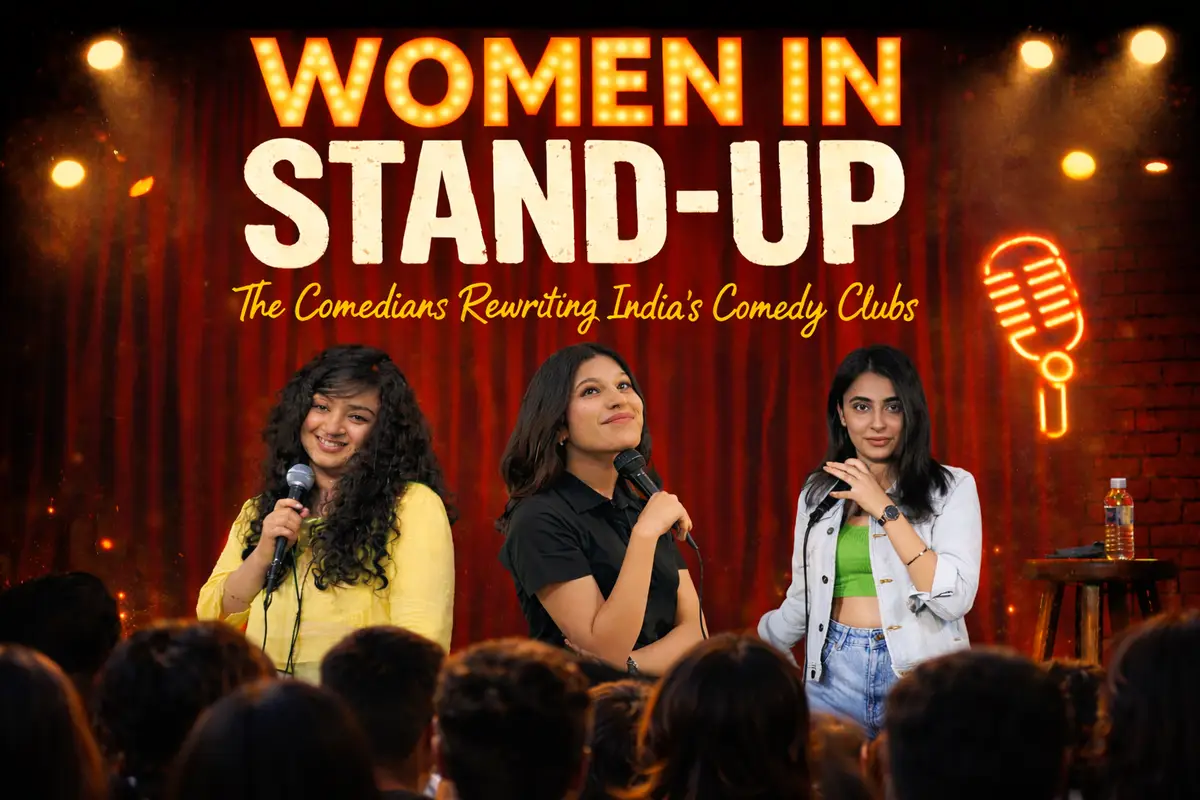
Women on stage, not dancing, not singing, not giving a speech, but they are here to make you laugh. This has been happening not for a few years, nor even a decade, but for almost a century. The 1920s were when Moms Mabley first performed on stage, breaking into a male-dominated comedy space.
Since then, women have found joy in holding a mic and turning everyday experiences into humour, much like adding spices to recipes passed down through generations. It became both a creative outlet and a source of income, and audiences slowly began appreciating women commanding the stage.
Decades later, comedians like Aditi Mittal, Neeti Palta and Radhika Vaz are considered pioneers who began shaping the space for women in Indian stand-up comedy, making female voices more visible through performances across shows and publications. Bharti Singh is also one of the earliest female stand-up comedians to find success on television since 2008.
Following them, several prominent names emerged, including Kaneez Surka, Mallika Dua, Urooj Ashfaq, Sumukhi Suresh and Sugandha Mishra.
Comedians like Surabhi Vanzara, Trisha Pathak and Aashna Suneja are steadily making their mark in India’s stand-up circuit with relatable humour and honest storytelling. In this interview, they discuss their journeys, challenges and what keeps them going.
Trisha Pathak: Stand-up comedian known for her quirky personality and observational humour that turns everyday moments into laughter.
Q. When you did your first show, what was it like?
Ans: It was magical. I was always goofy and quirky, but I didn’t realise I could make people feel this way. I always say that I didn’t choose stand-up comedy—it chose me.
Q. Do you think venues for stand-up comedy are efficient? Would you suggest any changes?
Ans: Comedy clubs in India are beautifully designed, and producers put a lot of thought into them. Stand-up is still new here, so there are gaps, but I’m sure they’ll be filled with time.
Q. If not stand-up comedy, what would you see yourself doing?
Ans: I don’t see myself doing anything else. I love performing and making people laugh. I think it’s a generational gift I’m finally putting to use.
Q. Do you idolise someone in this field?
Ans: I admire people who started comedy in India when it wasn’t even a known art form. If I had to take one name, Shreya really inspires me. Her growth curve is incredible, and she’s very hardworking.
Q. What has been the most awkward source of comedy content for you?
Ans: My friends and family. They’re always worried that if they say something wrong, I’ll turn it into a joke.
Surabhi Vanzara: Actress and Stand-up Comedian who blends her experience in television with sharp storytelling and relatable humour on stage.
Q. When did you realise stand-up comedy could become your career after television?
Ans: Stand-up was always something I wanted to try. Television often demands louder comedy, but stand-up allows subtle humour and personal storytelling. When comedians like Vir Das and Zakir Khan became popular, it started feeling like a serious career option. Comedy also comes from my personal life. I had a difficult childhood, and humour became a coping mechanism.
Q. What can audiences expect from you next?
Ans: I’m planning solo shows in Mumbai and hoping to tour Maharashtra and Gujarat. Since I’m married to a Gujarati, a lot of my material revolves around those everyday family situations.
Q. Do you test your material with friends or family first?
Ans: Never. Creative work is delicate in the early stage. Even silence from someone can affect you, so I prefer presenting it directly to a live audience.
Q. Are there comedians who inspire you?
Ans: I admire many. Zakir Khan’s storytelling is incredible, and I also really respect Prashasti Singh for her unique perspective.
Q. How do you deal with a joke that doesn’t land?
Ans: I keep refining it. If the idea is strong, it usually means the structure or delivery needs work.
Aashna Suneja: Stand-up Comedian whose honest storytelling and everyday observations bring fresh perspectives to India’s comedy circuit.
Q. Being relatively new in this field, is it difficult to navigate your way up?
Ans: Sometimes, yes. Stand-up in India is still evolving, and there’s no clear roadmap. Early on, I would walk into green rooms and feel like I had accidentally entered the men’s washroom—I was often the only woman there. But with time, you find your voice and your rhythm.
Q. Is stand-up a safe career bet or more of a side hustle for you?
Ans: No career is completely safe. My day job is content writing, so humour is already part of my professional world. Stand-up can be unpredictable in the beginning, but with consistency, it grows.
Q. Does comedy come naturally, or do you write your material carefully?
Ans: Humour might come naturally because I come from a fun Punjabi family, but comedy still requires serious writing and practice. What looks spontaneous on stage usually takes a lot of refinement.
Q. What is one goal you want to achieve this year?
Ans: I recently released my first YouTube video. Next, I want to start doing solo shows and build towards a one-hour special.
Q. Who inspired you to pursue comedy?
Ans: Theatre was my first love. During COVID, I wrote a stand-up set and performed it for friends on a video call. Their encouragement pushed me to try an open mic.
Q. Do you idolise someone in comedy?
Ans: I admire comedians like Kanan Gill, Biswa Kalyan Rath and Abhishek Upmanyu. But my biggest inspiration comes from fellow comedians hustling alongside me.
Looking Forward
The legacy of women in comedy continues to grow stronger. With pioneers paving the way and new voices emerging, the story of women in stand-up is becoming bolder and more visible.
As audiences seek diverse perspectives and fresh humour, women comedians are ensuring that every punchline is sharper, wittier and more relatable. For young women watching from the audience, the message is simple: follow the road less travelled. With passion, persistence and a sense of humour, even the most unlikely stage can become yours.