

![Small Town Startup India: A Founder’s Guide to Government Schemes for Startups [2026]](https://pub-28ef1672737d46bfab8726ed1576e07a.r2.dev/images/7c6ba5d3-74a7-4ea1-a9f9-30dac7171388/large.webp)
Under the leadership of PM Narendra Modi, India has been developing at a pace like never before. For the country’s economy, start-ups are crucial, especially in India, where they generated 1.66 million jobs in 2024. This plays a significant role in improving our global image and reputation. Start-ups also promote innovation, enhance productivity and global competitiveness. This highlights the rise of small town startups in India, supported by evolving government schemes for startups in India.
Successful startups can help in reducing reliance on imports from other countries. It is directly proportional to the nation's trade balance. Alongside this, it was noted during the COVID-19 pandemic that Indian entrepreneurs are capable of manufacturing many items that were formerly imported. The unreliability of global supply chains pushed us to make our own products.
Startups also contribute to the GDP growth of the country. They bridge the gap between urban and rural. 50% of recognised startups are now coming from Tier II or Tier III cities. This shift clearly indicates the decentralisation of the Indian startup ecosystem. This is the place where ambition meets affordability and innovation meets impact. Startups also force the legacy businesses to do something different and improve their own services to stay competitive.
Financial startups have reached the “unbanked”, providing financial aid in remote areas. Some startups promote sustainability that helps the nation reach its environmental goals. A major underlying win is also that 45% of these startups have at least one woman director.
Why Small Town Startups In India Are Growing Rapidly [2026]
The era of people moving to metro cities for business is over. Now, people are scaling businesses from their hometowns. The thriving ecosystem of cities like Mumbai and Bengaluru is no longer a mandatory requirement to build a scalable business. Below is why:
Lower cost of operations:
Rents, salaries and logistics are much cheaper in smaller cities as compared to metro cities. These advantages allow the owners to save and reinvest more in the business.
Untapped markets:
For a lot of startup ideas, small towns are a perfect place to start. They get more demands and less competition to start with. The people in these areas are ideal for the trial-and-error process.
Local insights:
Most businesses rule out a product trial in local markets where 80% of their consumers come from. Combatting this, it is an advantage for small town startups to get testing and approval from these consumers.
Access to more government funding for small businesses in India:
There are several schemes formulated to bring up the tech sectors in remote places. Small town startups can take advantage of such resources.
Government Schemes for Startups in India: Backbone of Small Town Entrepreneurship
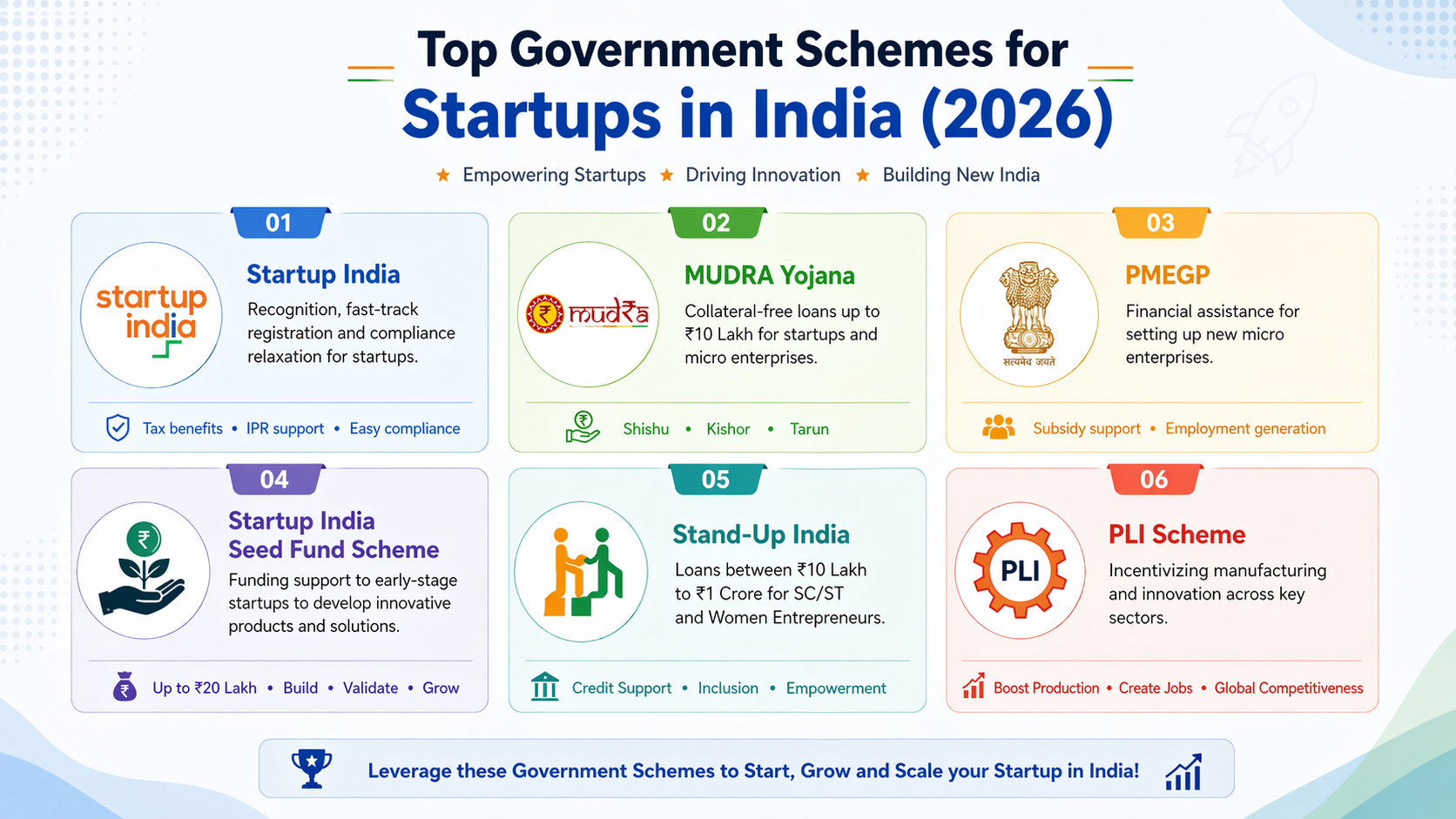
To promote the strategic growth of the startup ecosystem in India, the government is actively focusing on providing a cushion and support to not just the metro cities but also the tier I and tier II cities. These initiatives are strengthening rural entrepreneurship in India and enabling local founders to scale nationally. Below are all the government policies and schemes for helping startups scale in 2026.
Startup India Initiative
This flagship programme helps a startup in the following ways:
By easy registration of the business with DPIIT [Department for Promotion of Industry and Internal Trade], the business can be officially recognised, which enables self-certification for labour and environmental laws. In case of insolvency, the exits are faster.
A 3-year tax holiday and specific exemptions on capital gains are also made possible.
Funding support through venture capital networks
They get patents and trade marking faster and also get a rebate on filing fees.
They have a hub where owners can have access to networking, mentorship, investors and incubators.
Fund Of Funds 2.0 [2026]
For a push in growth capital, Fund of Funds for Startup [FFS] has been backed with another ₹10000 crores. It helps in the following manner:
Instead of directly funding the startup, what this fund does is make the pipeline of funding stronger.
Tech-based businesses like AI, Semiconductor, hardware and space innovations do not get funding easily because of the long duration in development. This funding bridges that gap.
Small Industries Development Bank of India [SIDBI] gets the money from the government, and it passes it on to SEBI-registered funds, which then invest in startups.
With this structure, the pool of capital becomes larger, and eventually the ventures can write bigger checks.
Atal Innovation Mission (AIM)
AIM is focused on starting the development from early stages [students] and then growing. It benefits in the following ways:
Atal Tinkering Labs [ATL’s] are provided in several schools across the country, where students can get hands-on knowledge and experience of working with robotics, 3D printing and DIY tech.
After that, workshops, mentorship and investment opportunities are also provided in the form of Atal Incubation Centres [AIC’s]. They are basically incubators, but with government backing.
PMEGP (Prime Minister Employment Generation Programme)
Implemented by the Khadi and Village Industries Commission, this scheme is widely used by self-employed and micro-enterprise owners.
This is a simple government scheme that helps the owners to get a loan from the bank to start their own business.
The scheme will have the government give you 15% - 35% subsidy. It is a credit-linked scheme.
SVEP (Start-up Village Entrepreneurship Programme)
Run under the Deendayal Antyodaya Yojana – National Rural Livelihoods Mission, this policy simply allows people from rural areas to start their own business.
They provide local expertise through people from the same community.
You get access to small loans and business training
They focus on building village-level entrepreneurship, mainly targeting women
ASPIRE (A Scheme for Promotion of Innovation, Rural Industry and Entrepreneurship)
Implemented by the MSME [Ministry of Micro, Small and Medium Enterprises]
This scheme works on a grassroots level and generally helps the agro-based startups.
Mainly works in rural areas for small-scale innovators.
They set up livelihood business incubators (LBIs).
Self-Reliant India Fund (SRI Fund)
With a top-up of ₹2000 crores on this fund, the SRI is anchored by the MSME. It enables:
Higher risk capital for micro businesses, by increasing the pool of equity and quasi-equity.
They also focus on existing MSMEs willing to scale, or businesses that don’t fit into the ideal venture capital model.
Doesn’t just help with starting the business but also helps in surviving and scaling it.
Startup India Seed Fund Scheme (SISFS)
This scheme is launched under DPIIT. It grants support by:
Providing up to ₹20 lakhs for proof of concept, prototype development and product trials.
Furthermore, they provide up to ₹50 lakhs for market entry, commercialisation, and scaling early options.
Funds come through approved incubators to selective startups based on quality and impact.
Majorly useful for companies with hardware, tech and R&D infrastructures.
SME Growth Fund
Another scheme that helps businesses grow, and not just start. It helps in the following ways:
₹10,000 crore equity-focused fund that helps businesses that have passed the early stages and are now capable of growing aggressively.
Equity-based model, so no pressure of immediate repayment.
It helps Indian companies become global competitors by providing capital that can stop stagnation.
Credit Guarantee Scheme for Startups (CGSS)
This scheme is backed by DPIIT. It provides
A credit guarantee without heavy collateral for lenders.
Helps startups wanting debt financing
MUDRA Yojna [Pradhan Mantri Mudra Yojana [PMMY]]
Stands for Micro Units Development and Refinance Agency Bank. This scheme offers:
Small loans, that is, up to ₹10 lakhs
3 categories get funding: Shishu, Kishor, and Tarun, representing early-stage, growth, and expansion.
Focuses on micro-trainers and first-time entrepreneurs.
Stand-Up India Scheme
The Small Industries Development Bank of India runs this scheme.
They help in getting loans of ₹10 lakh to ₹1 crore from banks
Specifically designed for women and SC/ST entrepreneurs
Focuses on inclusion and stability, not just growth.
Digital India / MeitY Startup Hub (MSH)
Led by the Ministry of Electronics and Information Technology.
This scheme supports tech startup funding, offering mentorship and market access.
Biotechnology Industry Research Assistance Council (BIRAC) Schemes
Under the Department of Biotechnology, this scheme:
Provides grants and funding for biotech startups
Do programs like BIG (Biotechnology Ignition Grant)
Provides industry-specific support that is otherwise hard to get.
Production Linked Incentive (PLI) Scheme
Run by multiple ministries under the Government of India
Incentivises manufacturing in sectors like electronics, pharmaceuticals and semiconductors.
The main focus is on promoting and helping startups that are manufacturers, aiming to reduce imports from foreign countries.
Understanding these schemes is the first step, but execution is what truly defines success.
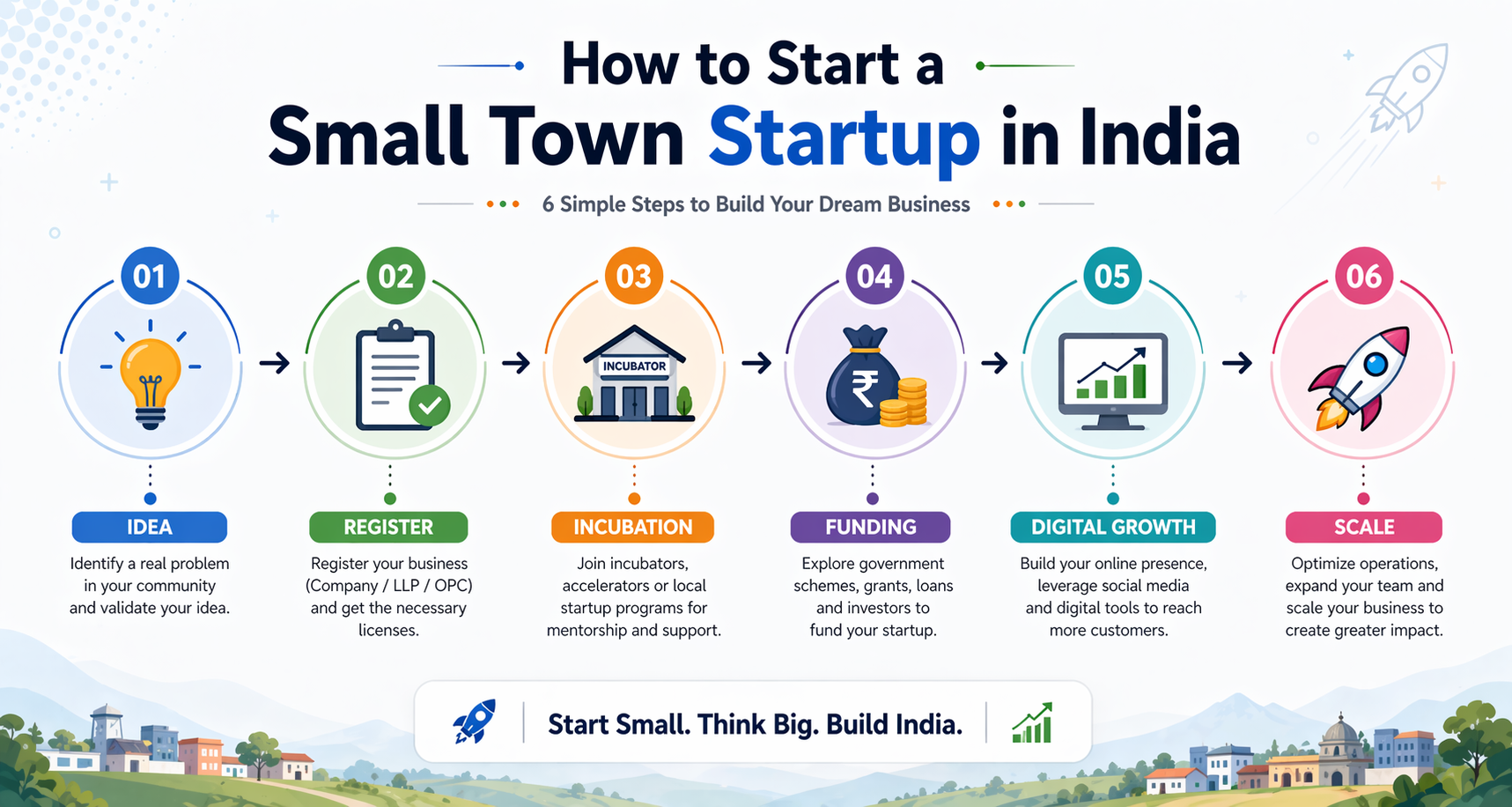
How to Start a Small Town Startup in India: Step-by-Step Guide
Step 1: Solve a real local problem
Most businesses start by solving a hyperlocal problem.
Find a solution and prepare a roadmap for your service/product
Step 2: Register under Startup India
Make a company with DPIIT
Unlock tax benefits, funding and credibility
Step 3: Use Incubators and Mentorship
Join incubators under AIM or state programs
Get office space, tech support and networking with investors
Step 4: Get Government Funding
Go through the above-mentioned schemes, research what suits your business the best and choose a government scheme.
Early startups now get multiple funding channels.
Step 5: Grow Digitally
Use E-commerce platforms and take advantage of ONDC [Open Network for Digital Commerce]
Build a strong social media presence
Step 6: Scale with partnership
Build networks with logistics companies and collaborate with larger brands
Scale through Government marketplaces [GeM]
The Road Ahead
There is a significant rise in women entering entrepreneurial spaces. At least 45% of startups have 1 woman in the leading forces. With such schemes, non-metro/rural spaces are also entering manufacturing spaces concerned with AI, electronics and space tech. Contributing to the local economy, startups have generated more than 20 lakh new jobs. According to DPIIT data, India now has over 1 lakh recognised startups.
All these things come to light by overcoming challenges like limited access to talent, gaps in infrastructure, awareness of funding and barriers in market expansion. A Founder should consider these and focus on building within the country first. They should concentrate on early profitability by strategically using government schemes. The target should be building from Day 1 to scale by investing well in branding and storytelling. With increasing access to startup funding in India and policy support, small-town entrepreneurs are now building scalable national brands.
Geography will no longer limit ambition. India will have the best businesses come from Tier II and Tier III cities. So if you are building from scratch today, you are already in the middle of India’s next big growth story.
Frequently Asked Questions (FAQs)
What are the best government schemes for startups in India?
Some of the most popular schemes include Startup India, Startup India Seed Fund Scheme, and MUDRA Yojana.
Can I start a startup in a small town in India?
Yes, small towns offer lower costs, untapped markets, and increasing access to government funding.
How can I get startup funding in India?
You can apply through government schemes, incubators, or financial institutions supported by SIDBI.
Is DPIIT registration necessary for startups?
Yes, it provides tax benefits, easier compliance, and access to funding opportunities.