

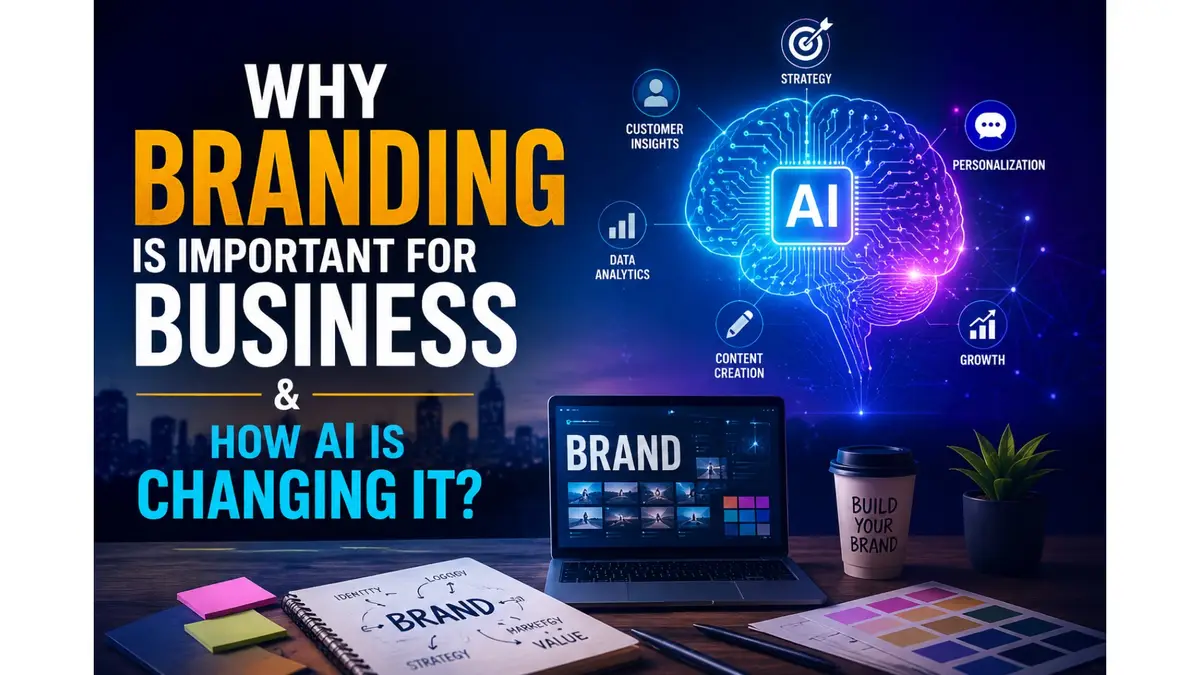
In today's market, great products or new services are no longer enough. Businesses need to build a strong brand to stand out, build trust and create lasting impact in the market and customers mind. Today one TVC or hoarding of a product is no longer sufficient as today branding is becoming important. At the same time, Artificial Intelligence is transforming how brands are built, managed and experienced. Before exploring AI’s impact, it is important to understand what branding is and why it matters to businesses.
What Is Branding?
Branding is the process of creating a unique identity for a company, product or service. It involves the process of building a new name, logo, color palette, slogan and brand voice. Although, branding is more than just a logo and color palette. It is the overall perception people have of a business. Every brand represents what they have to offer, its value, personality, mission and promise to its costumers. Every interaction be it from social media posts and advertisements to customer service and product packaging it all contributes to shaping a brand’s identity and reputation. Consider globally recognized brands such as Apple, Mc Donald and Coca-cola while luxury brands like Gucci, Louis Vuitton, Chanel, Hermes thrive by selling aspirations, exclusivity, and experiences rather than just selling products. Their success lies in creating emotional connections that influence consumer choices and foster loyalty.
At its core, branding answers 4 fundamental questions that give identity to a business: Who you are? What do you do? Who do you serve? And should people choose you? The answers to these questions help establish a clear and memorable identity in the minds of consumers. Think about your own shopping habits. For example: when you visit a supermarket to buy household essentials, you already have an idea of what you have to buy. Then you often choose brands that you already recognize and trust. In India, for example many consumers trust home-grown brands such as Amul, Mother Dairy, Tata, Dabur, Himalaya, Parle, etc. This is because these companies have already built trust and credibility over decades.
This is the true power of branding. It influences purchasing decisions even before a customer compares prices or features. A strong brand creates familiarity, builds confidence, and reassures consumers that they are making the right choice. Ultimately, branding is not just about being seen, it is about being remembered, trusted, and chosen.
Why is Branding Important for Business?
Creates Recognition: Strong branding helps you recognise a brand. Distinctive visual identity, messaging, and customer experiences help customers instantly recognize a company across multiple platforms. In fact, successful branding goes beyond logos and advertisements. Consumers often associate brands with specific tastes, smells, sounds, colours, or experiences. Over time, these sensory cues become so deeply connected with a brand that people can recognize it without even seeing its name.
For example, many people can identify Coca-Cola from the shape of its bottle or the taste of the drink. Similarly, the aroma of freshly brewed coffee can instantly remind customers of Starbucks, while the distinctive blue-and-white packaging of Amul products is familiar to millions of Indian households. Even a simple jingle, such as the iconic "Washing Powder Nirma" tune, remains recognizable decades after it first aired.
Builds trust: Customers are more likely to buy from brands they recognize and trust. Trust is often built over time through consistent product quality, reliable service, and positive customer experiences. When a brand repeatedly delivers on its promises, consumers feel confident choosing it over unfamiliar alternatives.
For example, a customer who regularly purchases milk from Amul or Mother Dairy may do so because they trust the brand's quality, safety standards, and consistency. Even when other options are available, they are likely to stick with a familiar brand that has earned their confidence over the years. This principle applies across industries. Whether it is choosing a Tata vehicle, an Asian Paints product for home renovation, or a Dabur healthcare product, consumers often gravitate towards brands that have established a reputation for reliability.
Drives loyalty: People often develop an emotional attachment to brands that align with their values and lifestyle. Sometimes basic things like maybe a brands look, design, taste, smell and overall effective product can help build loyalty. Loyal customers often are more likely to make repeated purchased. They would also recommend a brand to others. For example say X user has been using a specific coconut oil from a Y brand for hair growth. This similar X user will then recommend this product to a third person who faces similar problem. Thus loyalty begins when one person starts
Attracts talent, investors and partnerships: A strong brand does not only attract customers—it also attracts talented employees, investors, and strategic partners who want to be associated with a reputable and successful organization. People are naturally drawn to brands that have a positive reputation, clear values, and a strong presence in the market.
For example, companies such as Google, Tata, Apple, and Infosys receive thousands of job applications every year, not only because they offer competitive salaries but also because they have built strong employer brands. Many professionals view working for these organizations as a mark of credibility and career growth.
Similarly, investors are often more willing to support businesses with strong brands because they are perceived as more stable, trustworthy, and capable of sustaining long-term growth. Strategic partners and collaborators are also more likely to work with brands that have established credibility and a loyal customer base.
A strong brand therefore creates opportunities beyond sales. It helps businesses attract the right people, secure investment, build valuable partnerships, and strengthen their position in the marketplace. In many cases, a company's reputation can be just as valuable as the products or services it offers.
5. Supports Premium Pricing- Well-established brands can often charge higher prices because customers perceive greater value. Branding helps businesses compete on more than just cost. People rarely pay extra for a product—they pay extra for what the brand represents. Examples:
Nike sells motivation and achievement.
Starbucks sells an experience, not just coffee.
Tesla sells innovation and status.
A strong brand reduces price sensitivity and increases perceived value.
How AI Is Changing Branding
Artificial intelligence is reshaping branding by enabling businesses to understand customers better, create content faster, and deliver more personalized experiences.
Personalized Customer Experiences
AI analyzes customer behavior, preferences, and purchasing patterns to deliver highly targeted recommendations and communications. Instead of generic marketing messages, brands can create personalized experiences for individual consumers.
For example, streaming platforms such as Netflix and e-commerce giants like Amazon use AI to recommend content and products tailored to each user.
Faster Content Creation
AI-powered tools can generate blog posts, social media captions, ad copy, images, videos, and marketing campaigns within minutes. This allows businesses to maintain a consistent brand presence while reducing production time and costs.
Improved Customer Service
AI chatbots and virtual assistants provide instant responses to customer queries, improving customer satisfaction and ensuring brands remain available around the clock.
Better Market Research
AI can process massive amounts of data from social media, reviews, and online discussions to identify trends, customer sentiment, and emerging opportunities. Brands can make faster, more informed decisions based on real-time insights.
Predictive Branding Strategies
Rather than simply reacting to consumer behavior, AI can help predict future trends and customer needs. This enables businesses to adapt their branding strategies before market shifts occur.
Best AI-Driven Branding Campaigns (Global)
Coca-Cola's AI-Powered Holiday Campaigns
Coca-Cola has become one of the most visible global brands experimenting with AI.
Its recent holiday campaigns used generative AI to reimagine iconic Christmas advertising while maintaining brand familiarity. The company has also integrated AI into customer engagement initiatives.
Why it worked
Preserved iconic brand assets
Used AI for scale and creativity
Maintained recognizable Coca-Cola identity
Coca-Cola India's Diwali "Festicons"
A notable Indian-market example saw Coca-Cola partner with Google to launch AI-powered Diwali greetings.
Consumers could create personalized festive avatars using AI image generation, making the campaign interactive rather than passive.
Branding Lesson
Consumers didn't just view the campaign—they became part of it.
Indian Brands Using AI Successfully
1. Tata Play's AI Mascot "Coco"
Tata Play introduced "Coco," an AI-augmented puppy mascot developed using a generative AI workflow.
The company reportedly used more than 15 AI tools and a custom dataset of over 8,000 frames to maintain consistency across campaigns. The mascot now serves as a recognizable brand character across customer touchpoints.
Why it worked
Strong visual identity
Consistent brand storytelling
Scalable content creation
2. Tata Gluco+ AI Film
Tata Gluco+ launched one of India's first major brand films reportedly created entirely using AI.
The campaign, "Piyo Goodness, Karo Greatness," aired during IPL and demonstrated how AI could be used for end-to-end creative execution.
Why it worked
Reduced production complexity
Generated significant industry discussion
Positioned the brand as innovative
3. Tata Tea Agni's AI Storytelling
Tata Tea Agni created a campaign where homemakers could upload photographs via WhatsApp and receive personalized AI-generated videos celebrating their stories.
The campaign used AI not merely as a production tool but as a personalization engine.
Why it worked
Emotional storytelling
Community engagement
Personal relevance
4. Tata Tea Premium's AI Art Campaign
The "Desh Ka Garv" initiative used AI-generated visuals to celebrate regional Indian art forms while combining digital creativity with traditional craftsmanship.
Why it worked
Cultural relevance
Visual differentiation
Technology supporting heritage rather than replacing it
The Risks of AI in Branding
While AI offers powerful advantages, businesses should use it carefully.
Loss of authenticity: Over-reliance on AI-generated content can make a brand feel generic or impersonal.
Data privacy concerns: Personalization relies on customer data, raising important privacy and security issues.
Brand consistency challenges: AI-generated content still requires human oversight to ensure it aligns with brand values and messaging.
Ethical concerns: Transparency about AI usage is becoming increasingly important for maintaining consumer trust.
The Future: Human Creativity + AI
The most successful brands will not replace human creativity with AI—they will combine the two. AI can automate repetitive tasks, analyze data, and generate ideas, while humans provide strategic thinking, emotional intelligence, storytelling, and authentic brand vision.
In the coming years, businesses that balance technology with genuine human connection will have a significant advantage. Branding will remain fundamentally about building trust and relationships, but AI will make those connections more personalized, efficient, and data-driven than ever before.
Branding is one of the most valuable assets a business can have. It influences customer perception, drives loyalty, and creates long-term competitive advantages. As AI continues to transform the business landscape, companies have unprecedented opportunities to strengthen their brands through personalization, automation, and data-driven insights. However, the strongest brands will be those that use AI as a tool to enhance—not replace—the human elements that make brands meaningful and memorable.

![Small Town Startup India: A Founder’s Guide to Government Schemes for Startups [2026]](https://pub-28ef1672737d46bfab8726ed1576e07a.r2.dev/images/7c6ba5d3-74a7-4ea1-a9f9-30dac7171388/medium.webp)