Studies show that 70.4% of people made health decisions based on social media. But only 44.7% verified the information with a health specialist. These days our social media feeds are filled with more health content which is a good thing but fake health claims is where it goes downhill. Your whole feed is curated by social media influencers who now act like health specialists and doctors. You scroll through Instagram and youtube and all you find is glowing skin routines, weightloss trends, PCOS cures, homemade medicines, gut-healing hacks and neverending health tips.
Everyone on the internet seems to have a solution, but behind these reels and posts lies a growing concern. And we as citizens must question where the facts are coming from? Are they verified? Cross-checked with a doctor? So this raises a question, are social media influencers helping people stay healthy or quietly spreading dangerous misinformation?
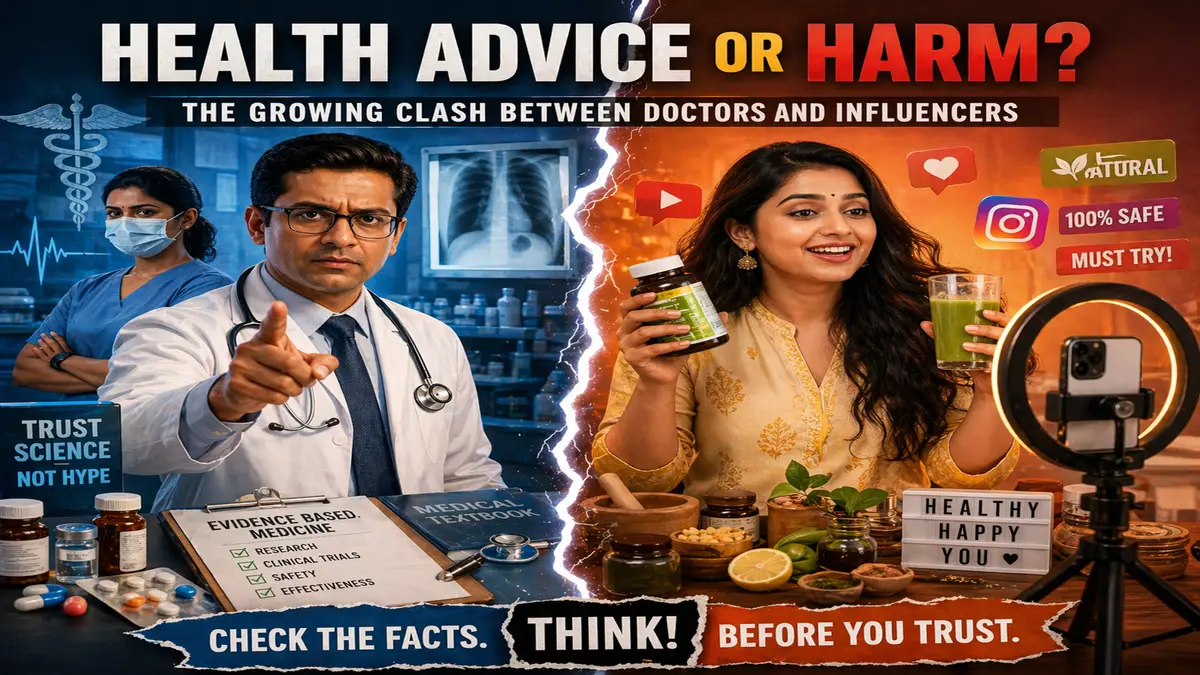
The debate has intensified in recent months, with many doctors increasingly calling out influencers and celebrity personalities for promoting unverified no fact based health advice. Thus, what was once harmless lifestyle content has now entered a far more serious territory: medical guidance without medical expertise.
The Rise of “Everyone is a Health Expert”
Today the rise of social media has made content creation a money making task. Anyone with a smartphone, a ringlight and a following above 100k is turning into an influencer. While social media does give the opportunity for everyone to showcase their creativity, knowledge and promote their businesses, it has also blurred the line between professional advice and personal opinions. The health industry is one such industry that has now been targeted. Every new reel that pops on your feed is giving you advice on your acne, your gut issue, muscle growth, etc.
The problem is that most of these health influencers are not qualified, they do not have a degree in doctrine or any other medical field. Influencers have also crossed the lines by recommending foods that can affect your health, making DIY electrolyte drinks, and promoting herbal concoctions as cures for hormonal disorders.
If influencers are stepping into the roles traditionally reserved for doctors, dietitians, surgeons, pediatricians and other healthcare professionals, then what about the doctors that are actually trying to look out for their patients in hospitals and clinics. Most of the facts on the internet are 90% untrue. While a growing number of medical professionals are raising their voice against these so-called health influencers , there are doctors that are now taking to social media to call them out and talking about the misinformation.
In India, doctors are increasingly raising concerns over a growing social media trend where “mom influencers” promote milk or energy mixes and multivitamin gummies as essential for a child’s growth. While these products are often marketed as convenient nutritional boosters, experts warn that many of them are actually high in sugar and fall under ultra-processed foods. More importantly, they are misleadingly positioned as “healthy” or even necessary, when in reality, most children can meet their nutritional needs through a balanced, home-cooked diet. Pediatricians stress that such marketing creates unnecessary dependency on packaged products, while also shaping parental anxiety around whether their child is “getting enough”—even when there is no real deficiency.
When Content Turns Controversial
In India, we follow many influencers for fashion, food and entertainment content. Although when brands collaborate with these influencers to promote their products often using scripts that arent fact checked they do not realise the harsh impact it can have on lives. A single reel that has now been viewed by millions of followers can affect at least 5% of the audience who may blindly follow their advice.
A recent controversy highlights this issue perfectly. Well known Influencer Apoorva Mukhija popularly known as the Rebel Kid faced backlash after posting a video suggesting that Lipton metabolism tablet could help manage PCOD (Polycystic Ovarian Disease). In the now-deleted reel, she shared her experience of visiting a doctor who recommended lifestyle changes like better sleep, exercise, and dietary control, but implied that a simpler alternative—taking the supplement could have been suggested instead.
The video quickly went viral and drew criticism from both audiences and medical professionals, who pointed out that PCOD is a complex hormonal condition that cannot be treated with over-the-counter products. Many also raised concerns about the role of brand collaborations, arguing that presenting such products as “easy fixes” could mislead viewers. Following the backlash, the video was taken down, but it reignited conversations around influencer responsibility and the spread of health misinformation online.
Similarly in 2024, a controversy involving actress Samantha Ruth Prabhu highlights just how quickly health misinformation can spread online. She shared a post promoting hydrogen peroxide nebulisation as a remedy for viral infections, based on personal experience. However, Dr. Cyriac Abby Philips strongly criticised this, warning that inhaling hydrogen peroxide can be harmful and lacks medical backing. The post sparked widespread backlash, with debates around celebrity responsibility and the risks of sharing unverified health advice. While Samantha later clarified her intentions, the incident became a clear example of how easily personal opinions on social media can be mistaken for legitimate medical guidance.
Another ongoing issue is the misuse of ORS (Oral Rehydration Solution). Traditionally, ORS is used to treat dehydration caused by conditions like diarrhea or severe illness. However, social media has begun promoting it as a daily hydration drink or post-workout essential.
A controversy involving Shilarna Vaze popularly known as Chef Chinu Vaze highlights this issue. She shared a reel making a “homemade ORS drink” using ingredients like monk fruit sweetener, spirulina, and salt, presenting it as a healthier alternative to standard oral rehydration solutions.
However, doctors especially pediatric experts such as Dr. Sivaranjani Santosh quickly called this out, warning that ORS is a scientifically formulated medical solution designed with a precise balance of glucose and electrolytes to treat dehydration. Replacing sugar with alternatives like monk fruit disrupts the body’s ability to absorb fluids effectively, potentially making the solution ineffective or even harmful.
The backlash emphasized that while ingredients like spirulina may be nutritious in general, they have no role in ORS and could mislead people into thinking such DIY versions are safe. Following the criticism, Vaze clarified she is not a medical professional and had shared the recipe based on personal research, but doctors maintained that such content can endanger lives especially when audiences treat influencer advice as credible health guidance.
Doctors have strongly pushed back against this trend. Medical professionals point out that ORS contains specific ratios of salts and glucose designed for clinical use—not casual consumption. Overuse without medical need can disrupt electrolyte balance rather than improve it.
The Algorithm Problem
Why do these health reels occur so frequently on our feeds? The answer lies in how social media algorithm works. The algorithm rewards content that is simple, engaging and emotionally appealing. Also, the more the number of views the more the algoritim pushes it, for soem it may also be that social media boostitng helps these reels to get targeted to specific audience.
Imagine you look for a quick fix for stomach cramps an you find one reel that helps you with i but the algorithm works in such a way that one reek will tur into 10 reels and half of it could be untrue.
Secondly a reel that says “Drink this juice daily for a week to fix your gut health” will always outperform reels that a professional doctor would make in a more complex term.
Influencers, driven by engagement and brand deals, often prioritize virality over accuracy. The more sensational the claim, the higher the reach.
Unfortunately, health is not something that can—or should—be simplified into 30-second content.
The Danger of “Quick Fix” Culture
One of the biggest issues with influencer-led health advice is the promotion of “quick fixes.”
Lose weight in 7 days.
Cure PCOD naturally.
Detox your body overnight.
These claims not only lack scientific backing but also create unrealistic expectations. When people don’t see results, they may blame themselves rather than the misinformation they consumed.
Worse, they may delay seeking proper medical help.
Conditions like PCOD, diabetes, thyroid disorders, and mental health issues require professional diagnosis and personalized treatment. Relying on influencer advice can lead to delayed care, worsening symptoms, and long-term complications.
Doctors Are Fighting Back
The good news? Medical professionals are no longer staying silent.
Across platforms, doctors, nutritionists, and researchers are actively debunking myths, reacting to viral videos, and educating audiences. They are reclaiming digital space to provide evidence-based information.
But there’s a challenge: credibility doesn’t always go viral.
A qualified doctor may spend years studying medicine, but an influencer with no formal training can gain millions of followers in months. This imbalance makes it harder for factual content to compete with flashy misinformation.
Still, the pushback is growing—and necessary.
The Responsibility of Influencers
Influencers are not inherently the problem. Many use their platforms responsibly, sharing disclaimers and encouraging followers to consult professionals.
However, with influence comes responsibility.
Promoting a skincare product is one thing. Suggesting treatments for medical conditions is another.
Health is not a trend. It’s not content. And it’s certainly not a marketing opportunity.
When influencers cross this line, the consequences can be serious—not just for their credibility, but for the well-being of their audience.
So, Who Should You Trust?
In an age of information overload, the answer is simple but important:
Trust qualified professionals.
Doctors, registered dietitians, certified nutritionists, and licensed medical practitioners spend years training to understand the human body. Their advice is based on research, clinical experience, and evidence—not trends.
That doesn’t mean you should ignore all online content. Social media can be a great starting point for awareness. But it should never replace professional consultation.
Before trying any health trend, ask yourself:
Is this backed by science?
Is the person qualified to give this advice?
Could this harm me if it’s wrong?
If the answer is unclear, it’s best to consult a professional.
Indian doctors are now becoming influencers to fight back
Interestingly, the internet has also seen the reverse trend, where influencers call out misleading health claims. For instance, Revant Himatsingka (FoodPharmer) gained massive attention for exposing high sugar levels in popular “health drinks” like Bournvita. His videos led to regulatory scrutiny and even changes in how such products are marketed, showing how social media can also be used to correct misinformation, not just spread it. He also calls out people for promoting health
Doctors like Cyriac Abby Philips are actively debunking fake health claims and calling out supplements and “natural cures” while warning about liver damage from unregulated products.
He’s even been internationally recognised for fighting misinformation online, showing how serious the issue has become in India. It is good to know that doctors are now calling out: the rise of a “likes over science” culture. Social media platforms reward content that is quick, visually appealing, and easy to understand, often at the cost of accuracy. As a result, a significant portion of health-related content online is either misleading or oversimplified. According to medical experts, the most affected areas include diet trends, lifestyle diseases, vaccines, and alternative medicine—topics that are already complex and require nuanced understanding. When reduced to short-form content, these subjects are often stripped of context, leading to half-truths that can be more harmful than outright misinformation.
Doctors warn that repeated exposure to such content can increase anxiety, especially among young people who are constantly consuming health-related reels and posts. It can also lead to avoidance of proper medical care, as individuals begin to rely on influencer advice or self-diagnosis instead of consulting qualified professionals. In some cases, people may delay treatment or experiment with unverified remedies, believing they are making informed choices based on what they’ve seen online.
A major factor driving this issue in India is the way health information spreads. Platforms like WhatsApp and Instagram play a central role, with health advice often circulating through forwards, reels, and short videos. Unlike traditional sources, this information is usually received passively, people don’t actively seek it out, but encounter it while scrolling or through messages from friends and family. Because it comes from trusted personal networks, it is more likely to be believed and shared further, often without any verification. This creates a rapid cycle where misinformation spreads faster than it can be corrected.
Certain health topics are particularly vulnerable to this kind of oversimplification. Conditions like PCOS/PCOD, weight loss, hormone balancing, detox diets, and gut health dominate social media conversations. These are all complex issues that require personalised and evidence-based approaches, yet they are frequently reduced to quick fixes or “one-size-fits-all” solutions online. Influencers often present these topics in a way that feels accessible and empowering, but in doing so, they overlook the scientific complexity and variability involved. This not only misinforms audiences but also sets unrealistic expectations about health and recovery.
Together, these trends paint a concerning picture of how health information is being consumed and shared in India today. What appears as harmless content—whether it’s a parenting tip, a wellness hack, or a nutrition recommendation—can have deeper consequences when it replaces credible medical advice. As doctors continue to highlight, the challenge is not just misinformation itself, but the scale at which it is trusted, normalised, and acted upon.
The Bottom Line
The clash between doctors and influencers is not just a social media debate, it’s a public health concern.
As more people turn to the internet for answers, the risk of misinformation grows. While influencers continue to shape trends, doctors are working to ensure those trends don’t turn into harm.
In the end, your health is too important to be left to algorithms, aesthetics, or unverified advice.
Because when it comes to your body, expertise should always matter more than influence.