Tata Interactive Systems has been a pioneer in India in the field of interactive education. For the past twenty years, most of this company’s clients have been in Western, developed countries. Today, however, teams of writers, designers, testers and coders work on creating online classrooms in India. One team is working on an online series of yogic asanas for Baba Ramdev while another is building an interactive CBSE module for students. For the sake of time-pressure, convenience and even cost, these learning methods are ideal for working professionals and for slow or disinterested learners to grab their attention in the classroom. Watching a set of designers build an interactive flash animation timeline on World War II, one realises that the possibilities for our future education are endless.
This trend is even recognised by the development sector. Chandita Mukherjee, Director of NGO Comet Media, in Mumbai has been working for the past few years to find a way to bridge the ‘digital divide’ between rich and poor. She feels that anyone today with access to a computer has the means to become a computer engineer. The team is aspiring to provide free video lessons in Hindi online, working towards teaching disadvantaged sections of society the basics of technology. Even corporates are jumping on the online-learning bandwagon. Advanced learning games allow new employees to learn about the company’s human resource policies and compliance information and to answer questions on them. Simulations make dull lessons on any aspect of the company more interesting and interactive.
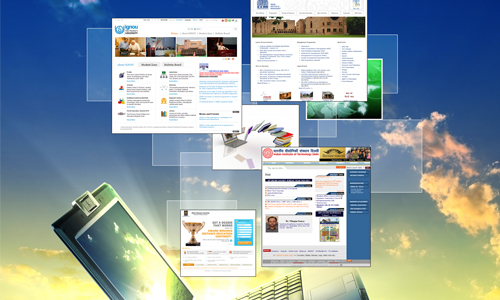
All this may be well and good, but what about options for the mainstream learner? Students can qualify with international institutions online and study at online classrooms domestically. The Indira Gandhi National Open University (IGNOU) has virtual classrooms where students can qualify in subjects such as law, social sciences, health, information technology and more. The university provides postgraduate certificates and diplomas, and even Master’s degrees in Library and Information Science (MLIS) and Intellectual Property Law (MIPL) that are delivered entirely online. One can register for the MLIS anytime for only Rs.8,000 and complete it within four years. The MIPL on the other hand costs a heft y Rs. 36,000 and goes on for two years.
The online features developed by IGNOU include multimedia course material, online counselling through webcasts and web chats, round-theclock learner support, group seminars through blogs, chat rooms, discussion forums and web conferencing, online project evaluation and examination.
IIM Ahmedabad, IIT Delhi and the Indian Institute of Foreign Trade are institutes in India that are pioneering online MBAs. However, the cost of these online MBAs does not differ significantly from attending classes in person but offer the student the flexibility and convenience of studying from their own homes. International qualifications, be it bachelor’s, master’s or MBAs are also available from reputed universities such as the University of Liverpool and University of Phoenix.
So where are future directions headed? Not towards a fully automated learning process, but one that is a balance of human interaction and online interaction. As we move towards becoming a knowledge-based economy, online education will need to increasingly become relevant.
Popular Virtual Classrooms
Volume 1 Issue 3
Bengaluru, February 4, 2026: Bengaluru today took centre stage in the global culinary spotlight as…
Hiring has changed fast, and AI sits at the centre of it. But here’s the…
Across the world, and especially in India, a quiet but powerful shift is taking place.…
The Department of Mass Media, K.C. College, HSNC University, Mumbai, successfully concluded the 23rd edition…
On Sunday, February 1, 2026, Finance Minister Nirmala Sitharaman presented India's Union Budget 2026 27,…
On January 13, the University Grants Commission introduced new rules to address discrimination in colleges…