















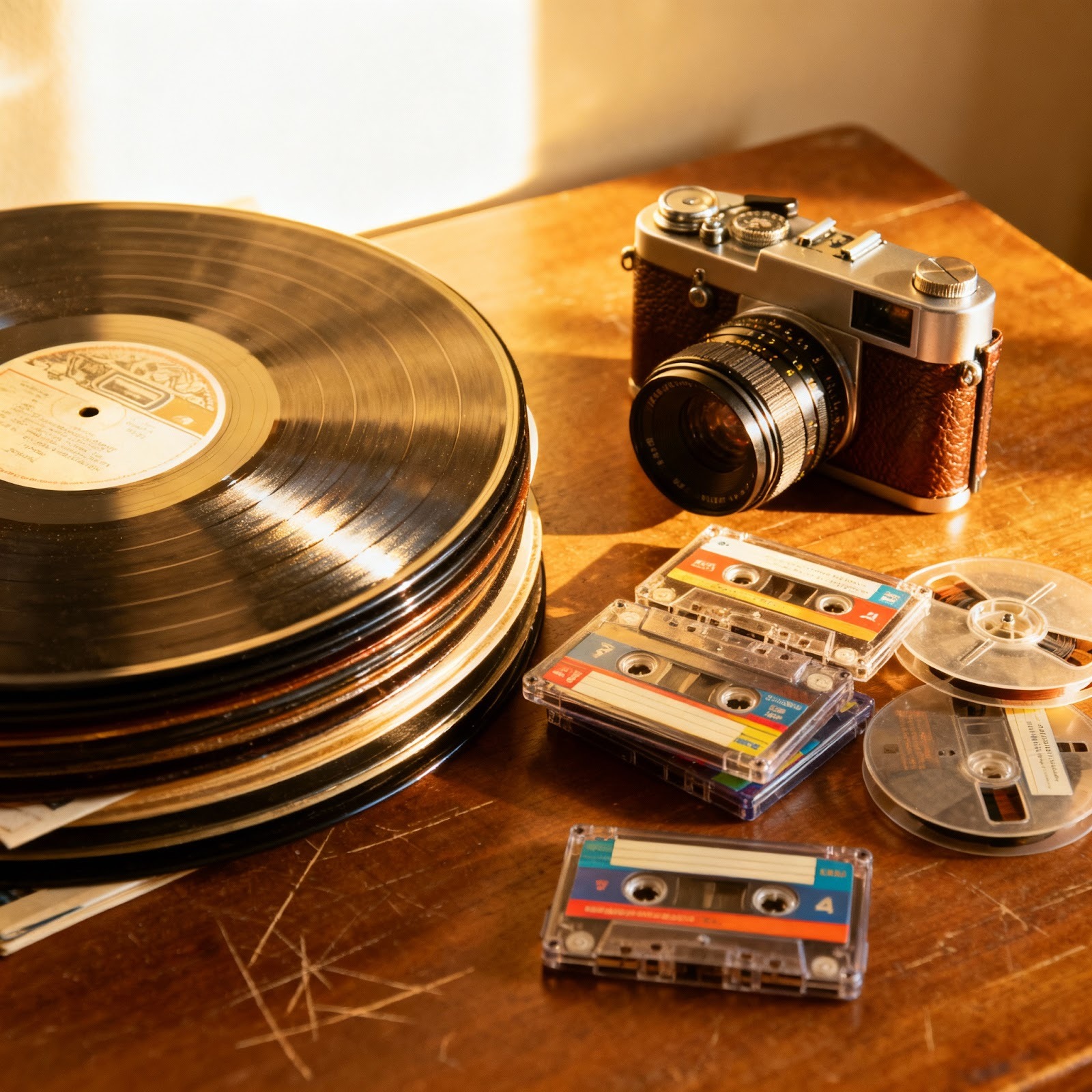
Something strange is happening in the corners of our digital world. While tech companies push us toward cloud storage and streaming everything, a growing number of young people are doing the opposite. Generation Z, brought up on smartphones and social media, is leading an enormous comeback of analogue technology. They are purchasing turntables, using cameras with film, and picking out paper books instead of reading on their e-readers.
The irony is hard to miss. People who can stream 70 million songs instantly are choosing to buy individual albums on vinyl for $30 each. Photography students who were brought up with digital cameras have been learning the process of film development in darkrooms. It’s not about the older generations holding on to what used to be; it’s that the youngsters are picking up the same technologies that their parents have long since given up on.
Vinyl’s Resurgence Among Indian Youth
The revival of analogue culture in India might seem puzzling at first. We live in an era where you can access millions of songs instantly, shoot unlimited photos on your phone, and share everything with a tap. So why are people spending money on clunky turntables, finicky film cameras, and formats that require actual effort?
The answer lies partly in what we’ve lost in the transition to digital. Photos just keep accumulating in cloud storage, and we never look at them again. The ease of use, which was meant to give us more freedom, has turned out to be a downfall, as it has made everything seem throwaway and unmemorable.
Vinyl records force you to slow down. You have to physically flip the record halfway through an album. You can’t skip songs as easily. You really see the pictures in the music album, read the small print, and handle the thing with care. It is not only a question of remembering the past, but it’s about establishing a different type of connection with the music.
Listening to music turns into a deliberate one, instead of being passive. You pick an album, take it out of its sleeve, put it on the turntable, and adjust the needle. Each step involves attention and care. Through this method, music listening becomes a primary one, instead of just being in the background while you multitask.
The Tangible Factor
There’s something deeply satisfying about holding a physical object that contains art. You can’t hold a Spotify playlist or frame your smartphone’s camera roll on the wall. But a vinyl record sleeve designed by a great Indian artist? A print from a roll of film you shot yourself? These objects exist in physical space and time. They can be damaged, lost, or treasured. That fragility and permanence give them meaning that digital files simply don’t have.
Record sales in India have grown steadily, with vinyl revenue gaining attention among urban youth. That’s not just older collectors hanging on to their habits; it’s young people driving the market. A growing number of vinyl buyers are under 35, according to industry observers. In metropolitan cities like Mumbai, Delhi, and Bangalore, vinyl records and film photography are becoming popular cultural trends.
Film photography follows a similar trajectory. Companies like Kodak and Fotokem India have started to respond to demand for film stocks. Camera repair shops, which were rare in the 2000s, have re-emerged with waiting lists in top cities. Online Indian communities dedicated to film photography have thousands of members sharing techniques, recommending cameras, and celebrating the particular aesthetic qualities that film provides.
Vinyl’s Imperfection as an Advantage
Digital technology aims for perfection. High-resolution audio files, pixel-perfect images, instant corrections. But perfection can feel sterile. Analogue formats have character baked in, the warm compression of vinyl, the grain structure of film, the way colours shift depending on the stock you use.
These “flaws” aren’t bugs; they’re features. They give each format a distinctive look and feel that’s recognisable and, to many people, more emotionally resonant than digital precision. A photo shot on Kodak Portra 400 looks different from one on Fujifilm Pro 400H, and both look radically different from a smartphone photo. Those differences matter to people who care about aesthetic choices beyond filters and presets.
Film photography requires commitment. You typically have 24 or 36 exposures per roll. You can’t see your results immediately. You can’t delete the bad shots and retake them on the spot. This limitation changes behaviour. Photographers become more deliberate, more careful about composition and timing. The constraint actually improves the work.
When a shot comes out slightly overexposed, with unexpected grain or a light leak bleeding across the frame, these accidents often become the most interesting elements of the image. Digital photography’s precision eliminates these happy accidents.
The Ritual Element
Analogue formats demand participation. You have to thread film into a camera, adjust settings manually, and wait days or weeks to see your results. You have to clean records, replace needles, and arrange your collection. They are not inconveniences; these are ceremonies that establish a connection and represent a value.
In a world where everything is at the push of a button and is subject to an algorithm, the practice of something that requires patience and skill still feels like a revolt. It is a means of rejecting the passive consumption that is the hallmark of modern life. You are not just hitting play; you are a co-creator of the process.
Record stores in cities like Mumbai, Delhi, Kolkata, and Bangalore have turned into community spaces where people come to rummage through collections, discuss music, and attend live performances. Film photography meetups arrange photowalks where strangers walk, take pictures, and exchange tips. These physical, social experiences are totally different from the isolated time spent in front of the screen, which dominates much of contemporary Indian culture.
Independent record stores have seen resurgence even as major retailers closed their music sections. Record Store Day, which started overseas, now has local events in some Indian cities, involving stores that feature limited releases selling out within hours. This festival provides something digital platforms cannot: the common, tangible experience.
Not Anti-Technology
This movement isn’t about rejecting technology wholesale. Most vinyl enthusiasts in India also use streaming services. Film photographers post their work on Instagram and use digital tools for scanning and editing their analogue shots. People aren’t choosing analogue over digital; they’re choosing both, using each format where it makes sense.
What’s really happening is a rebalancing. After decades of assuming that newer technology always means better, people are questioning that assumption. Sometimes the old way does something the new way can’t. Sometimes slower is better. Sometimes limitations produce better results than infinite options.
The analogue revival also reveals something about what gets lost in algorithmic culture. Spotify’s recommendation engine is impressive, but it can’t replicate the experience of browsing a record store and discovering something unexpected based on interesting cover art or a hand-written staff recommendation card. Instagram filters can approximate film looks, but they can’t give you the experience of shooting a roll, getting it developed, and seeing what you captured.
The Economics of Experience
Part of this trend reflects a broader shift in how people in India spend money. Younger generations increasingly prioritise experiences over pure convenience. They’ll pay ₹2,500 for a vinyl record when they could stream the same album for free. They’ll spend money on film and processing when their phone can take thousands of photos at no additional cost.
This spending pattern suggests that people are buying more than just music or photographs. They’re buying the experience of engaging with these formats, the satisfaction of building a physical collection, and the identity that comes with participating in these communities.
Looking Ahead: The Future of Vinyl and Analogue Culture
The return to analogue culture in India probably won’t mean the end of digital dominance. Streaming and digital photography are too convenient to disappear. On the other hand, the increasing attraction to tangible media implies that we are on the road to being more conscious of our interaction with technology.
That is because people are learning that they can decide the way in which they consume and produce art. They can opt for convenience when it is reasonable and for richness and ritual when that is more important. The future may not be entirely digital or fully analogue; it could be a combination of both, with people changing formats depending on what the moment requires. At present, this is not only a niche hobby among collectors and artists but also a cultural shift that has taken place openly in India. The warm crackle of a needle hitting a record, the waiting for film to be developed, the delight of holding something tangible—these are the things that will always be there. They signify the rejection of the endless scroll, the infinite playlist, and the disposable character of digital content. By opting for analogue, people are choosing to slow down, be in the moment, and make the world through physical objects and intentional acts.