



















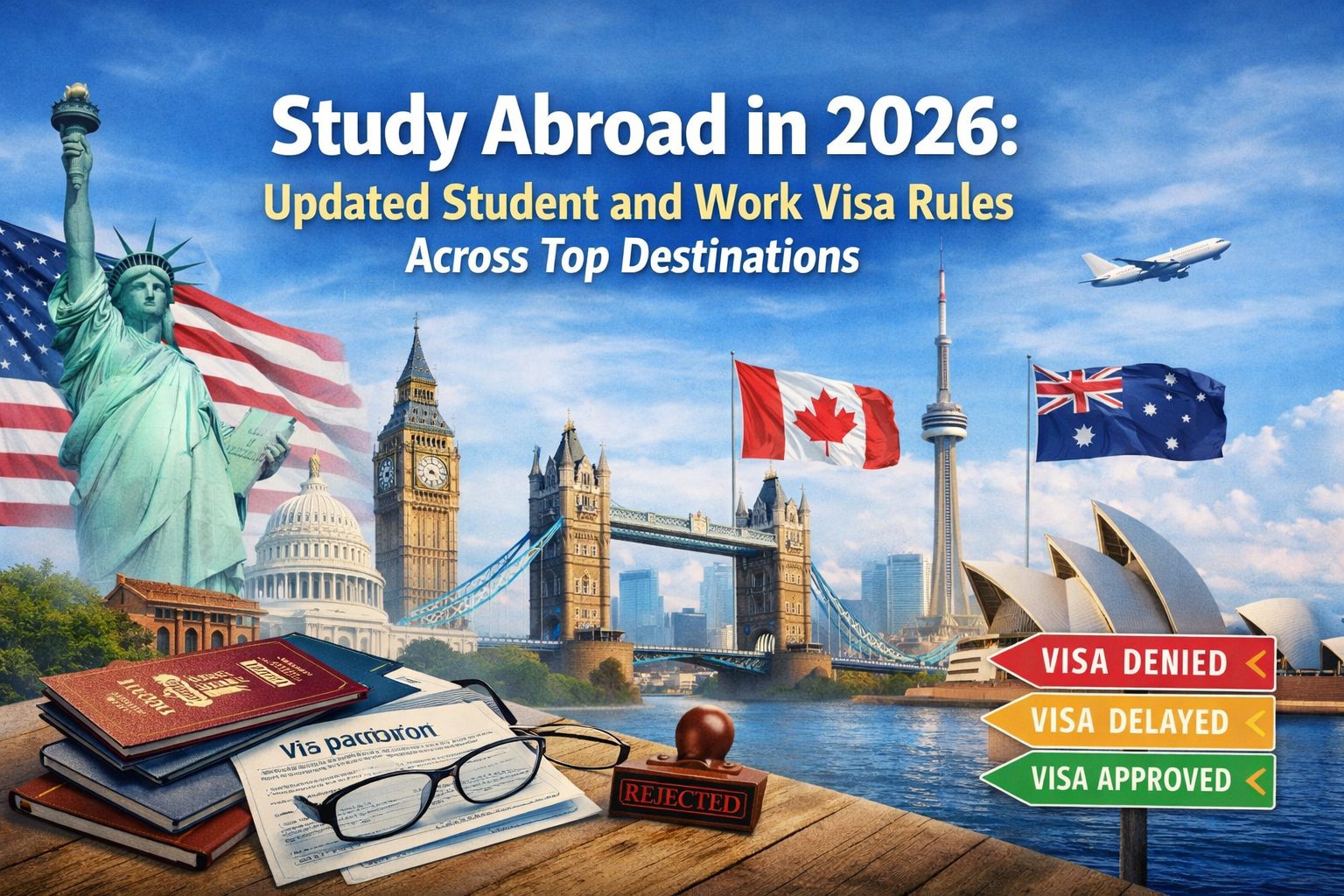
February 2026 marks a major turning point. The big players that once used to compete for international students have, at almost the same time, all tightened their visa rules, significantly altering students’ education and career plans. It is no longer a matter of blurry political rhetoric; these are firm policy modifications that directly impact and effectively constrain the choices of students who are thinking of studying overseas.
What’s Actually Happening Now
The United States imposed visa suspensions on 39 countries in January 2026. Nineteen countries face complete bans on student visas, including Afghanistan, Iran, Syria, Yemen, Somalia, and Libya. Another twenty have partial suspensions. If you hold a passport from these countries, you cannot get an F, M, or J visa.
A rule effective February 27, 2026, reshapes the H-1B visa lottery, the main pathway for staying after graduation. The government prioritises applicants by salary level. This matters because recent graduates start at lower wages. Even with a job offer, you might not qualify based on position level.
A proposed rule would cap student stays at four years, meaning master’s and PhD students could face visas expiring mid-degree. Visa interviews are mandatory with months-long waits. The State Department also reviews applicants’ social media presence.
The United Kingdom cuts post-study work substantially. Starting January 2027, bachelor’s and master’s graduates get only 18 months to find work (down from two years). PhDs last three years. Only research-level students can bring dependents. Financial requirements increased, and universities face stricter compliance audits affecting visa renewal.
Canada has essentially closed its doors. The government announced 155,000 new study permits for 2026, a 50% reduction from recent years. Ontario and British Columbia have strictly limited spaces. One opening exists: graduate students at public institutions are exempt from the cap. Post-graduation work permits are harder to obtain unless your field matches specific shortages.
Australia announced a 295,000 visa target for 2026 with a new “traffic light” processing system where universities exceeding enrollment caps face slower visa processing. Work-rights enforcement is strict with the 48-hour-per-fortnight limit during study periods, monitored through tax department data-matching. Starting July 1, 2026, post-study work visas will be shortened significantly. Bachelor’s and master’s graduates get roughly two years. PhDs get three years. Graduate visas now depend on whether your qualification matches skills shortage lists, making field selection critical.
What International Students Must Know About New Visa Rules
If you hold a passport from one of the 39 banned countries, the US is currently closed to you. Check the State Department list immediately; this is a hard barrier, not a hurdle to overcome.
For the UK, the clock starts ticking immediately after graduation. Master’s degrees take one to two years to complete. With only 18 months on your post-study visa afterwards, you’re racing to secure a job. Securing an offer before graduation is the safer strategy. Plan accordingly.
For Canada, only apply if you’re a graduate student or can secure a university spot. Check whether your province has available allocation spaces. Ontario and British Columbia are saturated, so Atlantic and prairie provinces have more room. Also, verify that your field qualifies for post-graduation work permits. Many programs no longer do.
For Australia, study regionally if possible. Regional locations add one to two years to your graduate visa, significantly extending career opportunities. Research skills shortage lists before choosing your program. A degree in a non-shortage field gets only the minimum post-study work period, limiting career options significantly.
Don’t rely on what universities tell you about pathways. Verify policy on government immigration websites. These rules change frequently, and promotional material lags behind reality. Get professional visa advice before committing financially to a program.
The Remaining Options
United States: It has become riskier with greatly reduced post-graduation pathways. New international student enrollments dropped 17% in fall 2025 alone. Be prepared for longer processing times and higher scrutiny levels.
United Kingdom: Leading for postgraduate master’s courses. An 18-month post-study work window is part of the plan, which is less time than many people anticipate.
Canada: Once the obvious choice for those hoping to build a life abroad. The 155,000 cap makes competition extremely fierce. Most college-level students shouldn’t expect admission.
Australia: More functional than other options, but requires strategic choices on location and field of study. Regional study adds extra years.
Germany: Offers free or low-cost tuition for many international students. Administrative visa process. Many programs are English-taught.
Netherlands: Maintains relatively stable visa policies. Strong postgraduate options available.
Ireland: Graduate visa pathways exist. A less politicised immigration environment than the UK or the US.
How to Plan Around Tighter Student and Work Visa Rules
What’s driving these changes is practical. Countries manage housing shortages, labour market concerns, and political pressure on immigration. These pressures aren’t easing. Housing isn’t being built fast enough. Labour market concerns are increasing. Immigration remains contentious. Policies will likely tighten further as these issues persist.
Start by being honest about your goal. Do you want to stay and build a life abroad? Some destinations are now closed or closing. Do you want an education and return home? Some destinations work fine for that. Do you want work experience abroad? That window is shrinking rapidly.
First of all, identify your target and then reverse engineer the steps. For example, if you want to live in the USA, find out if the list of banned countries includes yours. If so, that won’t be possible for now. If you aim for Canada, just apply as a university graduate; it’s really hard to get in.
And if it is the UK you want to work in, be prepared that you only have 18 months after graduating to switch to work visas.
Consider less-traditional destinations. Germany costs substantially less and offers free tuition in many cases. Ireland offers graduate pathways. The Netherlands has strong postgraduate options. These countries haven’t restricted international students the way major English-speaking destinations have.
Budget extra time for visa processing everywhere. US interviews can take months to schedule. Connect with current students before committing; they provide honest feedback about real experiences.
Most importantly, always stay alert to policy changes. What’s true today might shift in six months. Keep checking the official government immigration sites as they will have the most current information. The world is not entirely closed to international students; however, the reception is now conditional, and there are fewer routes than before. The very first and important step is to figure out how this affects you specifically.